Geoff Bennett:
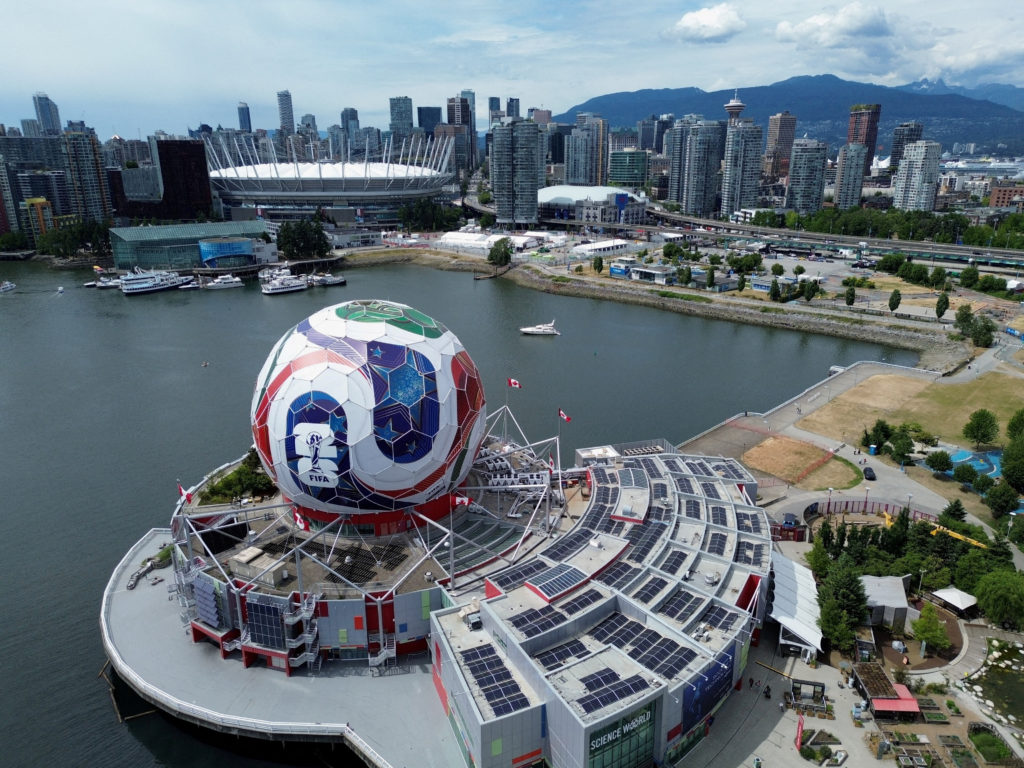
Well, the countdown is on to the start of a 2026 FIFA World Cup. The tournament is expected to be the biggest in the event’s history, with 48 teams competing across the U.S., Canada, and Mexico in 104 matches over 39 days.
But the road to kickoff has been anything but smooth. Organizers have faced criticism over soaring ticket prices, concerns about logistics and transportation, and geopolitical tensions that have complicated travel for some teams and their supporters.
We are joined once again by Roger Bennett, no relation, founder and CEO of the Men in Blazers Media Network and author of “We Are the World (Cup).”
(Laughter)
Geoff Bennett:
Roger, always great to see you.
Roger Bennett, Soccer Analyst:
Oh, big Geoff, it’s great to be with you.
Geoff Bennett:
So the opening match is Thursday in Mexico City. It’s Mexico v. South Africa.
Let’s start with the soccer itself. What are the handful of countries you see as genuine contenders to lift the trophy a month from now?
Roger Bennett:
I know I sound like I’m from England, but I have to legally say the United States of America, just because this is the moment when we all dream the American dream. Unfortunately, the 47 other teams who are arriving in the United States, Canada and Mexico, dreaming the very same thing.
World Cups are hard to win. Only eight nations have ever won it. And the big teams again are highly amongst the favorites, Argentina looking to go back to back with that tiny little joyful Ewok Lionel Messi.
Spain play an abundantly joyous form of football. France are more stacked than any cast outside of Christopher Nolan’s “The Odyssey.” And then England always dream at this point, always self-sabotage, but you don’t have to look much further than that pack to see the winner.
Geoff Bennett:
I have to say it’s the first time I have ever heard anyone describe Lionel Messi as a joyful Ewok. That’s…
(Laughter)
Roger Bennett:
He is, though. He is, though.
Geoff Bennett:
So…
Roger Bennett:
He’s at 39 going back to back. We are blessed to watch such a GOAT play the game.
Geoff Bennett:
Yes.
And, look, this is the first World Cup with 48 teams up from 32 back in Qatar. How does that change the dynamic?
Roger Bennett:
It’s going to be the Big Gulp World Cup in a gigantic way. We’re looking at 104 games over 39 days in three countries. It’s going to be in Mexico, the United States, which will carry the brunt in 11 cities from sea to shining sea, also up north in Canada.
The honest truth is, no one knows how it’s going to go. The opening round, which is normally used to eliminate, separate the wheat from the chaff, so many teams actually go through into the knockout rounds. It’s going to be very interesting to see the quality of football, the caliber of football. The competitive level will kick in.
And the heat is going to be a great unknown. And teams that are playing indoors in Texas in the U.S. are blessed to be playing two in SoFi Stadium in Los Angeles. It’s one of the great intangibles in terms of the energy levels.
Ultimately, this tournament is going to be an ultra-marathon, Geoff, and the winner is going to have to have tenacity, ferocity, an incredible collective culture and that little element of luck that allows kind of Greek epic poems to be written about their odyssey.
Geoff Bennett:
Indeed.
As you mentioned, this tournament is split across three countries. Geopolitics has become part of this story. You have got Iran. The team will be based in Mexico, shuttling back and forth for matches in the U.S. because of tensions obviously between Washington and Tehran.
What problems, what challenges does that present for FIFA?
Roger Bennett:
This is an unprecedented situation. The World Cup started in 1930. The host nation and one of the participants are currently in a conflict.
The joy of the World Cup, Geoff, is that when two teams take the field, the nation’s history, the nation’s politics, the nation’s culture takes the field alongside them. And that’s what gives this tournament its seismic depth. It’s not just sport. It transcends all of that.
And Iran has been a geopolitical — an incredible nightmare for FIFA to try and regulate. They are drawn to play in Los Angeles, which is home to one of the great diaspora communities of Iranian Americans. They had to move their base camp from the United States. It wasn’t sure they were going to be able to compete.
They moved it to Mexico. They’re going to come in for games. And it remains to be seen the level of protest amongst the Iranian American audience, many of whom are saying it’s a team that doesn’t represent Iran. It represents the Islamic Republic regime of Iran.
And the wheels within wheels of the complexities are going to be played out. That’s what gives football its wonder. It does hold up a mirror to the world around there. I have always thought that’s a great thing. But in times of challenge, we’re presented with really the unimaginable.
Just 22 guys wearing polyester shirts kicking a football around has become a symbol of the world around us and the chaos that we’re all experiencing.
Geoff Bennett:
What about issues of access, Roger? You have got everyday fans saying that they’re completely priced out. The only way they will be able to watch is probably on TV at this point.
Roger Bennett:
It’s been the drumroll of darkness going into this World Cup.
Look, every major World Cup has a catastrophizing element in the run-up. 2010 in South Africa, the doomsayers were talking about carjackings, whether the electricity grid would be able to support an international tournament, still the greatest symbolic tournament of my lifetime, South Africa, the whole continent of Africa and the Mandela.
Then, 2014, social unrest in Brazil. They didn’t want the football. They wanted social services and education, but, again, once a ball was kicked became the greatest party I have ever been to.
But the ticket issue has been beyond complicated. It’s a working-class game, football around the world. People travel with their teams multigenerationally everywhere. American sports culture, which is what the world is now colliding with, operates very differently. You have dynamic ticket pricing.
So we’re arguing about whether World Cup tickets are too expensive, while New Yorkers are paying $20,000 to sit in the bleachers and watch the Knicks. So it really is world culture meets American culture. It’s been a deep, deep friction point.
What I can tell you is, once a ball is kicked, Geoff, once Lionel Messi takes the field, once the tournament begins, it’s as if everything falls away and the whole world gets blanketed by a global eclipse that affects the whole planet simultaneously for 39 straight days. It will be a fleeting joy. It will be a fleeting sense of unity.
But I do hope in my heart of hearts there’s the kind of meaning, the kind of wonder and that America will show a face to the world that we dream of showing through this peace. But the second the game kicks off, we’re almost anesthetized and we all fall under the game’s thrall.
Geoff Bennett:
Roger, we have 30 seconds left. You speak so lyrically, I’m not sure if you can answer a question in 30 seconds, but here goes.
Every World Cup introduces the world to a new star, Messi, who you mentioned, Ronaldo, Mo Salah. Who do you think could leave this tournament as a near household name?
Roger Bennett:
Well, a global name with commercial heft and wonder, Spain have an 18-year-old, just wonder, Lamine Yamal, fearless, youthful. He’s already won the other major tournament, the Euros, at the age of being a teen.
If Spain win the World Cup led by him, it’ll be like Alexander the Great mourning that, at the age of 18, he has no more worlds to conquer and it’ll be magnificent to witness.
Geoff Bennett:
Roger Bennett, could talk to you all day.
(Laughter)
Geoff Bennett:
Thanks for being with us.
Roger Bennett:
Listen, Geoff, thanks for having…
(Crosstalk)
Geoff Bennett:
Let me give your real title here, founder and CEO of the Men in Blazers Media Network, author of “We Are the World (Cup).”
Thanks again.
Roger Bennett:
Oh, Geoff, any time. Big love. Courage.