The last time the United States hosted the men’s FIFA World Cup, in 1994, the country didn’t even have a professional soccer league.
This year’s World Cup, which concludes with tomorrow’s final featuring Argentina versus Spain, kicked off in a very different soccer landscape. Major League Soccer, which was founded as a condition for the United States to host in 1994 and held its inaugural season in 1996, now has 30 teams (including three in Canada), a handful of global stars and a combined team valuation of around $23 billion.
Team valuations in U.S. leagues like the N.B.A. and N.F.L. have skyrocketed with television rights for sports — one of the few types of programming that still draw large live audiences — in hot demand. And investors looking to buy into a sport with high growth potential have hung their hopes on soccer’s becoming as big in the United States as it is around the globe.
The list of power players who have acquired majority stakes in M.L.S. teams includes the hedge fund billionaire David Tepper, the Kraft Group C.E.O. Robert Kraft, the Home Depot co-founder Arthur Blank, the real estate mogul Stan Kroenke and the billionaire financier Philip Anschutz. Private equity has also piled in. In April, M.L.S. and KKR announced a strategic investment in M.L.S. Next Pro, the development tier of M.L.S., reportedly worth $150 million to $200 million.
But the 30-year-old league still lags behind better-established U.S. sports and European soccer.
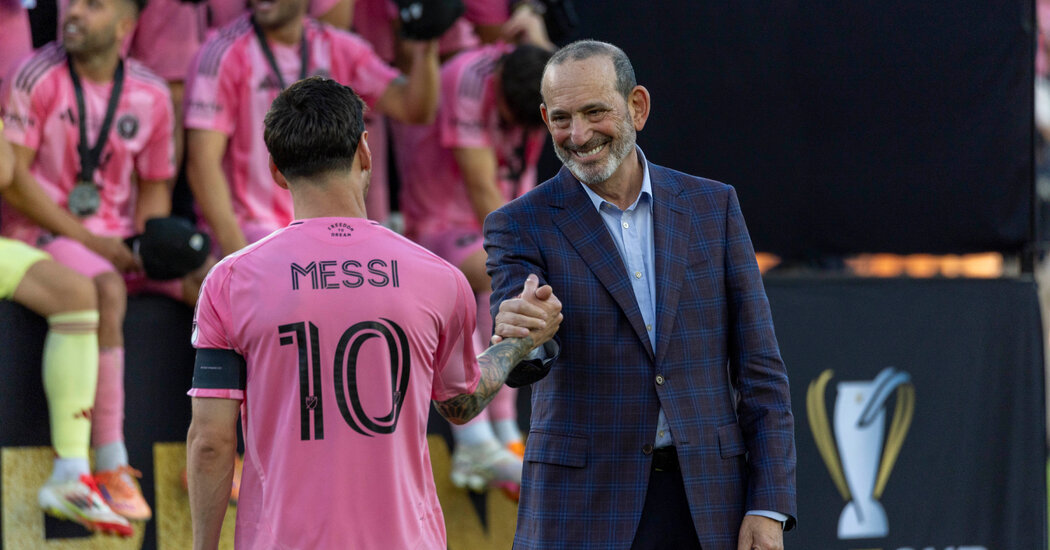
Don Garber, the M.L.S. commissioner, says he wants to harness the momentum of the World Cup, which has seen record U.S. television viewership and overall attendance, to further close the gap.
Garber, 68, has been running M.L.S. since 1999. And as a member of the U.S. Soccer board, he helped put together the bid to bring the World Cup to North America.
He spoke with DealBook on his way to the semifinal match between England and Argentina on Wednesday. The interview has been condensed and edited.
This World Cup has seen record U.S. English-language television viewership. What are your plans for capitalizing on this moment?
We in M.L.S. and at U.S. Soccer knew for eight years that the World Cup was coming to America. In M.L.S.’s case, it defined so many of the decisions we made. We’ve added seven new clubs, nine new stadiums. We just ran our first-ever paid national ad.
The message is we, M.L.S., so appreciate all of the interest and all of the passion for the game. And now, we’ll turn you into M.L.S. fans.
I’ve read that U.S. Soccer is expected to receive $100 million from hosting the World Cup. Is that right?
I’m not going to comment on the exact amount, because I think FIFA and U.S. Soccer are still finalizing that.
Whatever funds come out of this tournament, U.S. Soccer has this fabulous foundation called Soccer Forward with donors that are among titans of business. And the task will be how do we ensure that we have soccer in every school and give access to every kid who wants to play, regardless of their income level.
Tickets for this World Cup were the most expensive ever. Do you think that FIFA should have made any changes to prevent that?
I think FIFA has done what every other major property would do when it comes to bringing unprecedented events to this very vibrant and very commercially oriented market.
Sports fans are used to variable pricing. I’m a New Yorker. I saw that with ticket pricing during the N.B.A. finals. You’ll see that during the Super Bowl.
The other big news story has been President Trump asking FIFA to review Folarin Balogun’s World Cup suspension, which was ultimately overturned. How do you feel about that?
As commissioner of Major League Soccer, I observed it no differently than any other U.S. soccer national team fan.
Did you discuss the decision with other commissioners?
In other major-league sports, officiating groups are in many ways employees of the leagues. That’s not the way it is in soccer. The officials are not employees of the league. They have their own union, and they’re representing their countries. So I haven’t had any discussions with the other commissioners about it.
You recently shifted your season to be the same as the European schedule. Is that mostly about aligning with other leagues’ transfer windows, and making it easier to recruit stars, or are there other considerations?
We believe we could be one of the top leagues in the world. And in order to do that, our product on the field, our fan experience and actually our competition format need to align with the global game.
M.L.S. doesn’t have a promotion and relegation system like European leagues. A lot of fans think that would make it more exciting. Is that a change you’d ever consider?
I recognize the romance of promotions and relegations.
That being said, M.L.S. has, I don’t know, 18 or 19 of the top 50 most valuable soccer clubs in the world. We have some of the best stadiums in the world, 26 of them in 30 years. We have training grounds that are among the best in the world.
All of that requires economic stability. All of that requires some level of approved, structured financing. And all of it requires some hope and vision of investors who want to be sure if they’re going to invest a billion dollars into a team and a stadium that they’re going to be able to sustain that investment over a period of time. Promotion and relegation, in my view, prevents that from happening in today’s world.
But I would never say never to anything.
How much do you see the future success of M.L.S. as dependent on the ability to recruit star players from other leagues?
We did fan research in around 2004, 2005, and it said to us we need Major League Soccer to be attracting players that are among the most popular and best players in the world.
That motivated us to create the rule that brought in David Beckham. That subsequently brought in some of the biggest names in the history of the game, including Lionel Messi.
But it’s not just about the biggest names in the game. It’s about those that came up through the development system.
When it comes to attracting stars, do you think that the salary cap should change?
M.L.S. has increased its spending every year and will continue to do so.
We have done it in a very strategic way, like what we’ve done in providing salary cap relief for homegrown players, so that when we do spend more money, it’s in a way that is smart.
You recently made a deal with Polymarket. Have you set any policies to prevent the type of insider trading or manipulation that we’ve seen in some other leagues?
In a world where these markets were relatively unregulated, we were able to work with Polymarket and come up with checks and balances and guidelines and restrictions on how fans can engage with Polymarket.
Without the guardrails we never would have done the deal. It also allows us to work more closely with them to grow our fans, grow our fan base.
How much do you see your competition as other U.S. sports leagues versus other global soccer leagues?
There are a lot of alternatives for people to support the game, whether it’s international leagues or international tournaments. Our research shows that most soccer fans are fans of more than one team.
So if the Premier League in England grows their fan interest, I think that benefits us because those games are broadcast primarily on weekend mornings in the United States. And now we have a growing market of soccer fans that we can turn into fans of a local M.L.S. team.
A word from Andrew
Good morning. Andrew here. Ahead of the World Cup final tomorrow — which is expected to draw a large swath of C.E.O.s in the audience (think Super Bowl level) — DealBook’s Sarah Kessler spoke to Major League Soccer’s commissioner, Don Garber, about how he plans to leverage this moment to make soccer bigger in the United States. We also take a look at the biggest ad spenders for the World Cup (the numbers are eye-popping). And make sure to take our World Cup-themed quiz.
IN CASE YOU MISSED IT
A new Chinese A.I. model rocked markets. The open-source model Kimi K3, which the Alibaba-backed start-up Moonshot released on Friday, appeared to outperform the most powerful Western models in some tests. The announcement intensified a sell-off of chip maker stocks. Also on Friday, Xi Jinping, China’s top leader, laid out plans to compete for A.I. leadership with the United States.
Investors soured on IBM and SpaceX. Shares of IBM dived 25 percent on Tuesday, the company’s worst day of trading since 1968, after it previewed disappointing quarterly results that it attributed to artificial intelligence, with corporate clients favoring A.I. hardware over software subscriptions. Software stocks like Workday, ServiceNow and Salesforce followed. Elsewhere, SpaceX shares fell below their I.P.O. price amid a pullback on A.I. and defense stocks.
Stripe wants to buy PayPal. The private payment company, along with the private equity firm Advent International, made a $53 billion takeover offer to buy its publicly traded forebear. PayPal’s share price has fallen 23 percent over the past year as growth in its services business has slowed. PayPal has not yet responded to the offer.
More big deals: The Taiwanese chip maker TSMC said it would invest an additional $100 billion in Arizona. Citadel Securities invested $400 million in Crypto.com at a $20 billion valuation. Meta is in talks to lease computing power to Anthropic in a $10 billion deal. And the Centers for Disease Control and Prevention linked an outbreak of cyclosporiasis to lettuce supplied by Taylor Farms to Taco Bell restaurants.
The ad game
Through the semifinals, brands spent at least $857 million during more than 100 World Cup games across U.S. broadcast TV, streaming platforms, cable networks and local channels, according to the ad-tracking firm MediaRadar, which shared preliminary data across Fox, Telemundo and other platforms with DealBook.
Those aren’t quite Super Bowl numbers. (Advertisers this year spent $720 million on ads during just that one game.) But the spending is a signal that brands are eager to capitalize on the U.S. World Cup viewership, Marty Swant reports.
“It feels like almost every brand right now is trying to do something soccer-related,” said Gray Wheatley, the product manager for sports at MediaRadar. He added, “It’ll be interesting to see how long some of that lasts.”
Among the broadcast spending trends this year:
-
U.S. network TV spending more than doubled. Through the semifinals, advertisers spent $644 million on broadcast ads, compared with $316 million during the whole 2022 World Cup in Qatar. The trend didn’t hold on cable, where matches tended to start later at night and featured fewer top-ranked teams, with $39 million in ad spending so far in 2026 versus $73 million in 2022.Wheatley said factors this year included when matches started, a summer tournament instead of winter and about 40 additional matches, compared with 2022, because of an expanded field. This year’s World Cup also included new “hydration break” ads on Fox broadcasts, which created space for more advertisers but also angered fans who missed action when play resumed before the ads ended.
-
Advertisers spent about 30 percent more on English-language broadcasts than Spanish-language broadcasts. Through the semifinals, Spanish-language spending totaled $356 million, while English-language spending was $459 million. It’s also worth noting that Telemundo didn’t sell ad inventory during the hydration breaks as Fox did, so it had fewer spots.
-
At least 4,500 brands have advertised during the World Cup so far. The 20 official sponsors, led by Bank of America, Verizon and Home Depot, accounted for about 36 percent of the ad spending through the round of 16.
-
David Beckham isn’t in the World Cup, but he’s showing up plenty in the ads. The British soccer icon was in nearly a dozen ads for brands like Stella Artois, Bank of America and Adidas. Also appearing in multiple ads, for sponsors like Michelob Ultra and Lego, is Argentina’s superstar, Lionel Messi.
Big spenders
This question comes from a recent Times article. Click an answer to see if you’re right. (The link will be free.)
As the masses navigated buses, bikes or Ubers from Manhattan to the World Cup stadium in New Jersey, the ultrawealthy shelled out for a more pleasant journey. Fans from Bank of America and Goldman Sachs who traveled to games directly from the trading floor hired private helicopters from Blade Air that cost $6,000 for a total of six people. Others made the journey from the Hamptons in a larger helicopter for $10,000.
But big spending on the World Cup didn’t end with transportation. How much did the most expensive suite at the New Jersey stadium cost for all eight World Cup games?
Thanks for reading! We’ll see you Monday.
We’d like your feedback. Please email thoughts and suggestions to [email protected].
Follow DealBook on Instagram: @nytdealbook