With the top levels of government in chaos, most Brits are probably feeling more than their usual share of anxiety, anger, and depression.
Now, fascinating charts reveal exactly where your feelings about the current state of affairs are felt in the body.
Scientists have mapped exactly where your hope, anger, anxiety, depression, and disgust about politics are felt most strongly.
Researchers asked nearly 1,000 participants to draw maps of where they felt emotions in everyday life, then draw them again while thinking about politics.
This revealed that disgust, depression, hope, and anxiety are felt quite differently when they are evoked by politics.
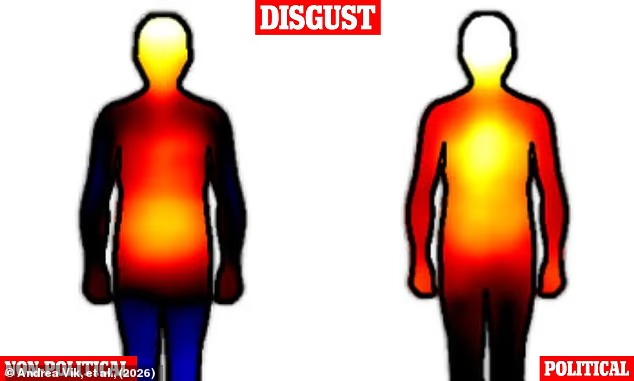
Political disgust, for example, is felt in the chest and arms rather than the stomach – appearing much more like normal anger.
The study also found a clear divide between left–wing and right–wing voters.
Left–leaning voters who might favour Labour or the Green Party were found to feel these negative emotions far more strongly than people on the right.
Scientists have revealed where your emotions about politics are felt in the body, and it is very different to how you experience everyday emotions
Lead author Dr Andrea Vik, from Royal Holloway University, says: ‘We tend to think of political emotions as things people simply think about, like how angry you are on a scale of one to ten.
‘But emotions are so much more than a scale; emotions are felt and lived through the body. We may feel “butterflies in our stomach” or “weak in the knees”.’
Adding the political context doesn’t just change how angry, depressed, or hopeful someone is; it changes how they physically feel those emotions.
Disgust is typically related to a feeling of physical sickness, brought on by a desire to purge yourself of anything harmful.
If you see some rotten food, for example, your emotion of disgust is also connected to a physical reaction to the threat of infection.
This means that disgust, as an emotion, is intensely felt in the stomach and throat.
But when people were asked to think of something that disgusted them in politics, the feeling manifested more strongly in the chest, arms, and hands.
This is the sort of pattern scientists would expect to see in someone feeling intense anger.

Depression is usually felt as a numbing sensation in the limbs, but political depression produces much more sensation and activation
The researchers propose this is because politics turns disgust into something more moral and outrage–based.
Depression also showed a significant transformation between everyday life and politics.
Normally, depression is marked by a widespread numbness and the loss of bodily sensation in the limbs.
However, political depression lacked this normal numbing effect and was actually associated with feelings in the chest and head.
Dr Andrea told the Daily Mail: ‘Our finding that political depression looks less like the typical emotional shutdown associated with everyday depression may help explain why, in some circumstances, it actually motivates political action rather than suppressing it.’
This implies that political depression might encourage people towards action and mobilisation, rather than paralysing them with despair.
Anxiety, meanwhile, was felt a little less in the stomach and more in the heart in a political context.
According to the researchers, this shows that ‘politics evokes a qualitatively different kind of worry, one that perhaps is centred more on collective uncertainty and vigilance rather than personal threat’.

Anxiety shifts away from the stomach and into the heart and upper chest when it is directed towards politics

People experience hope as less of a physical sensation when it concerns politics rather than other contexts
Similarly, political hope was felt quite differently from the everyday emotion, but participants reported experiencing it as a less powerful physical feeling.
Political hope was still felt in the head and heart, just less strongly than in the everyday context.
Anger, like political disgust, mainly manifests as a strong feeling in the chest, arms, and hands – only changing slightly in a political context.
Dr Andrea says: ‘We found that political anger involves less activation in the hands than everyday anger.
‘This makes some intuitive sense, if you are angry at someone in your personal life, you may feel more physically prepared for confrontation than if you are angry about, say, the climate crisis.’
Another fascinating finding from these results is that the physical feeling of emotion is strongly connected to how and when people get involved in politics.
The researchers found that American Democrats and Democrat leaning voters felt negative emotions more strongly in their bodies than Republicans.
A similar pattern was also true of left–wing and right–wing voters, with left–leaning voters who might favour Labour or the Green Party feeling emotions more strongly.

Anger does not change much in a political context, but it is felt less in the hands. This suggests less readiness for physical confrontation

Left–wing and Democrat–leaning voters experienced a stronger physical reaction to political emotions than their Republican–leaning counterparts
These left–wing voters tended to experience a greater physical sensation associated with anger, depression, and anxiety, especially in the head and upper chest.
‘We suggest these findings raise the possibility of what we call ideological bodies,’ says Professor Andrea.
‘Just as basic cognitive and perceptual tendencies relate to political worldviews, so too might basic bodily and emotional processes shape how those worldviews are experienced and expressed.’
This might be a particularly important finding, given that their data suggests a physical feeling of emotion strongly affects political action.
The strength of a person’s embodied political emotions was a reliable predictor of political participation, including voting, protesting, signing petitions, and online advocacy.
That means people with a more physical reaction to politics are likely to have a better turnout at elections and be more active in political discussion.
However, co–author Dr Alejandro Galvez Pol, from the University of the Balearic Islands, says that these results should be ‘interpreted cautiously’.
He adds: ‘It is correlational, context–dependent, and likely influenced by the political climate at the time of data collection. It does not mean that one side is inherently more emotional.’