When you trip over a pavement or get someone’s name wrong, it’s best not to be too embarrassed.
That’s because laughing at your mistakes makes you more likeable, according to a new study.
In a series of online experiments involving more than 3,000 people, researchers asked participants to read about other people’s embarrassing mishaps
These included walking into a glass door at a party or accidentally waving to the wrong person.
Participants were then shown how the people in the stories reacted after their faux pas.
Overall, they judged the people who laughed at their own minor blunders to be warmer, more competent and more authentic than those who acted embarrassed.
‘Our findings suggest that people often overestimate how harshly others judge their minor social mistakes,’ co-author Övül Sezer, from Cornell University, said.
‘For minor, harmless blunders, laughing at yourself can signal social confidence, reduce tension and communicate that the mistake was accidental.’
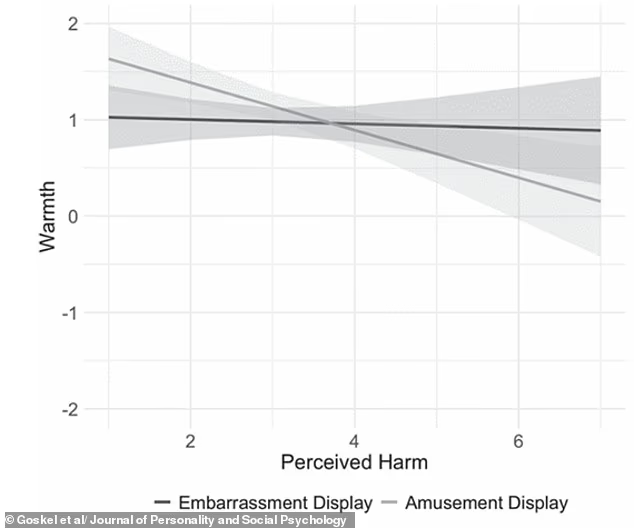
The researchers found that when a mistake is harmless, people are seen as being more ‘warm’ if they laugh at themselves. But as the harm of a mistake increases, amusement led to decreased levels of warmth
The researchers said in these situations, embarrassment was often seen as excessive.
‘Observers tended to think that actors who displayed embarrassment were feeling more embarrassed than the situation warranted, while laughing signalled that they recognized the mistake was minor,’ Dr Sezel said.
There was, however, a caveat – the mistake had to be harmless.
In a separate experiment, a person was described as accidentally tripping and breaking their own arm. In another, the personal tripped and knocked over a colleague, breaking the colleague’s arm.
In these cases, the person who laughed at themselves was seen as behaving inappropriately.
Previous research has found there can be social benefits to acting embarrassed after committing a mistake.
People like to see embarrassment because it signals remorse and respect for social norms, Dr Sezer explained.
‘What’s important is calibrating the reaction to the seriousness of the mistake,’ she added.

As part of the study, participants were shown how the people in the stories reacted after their faux pas – either by showing embarassment or amusement
The study, published in the Journal of Personality and Social Psychology, reads: ‘When a faux pas causes minimal or no harm to others, actors maximize reputation by displaying amusement.
‘But when a faux pas harms others, amusement becomes inappropriate, decreasing its reputational benefits.’
The team said there is a common inclination to strongly signal embarrassment after performing a social gaffe.
But signaling amusement offers a more effective strategy to maintain your reputation.
Join the discussion
Do YOU laugh at your mistakes?