Environmental scientists want Britons to ‘pause’ their shower while they lather their shampoo to help close England’s vast water gap.
By 2055, experts predict that England will face a five-billion-litres-a-day water shortfall with very real risks of disrupted supplies.
Rather than relying on products such as water-saving shower heads, they argue that changing everyday habits may be just as effective.
And one of their suggestions includes turning off your shower while shampooing your hair.
A new paper, published in the Journal of Environmental Management, recommends a ‘single, efficient pause while lathering’.
‘It turns out the biggest drivers of water use are not who you are or where you live,’ co-author Dr Pablo Pereira-Doel, from the University of Surrey, said.
‘What matters most is what you actually do in the shower.
‘Small routines such as applying shampoo twice or letting the water run while lathering can extend shower time far more than people realise.’
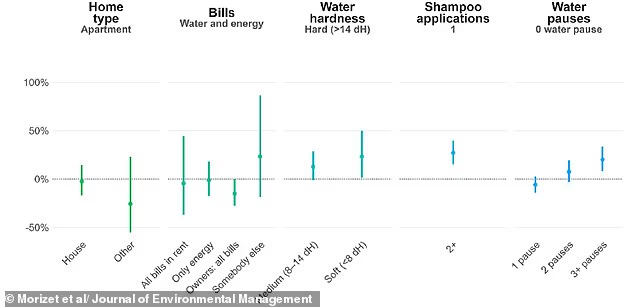
The researchers found that somebody else paying the bill, living in a soft water areas and shampooing twice increased water consumption. Taking a single pause, however, reduced water consumption during a shower
The team said showers account for up to 45 per cent of indoor household water use, making them a huge contributor to water consumption.
To investigate ways to reduce water use, they monitored 319 households across Germany by installing smart sensors in bathrooms that recorded exactly how people showered.
Over a 40-day period, the devices captured 8,550 individual showers, measuring their duration, water pauses and environmental conditions.
The researchers also collected time-stamped surveys after people washed their hair to understand how their routines affected water use.
On average, participants spent four minutes and 48 seconds in the shower, with almost two-thirds keeping their shower to five minutes or less.
However, around one in seven showers lasted longer than eight minutes, using considerably more water.
The study found that more than half of shampoo showers involved no pause in the water flow at all, suggesting many people simply leave the shower running while they lather their hair.
This, they suggest, represents a missed opportunity to save water – and people should be ‘nudged’ to pause their shower during this time.

The new paper, published in the Journal of Environmental Management, recommends a ‘single, efficient pause while lathering’ (file image)
The analysis also revealed that people who shampooed their hair twice spent around 27 per cent longer in the shower than those who washed it just once.
Water hardness also played a role. Showers in areas with softer water lasted about 23 per cent longer than those in hard water regions, possibly because softer water produces richer lather and a more comfortable experience, encouraging people to linger.
The researchers found that younger and middle-aged adults generally lingered under the water for longer than people aged over 50.
They suggest alongside behavioural nudges, smart devices that provide real-time feedback and even redesigned haircare products could encourage shorter showers.
A separate study, published earlier this year, suggested that Britons install meters to help cut down how long they spend in the shower.
The meters feature a timer that’s triggered as soon as you turn on the water, effectively shaming you for indulging in a lengthy wash.
In their study, the researchers surveyed 100 water professionals across 60 organisations in the UK.
These experts identified fixing in-home leaks, showering, and flushing the toilet as the three most important areas in which people could save water.
Showering typically uses about six to 15 litres of water per minute, and with the average Brit spending 6.7 minutes washing, that’s a potential total of 100 litres of water.
The government is currently aiming to reduce water consumption to 110 litres of water per day by 2050, meaning a long shower could blow your entire daily water budget.
In one study, installing shower timers reduced the amount of time people spent under the water by 26 per cent.
Co-author Sofie Voss, a PhD student at the University of Surrey, told the Daily Mail: ‘Most people do not consciously track how long they have been in the shower, and real–time feedback interrupts the autopilot mode.
‘It creates a moment of awareness, urging people to notice that time is passing and to decide to stop sooner.’