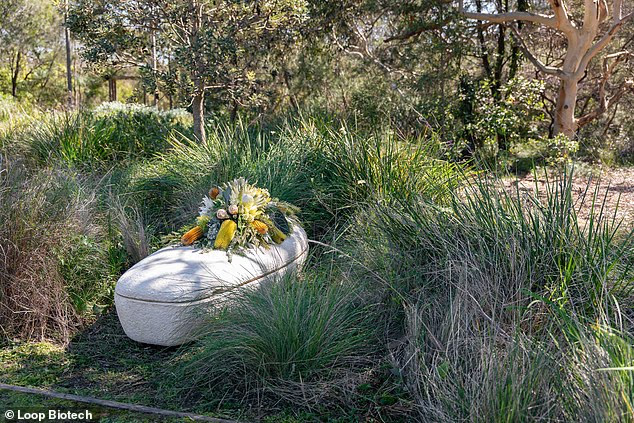
A woman has become the first person in Australia to be buried in a ‘living coffin’.
Carolyn, a woman in her 70s, was put to rest on 4 September in a futuristic casket made from mycelium – the underground root network of mushrooms – and upcycled hemp fibres.
These natural materials degrade in just 45 days once buried.
While mushroom coffins have already been used in the UK, this marks the first time one has been used in Australia.
Donald, Carolyn’s husband, said: ‘This is so Carolyn. She was always there to help others.
‘It feels very true to who she was that even after her death, she can still do something for others while giving something back to nature.’
A woman has become the first person in Australia to be buried in a ‘living coffin’. Carolyn, a woman in her 70s, was put to rest on 4 September in a futuristic casket made from mycelium – the underground root network of mushrooms – and upcycled hemp fibres
The living coffin is the brainchild of Bob Hendrikx, founder of Loop Biotech, a biotechnology company based in The Netherlands.
‘Five years ago, this existed only as an idea at Delft University of Technology,’ Mr Hendrikx explained.
‘Being here in Sydney and seeing the first Australian family choose it is incredibly special.
‘We hope this gives families another way to leave something positive behind: a final gesture that also gives something back to the land.’
Made from local mushrooms and upcycled hemp fibres, the coffin takes just seven days to be grown, and 45 days to return to the earth once buried.
Inside, it’s also lined with natural materials, with options for a soft bed of moss, wool, or soft organic cotton.
Carolyn’s family decided to choose the living coffin as a nod to her connection with nature.
Erin, Carolyn’s daughter, said: ‘Carolyn lived a life of service and was deeply loved and admired by her community.

While mushroom coffins have already been used in the UK, this marks the first time one has been used in Australia
‘It feels incredibly fitting that she became the first person in Australia to be laid to rest this way.
‘Continuing to give back even after her life.’
The farewell ceremony took place in Faulconbridge, followed by a burial at Springwood Cemetery in the Blue Mountains.
Carolyn’s friend, Christine, said: ‘When we saw her resting on the bed of moss, it looked almost whimsical.
‘It felt like she was already becoming part of the earth.’
The Loop Living Cocoon is priced at £2,595-£2,803 in the UK.
Mr Hendrikx told the Daily Mail: ‘Final consumer pricing in Australia is determined by the funeral directors and can vary depending on location, transport, services and the overall funeral package.’
So-called ‘green’ burials, which have grown in popularity since the 1990s, are a more environmentally friendly alternative to traditional funerals.

The farewell ceremony took place in Faulconbridge, followed by a burial at Springwood Cemetery in the Blue Mountains

The Loop Living Cocoon is priced at £2,595-£2,803 in the UK. The Daily Mail has reached out to the company to confirm the price in Australia
They focus on minimising environmental impact by using biodegradable coffins or shrouds and avoiding embalming, often taking place in designated natural burial grounds such as woodlands or meadows.
The latest burial option follows an emerging trend for ‘boil in a bag’ funerals that dissolve bodies and flush them down the drain.
The method, which could soon become available in Britain after catching on around the world, is officially known as water cremation or alkaline hydrolysis.
It involves rapidly decomposing a corpse in water and alkaline chemicals under high temperatures, leaving only liquid and bones.
The liquid, known as ‘effluent’, can go down the drain with other wastewater and bones that can be ground to ash for the bereaved owner to take home.
Advocates say the method is better for the environment, but others believe it is an undignified way to dispose of the dead.