The world’s oldest recorded asteroid impact has been discovered, revealing new evidence of Earth’s violent history.
Scientists have long suspected that the North Pole Dome in Western Australia‘s Pilbara region was the site of an ancient catastrophe.
Now, researchers have uncovered the first rock–solid evidence that provides an exact date for the impact.
Using advanced mineral dating techniques, they show that the crater was formed when a space rock smashed into Earth 3.02 billion years ago.
While billions of years of erosion have wiped away much of the evidence, this impact was substantial enough to leave a lasting legacy on Earth.
Lead author Professor Chris Kirkland told the Daily Mail that this meteor could have been a ‘kilometre–scale’ object, although its precise size is impossible to determine.
He said: ‘At North Pole Dome, the impact appears to have generated a long–lived fractured system that was later reused by fluids.
‘On the early Earth, that kind of process could have influenced chemical exchange between rocks and an early ocean, causing mineral alteration and potentially modifying the environments available for microbial life.’
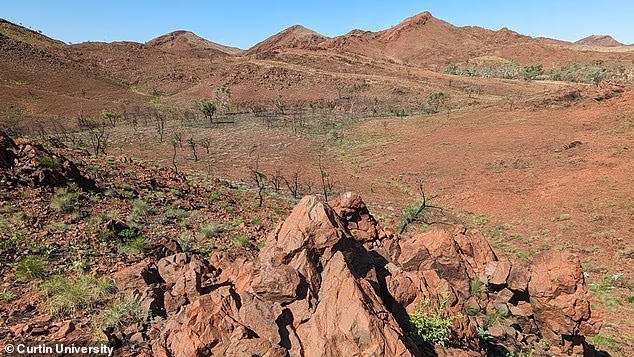
Scientists have revealed that the North Pole Dome in Western Australia’s Pilbara region (pictured) is the oldest asteroid impact crater on Earth
Although scientists believe space rocks have battered Earth throughout most of its history, evidence of these ancient impacts is nearly impossible to trace.
Big enough asteroid impacts cause geological changes in the surrounding rocks, but billions of years of heat, pressure, and fluid movements obscure or reset these changes.
This is why scientists have previously found it so difficult to pin down the exact age of the North Pole Dome crater.
However, Professor Kirkland and his team have now been able to track down a ‘mineral clock’, left behind in the damaged rocks.
The key piece of evidence was zircon, an extraordinarily resilient mineral that can hold its shape for billions of years.
When the researchers took samples from the rocks around North Pole Dome, they found that some zircon crystals had strange branching or ‘skeletal’ shapes.
Professor Kirkland believes that these are ‘impact–modified crystals’ formed when old zircon in the rocks was disrupted and partially recrystallised by the intense heat of an impact.
Critically, they were also able to date the formation of these crystals to an event around three billion years ago.

Scientists uncovered tiny zircon crystals in the rock, which were disturbed and reset by a massive asteroid collision

The researchers were able to date these disturbed crystals to around three billion years ago, making this the first evidence of the world’s oldest impact crater
Since there isn’t anything else in the geological history that could explain the crystal’s dramatic transformation, they are very likely to be the signature of a meteor impact.
The team then analysed a second mineral, apatite, which formed as hot fluids moved through the shock–damaged rocks – also producing a similar age estimate.
‘The agreement between two different mineral systems gives us confidence that we are seeing the signature of a single major event — a meteorite impact,’ says Professor Kirkland.
This is an exciting discovery for geologists since it dates the crater back to the ‘Archean aeon’, a time when the planet’s earliest continents were forming.
The moon’s surface, which provides a much more stable record, suggests that the inner solar system was heavily bombarded by meteors around this time.
Although the theory is not universally accepted, some geologists believe that this could have been part of a cataclysmic event known as the Late Heavy Bombardment.
According to this theory, a sudden change in the orbits of the giant planets – Jupiter, Saturn, Uranus, and Neptune – destabilised the asteroid belt and sent thousands of rocks flying in Earth’s direction.
These impacts could have helped to shape Earth’s early crust, creating basins, melting rocks, building deep fractures, and driving hydrothermal systems.

Scientists say that the rocks around North Pole Dome (pictured) would have been formed when Earth’s first continents were just being created
However, scientists have struggled to find any evidence on Earth of craters dating back to this period.
‘Earth must also have experienced that bombardment, but most of the evidence has been destroyed,’ explains Professor Kirkland.
‘That is why the North Pole Dome discovery is so important.
‘At 3 billion years, it is the oldest recognised impact structure on Earth and one of the very few windows into how impacts affected the Archean Earth.’
KILLING OFF THE DINOSAURS: HOW A CITY-SIZED ASTEROID WIPED OUT 75 PER CENT OF ALL ANIMAL AND PLANT SPECIES
Around 66 million years ago non-avian dinosaurs were wiped out and more than half the world’s species were obliterated.
This mass extinction paved the way for the rise of mammals and the appearance of humans.
The Chicxulub asteroid is often cited as a potential cause of the Cretaceous-Paleogene extinction event.
The asteroid slammed into a shallow sea in what is now the Gulf of Mexico.
The collision released a huge dust and soot cloud that triggered global climate change, wiping out 75 per cent of all animal and plant species.
Researchers claim that the soot necessary for such a global catastrophe could only have come from a direct impact on rocks in shallow water around Mexico, which are especially rich in hydrocarbons.
Within 10 hours of the impact, a massive tsunami waved ripped through the Gulf coast, experts believe.
Around 66 million years ago non-avian dinosaurs were wiped out and more than half the world’s species were obliterated. The Chicxulub asteroid is often cited as a potential cause of the Cretaceous-Paleogene extinction event (stock image)
This caused earthquakes and landslides in areas as far as Argentina.
While investigating the event researchers found small particles of rock and other debris that was shot into the air when the asteroid crashed.
Called spherules, these small particles covered the planet with a thick layer of soot.
Experts explain that losing the light from the sun caused a complete collapse in the aquatic system.
This is because the phytoplankton base of almost all aquatic food chains would have been eliminated.
It’s believed that the more than 180 million years of evolution that brought the world to the Cretaceous point was destroyed in less than the lifetime of a Tyrannosaurus rex, which is about 20 to 30 years.