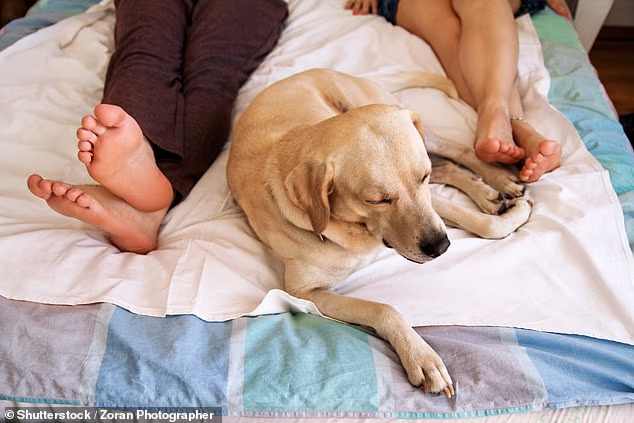
It is a debate that has left pet owners divided: Should the dog be allowed on the bed?
While some pet lovers claim they wouldn’t dream of banishing their faithful companion to the floor, others complain their pooches are ruining their sleep.
Now, pet experts have finally revealed whether your dog should be allowed to join you at night.
And it is good news for anyone who enjoys a bedtime cuddle.
While it isn’t suitable for every dog and every owner, pet experts say that letting your dog up for a nap can have benefits for all involved.
Dr Jacqueline Boyd, an animal scientist and canine consultant from Nottingham Trent University, told the Daily Mail: ‘Many caregivers report increased connection with their pet, lower perception of loneliness and increased social contact.
‘Where there are good bonds between person and pet, this can also lead to improvements in physical health too.
‘All of this can have physiological, physical and psychological benefits for person and pet.’
Scientists have finally settled the debate; it is a good idea to let the dog onto the bed. In fact, experts say it could have some surprising benefits
The question of whether to let the dog share the bed has left dog owners on social media bitterly divided.
In one debate on Reddit, some commenters argued that their bed was the natural place for their pup to sleep.
One commenter joked: ‘Where else would he sleep? The whole house is his honestly; I just pay all the bills.’
Another argued that spending a few weeks alongside their dog had made them ‘more loving, more willing to stick with us, and has been showing more personality.’
While one commenter worried that their dog ‘usually gets stressed when he sleeps alone’.
On the other hand, many other commenters had their reasons for banishing the pets from the bedroom.
‘I don’t let my dog sleep in the room with me. Insomnia and being a light sleeper. Her snoring and dream twitches are just too much,’ one dog owner wrote.
One complained: ‘I’m such a light sleeper I can’t get any rest when my dog is in bed with me.’

On social media, pet owners have been divided over whether to let their pets sleep in the bed with them. With some claiming they wouldn’t dream of kicking out their furry friends
Some were more concerned about hygiene, with a pet owner writing: ‘Why would I want that in my bed when I don’t even dare sit on my bed with my outside clothes?’
However, despite these concerns, pet experts point out that there could be some surprising benefits to nodding off next to a dog.
Studies looking at subjective measures of sleep quality show that pet owners typically report having a better night’s sleep when their dog joins them.
This could be due to the fact that a dog’s presence leads to lower levels of emotional arousal, which leads to better perceived sleep quality.
Dr Boyd says this could be ‘a result of being relaxed, increased feelings of safety and security and in some cases even warmth.’
But it isn’t just the owners themselves that stand to benefit, as your dog may get a lot of psychological benefits from a nighttime cuddle.
‘Many dog and cat breeds, for example, have been selectively bred to have a desire to closely affiliate with people, and this includes a preference to rest and relax together,’ says Dr Boyd.
‘Spending time together resting and sleeping can also be good for pets who might be worried or anxious about specific triggers, or simply have big feelings about the world.’

Other pet owners say they have a strict no pets on the bed rule, even if their pups don’t always agree
If sleeping in the bed helps your dog get better sleep, this can be extremely beneficial for their health – especially for puppies, which need up to 20 hours of rest per day.
Likewise, despite a common misconception, there is actually no evidence to suggest that letting your dog into bed leads to separation-related behaviours, such as separation anxiety.
In fact, Dr Boyd says that this could actually help to strengthen the bond between person and pet to create ‘solid and consistent attachment’ when used properly.
And although hygiene and hair may be a problem for those with allergies, ensuring the dog is properly groomed and the sheets regularly changed avoids the risk of spreading bacteria and illness.
However, experts caution that sharing the bed won’t be right for all dogs and owners.
For example, dogs shouldn’t be allowed into the bed with young children as this could lead to injuries, such as scratches from the pet jumping up.
The same goes for older dogs who might be accidentally injured by their owners tossing and turning in the night.
Tod Langston, dog trainer at Packlife K-9 Behavior Solutions, says that letting the dog into the bed ‘amplifies’ the relationship that is already there.


While some pet owners might disagree, experts say that letting your pets onto the bed can improve your wellbeing and that of your dog
While this can be a beneficial force leading to stronger relationships, it could become a problem for badly behaved pooches.
Mr Langston says: ‘Each dog and owner have different elements in their relationship that change the meaning of the bed.
‘Dogs who are constantly pushy, demanding, invasive, aggressive, or possessive will often become controlling and possessive of the bed, and they get empowered to be more controlling in the future by sleeping in the bed.’
Mr Langston advises that dog owners ensure they are in control of when their dog can get onto the bed and not the other way around.
That means you should get into bed first, and the dog should only follow after once you call it.
But the biggest thing to consider is the potential for lost sleep, especially if you have a big dog.
While people often report having had a better night’s sleep, objective measurements show that sleep quality typically declines when the dog is invited into bed.
In one study, researchers found that people’s sleep was more fragmented, interrupted by more periods of waking, and lower quality overall.

The only downside is that pet owners report higher insomnia scores (left) and lower sleep quality (right) when their pet is in the bed, which could be a trade-off for the extra psychological well-being
Dr Renata Roma, a clinician and researcher specialising in human-animal interactions, says: ‘Humans and dogs have different sleep patterns. Dogs tend to have several shorter sleep cycles, while humans need longer, more consolidated sleep.
‘Sleeping together may have emotional benefits, but some studies also suggest it can lead to more sleep disruptions over time.
‘Over time, repeated sleep interruptions can affect memory, mood, and overall well-being. So the decision should take into account the well-being of both the person and the dog.’
However, exactly what works best for you will often depend on your specific situation.
If you’re a heavy sleeper with a big bed and a small dog, then the emotional benefits could outweigh any potential disruption.
However, if you wake up at the slightest noise and have two or three Rottweilers, it’s probably not a great idea to invite the pups in for a nap.
Dr Roma concludes: ‘People should think about both the short- and long-term effects.’