The Russia-Ukraine conflict and the United States-Israel war on Iran have exposed how fragile energy systems built on dependency and external markets truly are.
This cycle of fuel crises and price shocks should be encouraging countries dependent on energy imports to address energy deficits and mitigate the impoverishment they cause among citizens. And yet few are undertaking the bold actions needed to improve energy independence.
Tunisia is certainly not one of them. The country’s energy deficit currently stands at roughly $3.8bn – nearly 51 percent of its total trade deficit – and has grown every year since 2000, driven by rising domestic consumption and a structural failure to build genuine energy sovereignty. The Tunisian authorities, however, are pursuing the wrong policies to address the problem.
They have hedged their bets on the privatisation of the energy sector, as reflected in the recent approval of five renewable energy concessions. The projects allow foreign multinationals to extract profits from renewable energy production and dump costs on the Tunisian people. This approach will not solve Tunisia’s energy crisis; instead, it will deepen its energy dependency while transferring public wealth into private hands.
Five bad energy concessions
On January 29, five new concession contracts for electricity production from renewables were submitted to the Tunisian parliament for approval.
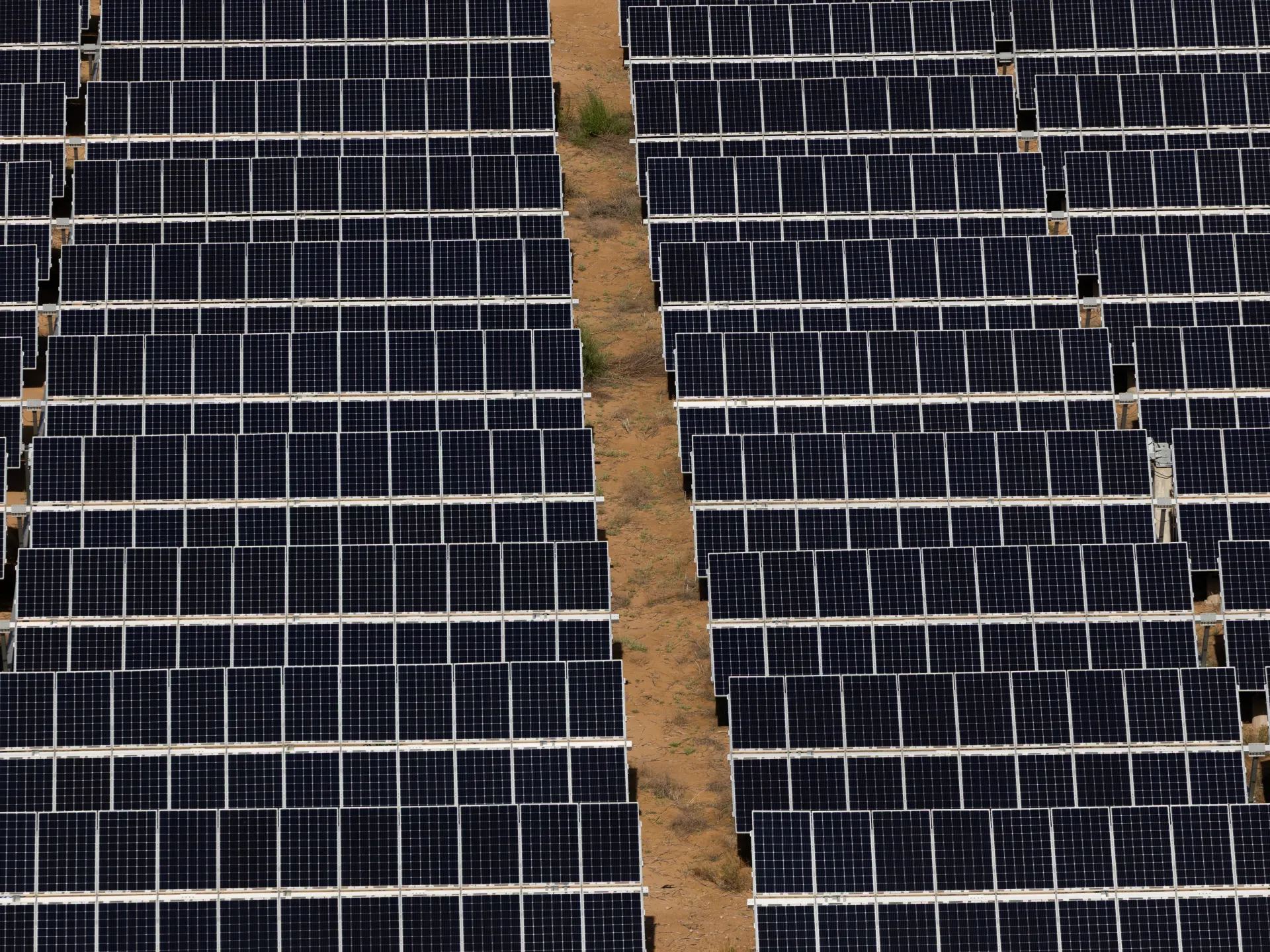
The five solar plants – Khobna and Mezzouna in Sidi Bouzid in central Tunisia, El Ksour and Sagdoud in Gafsa in the west, and Menzel Habib in Gabes on the coast – would have a combined capacity of roughly 598 megawatts, with a total investment estimated at $560m. They would be granted to foreign multinationals.
In the following months, concern about the proposed projects grew. On April 21, the Electricity and Gas Federation, a trade union organisation, held an urgent news conference laying out the concrete mechanics of what the parliament was being asked to approve. The concessions, they argued, would reduce STEG, Tunisia’s national public utility, to a mere grid operator, while electricity production would be handed to foreign companies. Infrastructure costs would be paid by the public, while profits would leave with the corporations.
This is a standard model, exported wholesale from the structural adjustment playbook of the 1990s, now repackaged in the language of green transition.
Furthermore, according to the Tunisian Economic Observatory, the five concessions would benefit from extensive tax exemptions and stabilisation clauses that could undermine Tunisia’s fiscal sovereignty. There would be no meaningful technology transfer, weak local integration, and limited employment opportunities, which raised serious concerns about the developmental value of these projects.
The observatory also reported that under these contracts, carbon credits generated through emissions reductions on Tunisian territory could be transferred to the multinationals rather than remaining a public asset.
Concerns over this practice had already sparked opposition before these five concessions reached parliament. Last year, the Electricity and Gas Federation organised a strike denouncing the transfer of carbon credits to private developers. Notwithstanding the opposition, the five concessions came to entrench and expand this mechanism, allowing project developers to claim credits and use them to access international subsidy programmes. Incentives that were intended to support a national energy transition would thus be captured by private actors to boost their profits.
The public awareness raised by the federation and independent media mobilised public opinion against the concessions. Workers and activists staged a protest outside the parliament. Nevertheless, the five concessions were voted through, and the contracts were approved. The energy minister and a senior Ministry of Industry official were dismissed to placate public anger and distance the ruling elite from the controversial projects.
The right solution for the right deficit
The concessions were pushed through with the justification that the country needs them to reduce its energy deficit, to cut its dependence on Algerian gas, which currently supplies about 60 percent of the country’s natural gas needs, and to meet its commitment to reach 35 percent renewables in the energy mix by 2030.
At first sight, this may sound reasonable, but it rests on a selective reading of the numbers and a deliberate narrowing of what counts as a solution.
The most glaring omission concerns the nature of the deficit itself. About 73 percent of Tunisia’s energy comes from petroleum products (gasoline and diesel), consumed overwhelmingly by a transport sector built around private transportation.
Addressing it requires a fundamentally different set of choices: Investment in public transport, restrictions on car imports, progressive taxation on high-consumption vehicles, etc. It also means thinking regionally. Reducing petroleum imports requires strengthening domestic refining capacity, and specifically investing in and upgrading the Tunisian Company of Petroleum Industries (STIR). This demands revisiting the kind of regional cooperation that was once within reach.
In 2012, for example, Tunisia and Libya discussed a joint refinery project at the coastal town of Skhira that could have significantly advanced energy sovereignty for both countries. The $2bn project was suspended due to the conflict in Libya, which made a steady crude supply impossible to guarantee. Eventually, it was quietly abandoned not because it lacked merit, but because this kind of sovereign regional cooperation threatened the interests of European hegemonic powers that profit from exporting refined petroleum products to the region.
Libya exports crude oil but imports refined products; Tunisia, with far fewer resources, is caught in the same extractivist logic, also exporting primary commodities (raw materials and agricultural produce) as well as a limited number of semi-industrial or manufactured products while remaining dependent on imports for high-value industrial and technology products. A shared refinery would have broken that cycle in the energy sector, to some extent.
Countries that continue to be subordinated to foreign powers are rarely allowed to industrialise, move up the value chain, or build the kind of productive sovereignty that would reduce their dependence on external markets and empower them to challenge imperialist domination. The buried refinery project is a case study in how that domination operates – not merely through direct prohibition, but also through the slow, structural foreclosure of alternatives.
The five solar concessions are another iteration of the same logic. They do not address the real structural issues of Tunisia’s energy deficit. They do not build domestic industrial capacity. They do not transfer technology. What they do is open a new frontier for international capital accumulation dressed, as the trend dictates, in the language of transition, sustainability, and development.
Transition – but on whose terms?
Few would dispute the urgency of transitioning towards renewable energy. The question that matters is how, by whom, and in whose interest.
Tunisia’s energy crisis is real. But its solution is not the further privatisation of public resources under foreign management and neocolonial schemes. What is required is a fundamentally different set of choices: Public control over energy production and distribution, genuine technology transfer, investment in domestic industrial capacity, a shift in the consumption paradigm through energy efficiency and public transport, and regional cooperation that builds sovereignty rather than deepening dependency.
The neoliberal corporate-led model has demonstrated its limits in financial crises, in pandemics, and in the geopolitical shocks now reshaping the global economy. Each new crisis should serve as an alarm. Instead, they are consistently used as a pretext for doubling down on the same failing logic.
We must transition. But we must insist on transitioning on our own terms with public control, democratic oversight, and genuine inclusive development defined by the needs of the many, not the profit margins of the few.
The views expressed in this article are the authors’ own and do not necessarily reflect Al Jazeera’s editorial stance.