
Amna Nawaz:
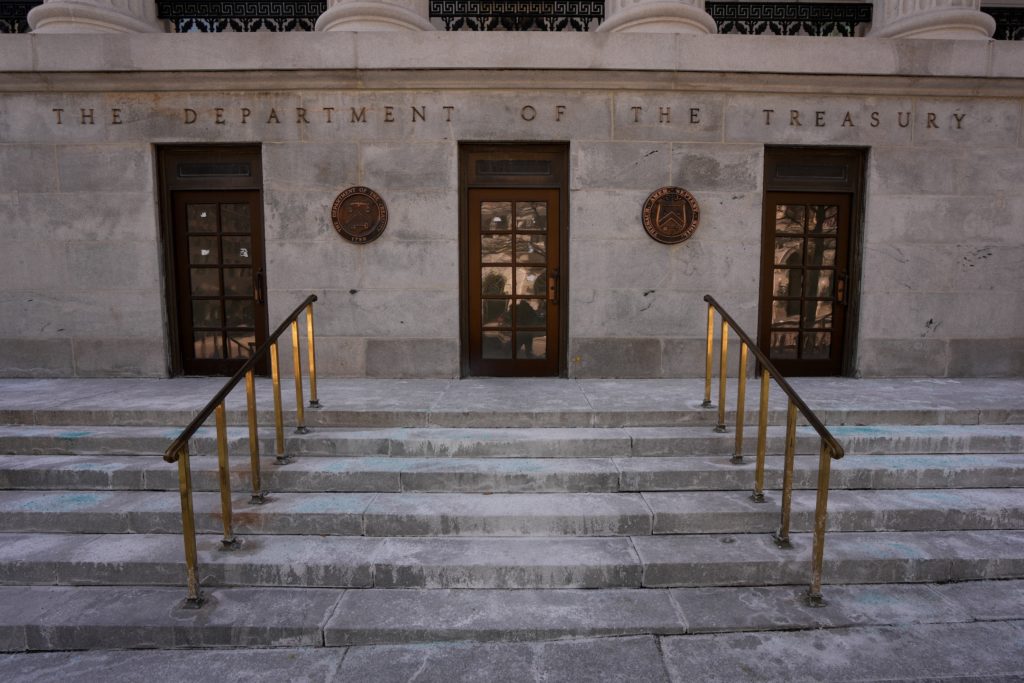
Yesterday, Treasury Secretary Scott Bessent announced new steps to try to help stabilize the bond market. Essentially, the government will increase the amount of bonds it buys back. That all comes as the national debt officially passed the $40 trillion mark this week.
This morning on CNBC, Bessent said he was confident that higher yields or interest rates for those bonds would come down soon.
Scott Bessent, U.S. Treasury Secretary:
We routinely do buybacks, and we’re going to increase the size of the buyback. We have a big toolkit, so we will see. And part of it is signaling here, and to show that we believe that the yields don’t reflect the underlying fundamentals.
Amna Nawaz:
To help make sense of it all, we’re joined again by David Lynch. He’s global economics correspondent for The Washington Post and author of the book, “The World’s Worst Bet: How the Globalization Gamble Went Wrong and What Would Make It Right.”
David, welcome back to the “News Hour.” Thanks for joining us.
David Lynch, The Washington Post:
Happy to be here.
Amna Nawaz:
Before we get into all the implications here, help us just understand the basics of the bond market. When we say that Treasury yields are rising or falling, in practice, what does that really mean?
David Lynch:
Well, if yields are rising, it means that investors are demanding a higher return in return for lending their money to the government.
A bond is really just a fancy word for a loan. It’s — the bond market is where governments and corporations go to raise money. And if I decide to buy a bond, I’m lending money to the government in return for a promise to pay me a return, which is called the yield.
Think of it like an interest rate. Five percent means I will get 5 percent back every year until the bond matures, in this case, say in 30 years. And then the government pays me back.
Amna Nawaz:
So let’s take some of those numbers specifically here. You mentioned that 30-year U.S. Treasury bond that’s considered to be one of the safest bets in the world. The yield on that hit 5.3 percent on Tuesday. That is up from as low as 1.7 percent in 2021. It’s the highest rate since 2007.
What should we understand about what’s driving that increase?
David Lynch:
Well, there’s a number of factors that have come together at the same time, but the major ingredient here is really just basic supply and demand.
You’ve got a lot of institutions, both on the government side and big business, that are going into the bond market and trying to raise money. And as a bond investor, I’ve got a lot of competition for my money. So, the price of my money effectively is going up. If there was — if it was just the U.S. government that wanted to raise money and there were no corporations, then the government would probably have to pay very little to get me to loan money because I’d have no alternative.
But, as an investor, I can lend my money to Amazon or to Google or one of the big A.I. hyperscalers that are building out the artificial intelligence revolution, or I can lend my money to a government, the U.S., Germany, Japan, whatever.
And because there’s so much demand for money in the bond market, I want a better return. I want 5 percent. I don’t want 1.7 percent.
Amna Nawaz:
Let me ask you more about the impact of A.I., as you mentioned on, all of this, because tech companies have borrowed some half-a-trillion dollars so far this year to fund that A.I. build-out.
What’s the impact of all of that borrowing and spending?
David Lynch:
Well, that that’s really the key factor here, because what we’re seeing is not routine levels of corporate borrowing and activity. This A.I. phenomenon is really driving the economy and it’s driving markets, both stock and bond markets.
And in the bond market, it’s effectively almost crowding out the government. You have got governments, not just here in the U.S., but really around the world, around the developed world, but also in emerging markets, who are jostling with these major corporations to get scarce capital.
And because there’s more demand for the capital than there is capital, the price of that money goes up.
Amna Nawaz:
David, what about the impact on American households? These are households already pinched by high gas prices, grocery prices, health care and housing. What does a 30-year Treasury bond yield have to do with their lives?
David Lynch:
Yes, it’s a good question. This is not just some esoteric financial market issue that the average person can ignore.
The yields on long-term government securities like the 30-year, also the 10-year, affect loans that consumers get for home mortgages, and we have seen mortgage — the 30-year mortgage rate climb up past 6.6 percent, heading perhaps to 7. It affects auto loans. It affects the loans that businesses pay.
And so, as the price of money goes up, as it becomes more expensive for businesses to raise money, that means they’re probably going to hire fewer people, build fewer factories. And, for consumers, if the cost of a car loan or a 30-year mortgage goes up, people are going to think twice before they buy a new car or go into the housing market.
And you’re seeing that weakness reflected, particularly in housing, with new starts down last month.
Amna Nawaz:
In the few seconds we have left, big picture here. We have talked about the national debt hitting the staggering $40 trillion level now.
Is there a point at which fewer and fewer people will want to buy these government bonds?
David Lynch:
Well, that’s what folks have worried about and talked about for years.
And the problem is, there’s no magic number. Economists used to think that once debt got up as high as an amount equal to, say, 90 percent of the economy, that that would be the trigger. And it turned out that wasn’t right. Now we’re at about 100 percent, a level we haven’t seen previously since World War II.
And Secretary Bessent is right when he said today that there’s no magic to the number $40 trillion. It’s no different in terms of market sentiment really from $39 trillion or 41. But the problem is, the number has doubled in the past 10 years or so, and it keeps climbing higher.
And what everyone in the market knows and what everyone in government knows is that this can’t go on forever, and eventually the bill is going to have to come due.
Amna Nawaz:
That is David Lynch, global economics correspondent for The Washington Post.
David, thank you so much.


