Geoff Bennett:
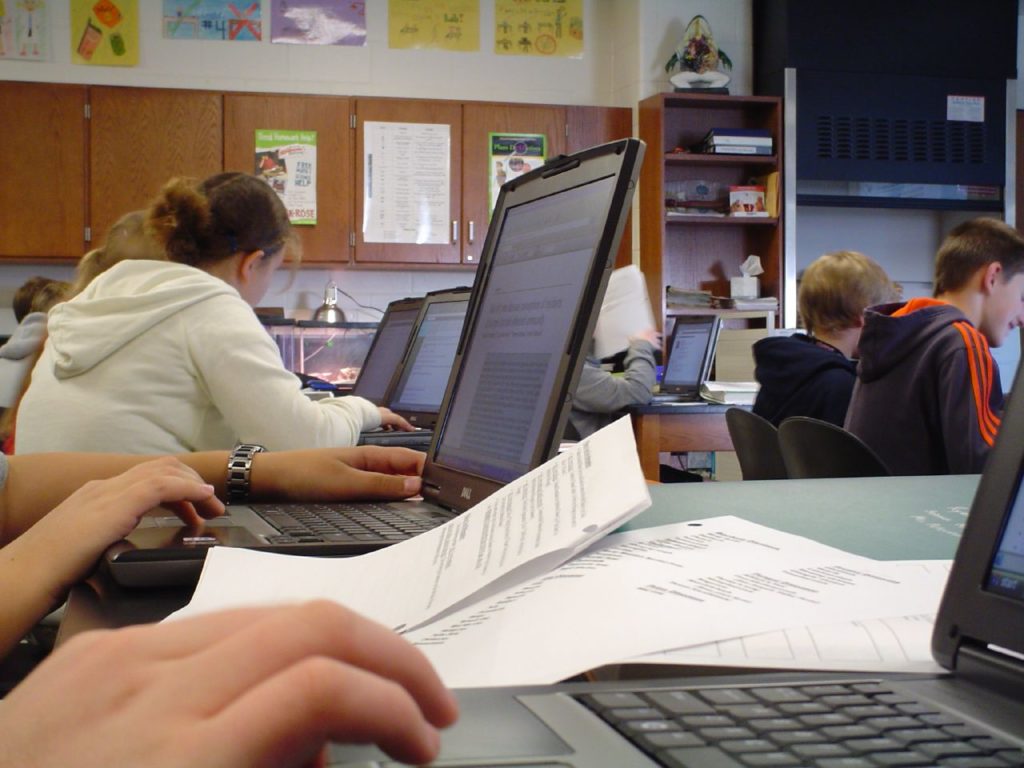
This week, the nation’s second largest school district, Los Angeles Unified, imposed strict new limits on screen time for its roughly 400,000 students.
As William Brangham reports, it’s just the latest example of a growing backlash against technology in classrooms across the country.
William Brangham:
That’s right, Geoff.
L.A., for — like many districts, for years worked aggressively to get technology into the hands of students to get Chromebooks and iPads into the classrooms. But this new policy, one of the most aggressive in the country, marks a dramatic shift.
No screen time will be allowed before second grade, and older students will see sharp limits, six hours per week for middle schoolers and 10 hours, including homework time, for high schoolers.
So to help understand these new rules and the rationale behind them, we are joined by Nick Melvoin. He’s a member of the Los Angeles School Board, and he sponsored this new screen time rule.
Nick, thank you so much for being here.
Just a decade ago, Los Angeles was spending hundreds of millions of dollars to get technology into the classrooms. And now there is this abrupt shift. How did we get to this point?
Nick Melvoin, Board Member, Los Angeles Unified School District:
Well, thanks for having me.
And I think, as policymakers, particularly when it comes to students’ educations and livelihoods, we have an opportunity when we know better to do better. And like you mentioned, L.A. was a real pioneer when it came to trying to bridge the digital divide with laptops and devices and Internet.
And it was a blessing that we were, because, during COVID, of course, that was a lifeline for the hundreds of thousands of students who rely — who relied on those in L.A. for any education.
But since we returned to school in person, and I spend time every week in classrooms, I was struck by kind of the overreliance we had on technology in schools. First, students who were on their cell phones, I brought the resolution to ban smartphones in L.A. Unified a couple years ago, and we just actually had the results of a survey of our teachers that came back this week that said over 90 percent of teachers report that engagement is up, mental health challenges are down when it came to cell phones.
But I still was seeing so many kids on screens for hours a day. And so I just thought it was important for us to recalibrate and reset students’ relationship with technology as we return to school and as we think about the next 10 years.
William Brangham:
So, how will these limits work in practice? Are teachers going to keep a stopwatch of how much screen time is going to happen for the young students? How are they going to do this?
Nick Melvoin:
Well, so the idea, not unlike our cell phone policy, is not to start with the punitive, but really the instructive and try to win hearts and minds, if you will.
And this was developed with educators in mind. You know, we are a first mover here. It was after my resolution came out that the surgeon general’s office had suggested screen time limits. But other than that, there’s really no district that has a policy like this.
And so it was an iterative process with our teachers. And, again, the idea is not to be punitive, but to recalibrate and revert back to not technology being the default, but being an instructional tool, just that.
And so, at elementary school, it is more restrictive. In high school, it presumes the fact that you’re going to have certain classes, like a computer science or graphic design, that may require more screen time. But the idea is that teachers just need to think about that more holistically.
And if they’re assigning research that’s going to be online for homework, they should limit the amount of time that kids are on screens during the day. There’s not a punitive piece in place like a teacher log. We want to respect educators are professionals.
This is about the amount of time that kids are sitting with a screen, knowing how much screen time they may be getting outside of the school day. We want to make sure that we take a — put a stake in the ground in how much they should be sitting in front of screens during the school day.
William Brangham:
I mean, some of your critics have argued that this doesn’t make a clear distinction between harmful screen time, playing games or apps or things that are not educational, and screen time use that is educational.
And it goes back to this original question. Do you worry that this could exacerbate the digital divide between wealthier districts, where kids could have access to screens more often at home, and poorer districts?
Nick Melvoin:
Well, what I was responding to — and my teaching career began in South L.A., where we saw this digital divide. And I should be clear that this policy still encourages families who need devices and Internet to opt in.
The district will continue providing that for families who need it, but it won’t be the default option. And what we see is that students from lower-income backgrounds, because their parents are working multiple jobs, they’re the ones who are, outside of the school day, actually spending more time on screens.
They get home and there’s a lot of whether that’s TV time or iPads or devices. And so there’s an irony here, because, from an equity perspective, it’s actually those students who are seeing the deleterious effects of screens throughout the day.
And so I think this policy strikes the right balance between saying we still want to make sure that students who need it have access to devices and Internet, but we know that those students in need are the ones who actually will benefit the most from a new renewed focus on hands-on learning, less time in front of a screen, going outdoors, at the elementary school level, in particular, more play-based learning.
That was my hope of this.
William Brangham:
More than a dozen states have been following your lead here. The previous surgeon general warned against screen time for young people.
Do you think this is the beginning of a vanguard, of a pushback against technology in classes?
Nick Melvoin:
I do.
I think, like I said at the outset, when we know better, we need to do better. And I think that L.A. Unified is leading what will be a nationwide, if not global charge to recalibrate and think differently about the promise of ed tech and focus on that tactile hands-on learning and the mental health benefits for kids when they’re off of screens.
William Brangham:
All right, that is Nick Melvoin of the Los Angeles Unified School District.
Thank you so much for being here.
Nick Melvoin:
Thanks for having me.