They’re billed as a stress–free, all–inclusive holiday at sea – but cruise ships are especially prone to disease outbreaks, an expert has warned.
Vikram Niranjan, an assistant professor in public health at the University of Limerick, has revealed that the ‘floating cities’ make it easy for infections to spread in ways that are ‘hard to stop’.
It comes as three passengers on the Dutch cruise ship MV Hondius have died from a rare strain of hantavirus after it set sail from Argentina around a month ago.
Another three people with symptoms have been evacuated from the ship to receive care in the Netherlands, the World Health Organisation said.
Around 150 people remain on–board, confined to their cabins while disinfection and ‘other public health measures are carried out’ as the ship is anchored off Cape Verde.
Dr Niranjan said buffet–style dining, the ship’s design and ventilation all contribute to the rapid spread of diseases such as Covid, norovirus and legionnaires.
‘The basic structure of cruise travel still creates the same challenge: many people sharing the same meals, the same air, the same water systems and the same common spaces,’ he wrote on The Conversation.
‘That is why outbreaks keep returning, and why cruise ships remain a useful reminder that public health is shaped as much by design as by germs.’
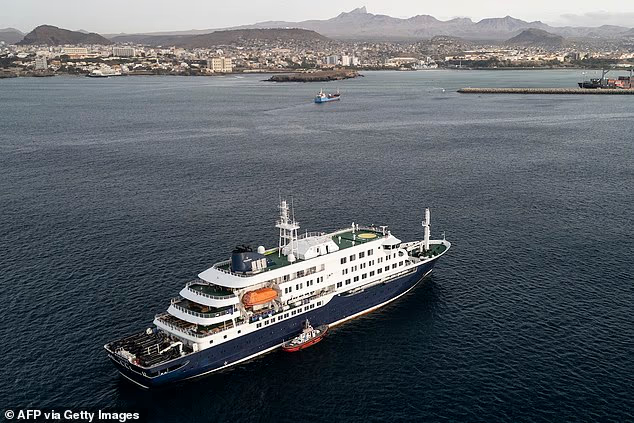
A researcher has revealed that the ‘floating cities’ make it easy for infections to spread in ways that are ‘hard to stop’. Pictured: MV Hondius

The outbreak of the rare, rat–borne illness that has a 40 per cent mortality rate has left three people dead and several others seriously ill
Dr Niranjan referenced the 2020 Diamond Princess outbreak – in which 619 passengers and crew tested positive for Covid – as a well–known example.
Researchers found the ship’s conditions made the coronavirus spread more easily.
Meanwhile, the so–called vomiting bug norovirus is the infection most closely linked to cruise ships.
In a review of previously published studies, scientists found 127 reports of norovirus outbreaks on cruise ships with many linked to contaminated food, contaminated surfaces and person–to–person spread.
‘Food service plays a big part in this risk,’ Dr Niranjan explained. ‘Buffet–style dining, shared utensils and many people touching the same surfaces can make it easier for stomach bugs to spread.
‘If someone is infected but does not yet feel sick, they may still contaminate food or surfaces before they realise they are unwell.’
The way these ships are designed also exacerbates the issue, as people spend a lot of time together in dining areas, bars, lifts, corridors, theatres and spas.
Crew members also live and work in the same environment, often in shared accommodation.

Health workers in protective gear arrive to evacuate patients from the MV Hondius cruise ship at a port in Cape Verde
He added: ‘Ventilation also plays a crucial role. Cruise ships are not closed boxes, but they do rely heavily on indoor spaces where people spend long periods together.
‘Studies into cruise ship air quality have shown that illness can spread more easily in crowded, enclosed spaces, like cabins, restaurants and entertainment venues, if the ventilation system is not up to scratch.’
Age plays a role, as cruise holidays are especially popular with older adults.
Many passengers have long–term health conditions that make infections more serious, Dr Niranjan added.
While cruise ships do have medical facilities, these are limited compared to land–based hospitals.
They are not designed to handle a fast–moving outbreak, he said, and instead are built to give first aid, basic treatment and short–term care.
He explained that legionnaire’s – a serious lung disease caused by bacteria – can easily be spread among passengers through contaminated water systems.
A well–known outbreak has previously been linked to a whirlpool spa.
‘Hantavirus – a severe respiratory illness spread by rodents – outbreaks on ships are rare,’ he said. ‘However, as recent news of the deaths on the MV Hondius attests, germs in close quarters find it much easier to spread.’
When it comes to limiting risk, the best protection starts before boarding, Dr Niranjan said.
This includes making sure routine vaccines are up to date and ensuring travel insurance covers illness–related disruptions.
‘Once on board, washing your hands with soap and water is the most useful step for preventing stomach bugs like norovirus,’ he advised.
‘Hand sanitiser can help, but it does not replace soap and water. If you start to feel unwell, the safest move is to avoid buffets and crowded shared spaces and report symptoms early rather than trying to carry on as normal.’