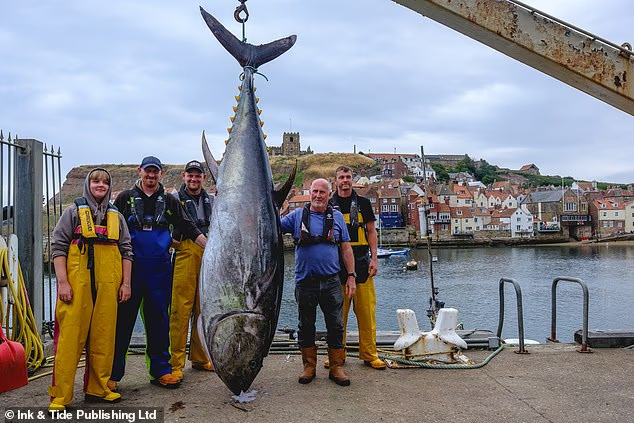
Scientists have revealed why giant bluefin tuna are returning to British waters after a colossal 746lb (338kg) specimen was caught in the North Sea for the first time in almost 90 years.
The enormous fish was landed at Whitby Harbour on Sunday and is thought to be the first bluefin tuna brought into the Yorkshire port since 1939.
The warm–blooded species, which can reach a top speed of 43mph, is usually found in the temperate waters of the Atlantic Ocean and the Mediterranean.
But in recent years the species has returned in huge numbers to the waters of the South West, with the seas off Devon and Cornwall teeming with ‘tunny’.
Now, it appears to be thriving in the North Sea, too – and experts say warmer waters are partly to blame.
Researchers say rising sea temperatures and more frequent marine heatwaves appear to be making UK waters increasingly suitable for the fish.
According to Met Office scientists, 2025 was particularly exceptional with marine heatwave conditions persisting for more than three–quarters of the year. Similar events were also recorded in 2022 and 2023, while 2026 has once again seen sea temperatures significantly above average.
Grace McNicholas, a PhD student at Trinity College Dublin who led a study on bluefin tuna distributions, said: ‘Our results provide early indications that the fish are moving further north than would be expected, and we believe this is due to warming seas.’
A bluefin tuna at Whitby fish market on Monday, the second in two days and among the first landed in 90 years

2026 has once again seen sea temperatures around the UK significantly above average, with many areas reaching 3°C above normal
Recent research from the University of Exeter found that bluefin tuna caught around the UK had been feeding heavily on small oily fish, including anchovies, sardines and sprats.
The abundance of these fish in British waters provides a plentiful food source for the giant predators as they make a comeback in the region.
‘Bluefin have probably always been in British waters, but they were overfished across the range they live in,’ Dr Lucy Hawkes, an ecologist at the University of Exeter, told the Daily Mail.
‘By about the mid–1950s to 1960s the stock had pretty much collapsed and were no longer seen off the Yorkshire coast.
‘They have been making their way back into British waters since at least 2014, and more recently off the North East coast of the UK – particularly off Whitby.’
Dr Hawkes said there are likely some relationships between bluefin tuna numbers and climate change.
However, she said stricter quota measures introduced in 2007 will have played a huge role in allowing the population to increase again.
Commercial fishermen are limited to 120 tonnes of bluefin tuna in UK waters this year, spread across a maximum of 30 vessels.

Researchers say rising sea temperatures and more frequent marine heatwaves appear to be making UK waters increasingly suitable for the fish. Pictured: A bluefin tuna caught by a West Country fisherman in 2023

Caught in Whitby in 1933, the largest Atlantic bluefin tuna ever caught weighed a staggering 851lbs (386kg)
The return of bluefin has also coincided with a wider resurgence in marine life, including increasing sightings of dolphins and whales, suggesting that parts of the ecosystem are becoming more productive.
‘Bluefin tuna are also top predators who can only be in these waters if the ecosystems underneath them are healthy,’ Dr Hawkes added.
Bluefin tuna were once a familiar sight around Britain, particularly during the heyday of big–game fishing in the 1930s, when Whitby produced a British record of an 851lb (386kg) fish.
They largely disappeared after that, before beginning to reappear in significant numbers around the UK from the 2010s, particularly off Devon and Cornwall.
The latest North Sea catch suggests their range may now be extending further around Britain as conditions become increasingly favourable.
‘There is a high likelihood that we will continue to see more bluefin tuna in UK waters in response to that,’ Dr Katie Smith, a researcher at the Marine Biological Association, told The Times.
Scientists are tagging and monitoring the tuna to discover where they travel, where they feed and whether Britain’s waters are becoming a permanent part of their range.
Under Defra rules, fishing vessels are granted an annual licence to catch and land a small quota of bluefin tuna which they can sell to markets for thousands of pounds.
Last month, experts warned of ‘extreme’ temperature spikes in British waters with some areas reaching 5°C above the norm.
But Professor Matt Frost, from the Plymouth Marine Laboratory, said warmer waters are not always a positive for fishermen.
He told the BBC: ‘It can be exciting to see new species arrive and we all enjoy seeing something like an Atlantic bluefin [tuna] or an octopus, but the problem is we’ve also got the negative impacts of that.
‘We’re seeing a decline in the numbers of cod and other key species… you’re also getting other species that could displace native species.
‘That could bring disease [and] all sorts of problems.’