Eurovision 2026 is just around the corner – and now scientists have revealed the formula for the winning song.
Each year countries put forward their most diverse acts, ranging from mainstream pop to dramatic ballads and eccentric performances.
Previous winners have included ABBA, Katrina and the Waves and Celine Dion.
As part of a new study, scientists examined past competitions and have pinpointed the ‘recipe’ for what makes a song a hit with judges and the public.
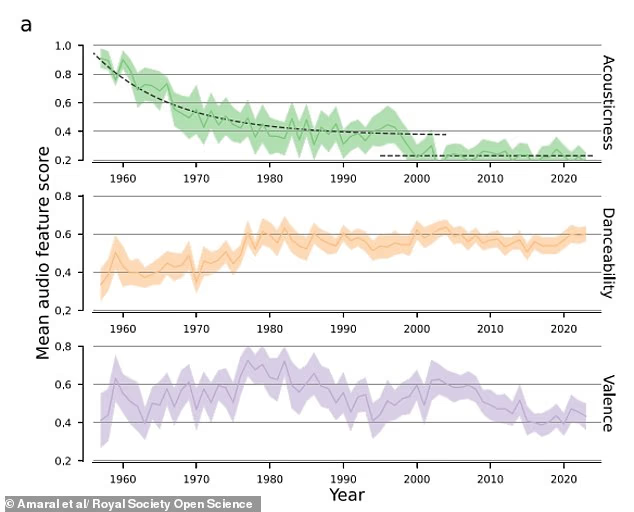
They found a combination of English lyrics, pop and danceability are the key for success in recent decades.
‘We have revealed the generalized adoption of strategies that increase song competitiveness: use of English language, increased danceability, increased use of Pop styles, more diverse lyrics and the focus on themes that better capture the cultural Zeitgeist,’ they said.
The BBC has selected experimental musician and YouTuber ‘Look Mum No Computer’ – originally called Sam Battle – as this year’s entry. He will take to the stage in Vienna in May in a bid to win over Europe’s votes.
But does his song ‘Eins, Zwei, Drei’ stand a chance? Here, we analyse how it stacks up against the formula.
The experts found danceability – along with English lyrics and being a pop song – was part of the winning formula

The BBC has selected experimental musician and YouTuber ‘Look Mum No Computer’ – originally called Sam Battle – as this year’s entry
English
‘English has been adopted as the lingua franca (common language) of the competing songs,’ the team, from Northwestern University, said.
But as the name suggests, the UK’s song entry – ‘Eins, Zwei, Drei’ – is not completely English.
While the majority of lyrics are in standard English, they are interspersed with the regular count of ‘one, two, three’ in the German language.
This mix of languages gives the song a quirky feel – and might even help it resonate with German viewers.
Pop
The song is distinctly unconventional, with the heavy use of synthesisers, shouted vocals and humorous lyrics.
While ‘Look Mum No Computer’ is predominantly an electronic act, critics have described the song as ‘an 80s–inspired synth–pop song with Britpop influences, featuring pulsing electronic instrumentation and lyrics about escaping the monotony of everyday work’.

Look Mum No Computer said it was ‘bonkers’ to be part of Eurovision after being a fan of the contest for many years

In recent years Eurovision songs have becoming predominantly English, compared to previous years when the French language dominated
Danceability
‘Danceability is based on a combination of musical elements – including tempo, rhythm stability, beat strength and overall regularity – relating to whether one can dance easily to the song or not,’ the researchers wrote in the journal Royal Society Open Science.
The song has a tempo of about 127 beats per minute, which sits within the sweet spot for dancing.
Experts have described it as ‘high energy’ and ‘very danceable’ with ‘catchy beats’ – which sounds promising for its prospects.
‘The danceability of top performing songs is a statistically significant attractor,’ the researchers explained.
Diverse lyrics & focus on themes
The song includes lines like ‘so sick of munching roly–poly with custard’, ‘kill at karaoke’ and ‘a slice of pepperoni’ – which arguably make it diverse.
Meanwhile overarching themes such as burnout, escapism and food cravings run throughout, and could feasibly describe the prevailing mood of the nation.
After his involvement was announced on BBC Radio 2’s Breakfast Show, Look Mum No Computer said it was ‘bonkers’ to be part of Eurovision after being a fan of the contest for many years.
He launched his career in 2014 as Sam Battle, the frontman of the indie rock band ZIBRA.
The band performed at Glastonbury in 2015 for BBC Introducing, and since then he has launched his flourishing solo career indulging his passion for electronic and synth sounds.
Kalpna Patel–Knight, Head of Entertainment at the BBC said: ‘We are absolutely thrilled to have Look Mum No Computer representing the UK at Eurovision in Vienna in 2026.
‘His bold vision, unique sound and electric performance style make him a truly unforgettable artist.
‘Look Mum No Computer’ embodies everything the UK wants to celebrate on the Eurovision stage – creativity, ambition, and a distinctly British wit. I am sure he will make us all proud on the international stage in May.’