Every tree, flower and blade of grass will one day wither and die – and scientists now believe they have worked out when that bleak moment will arrive.
According to a new study, our planet’s plant life will end in around 1.8 billion years as the sun grows steadily hotter.
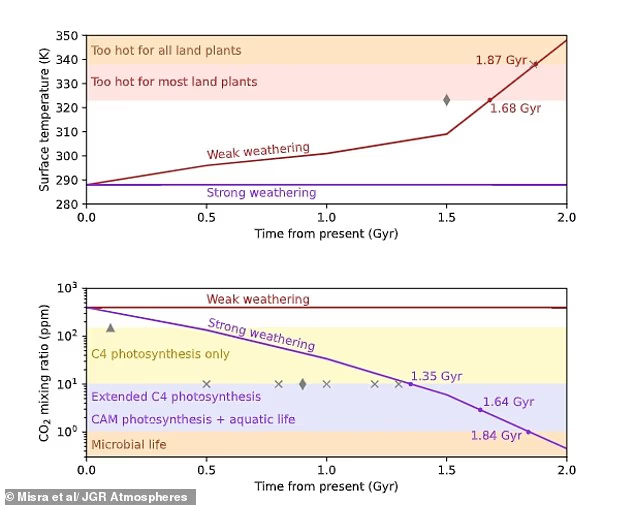
The increasing heat will eventually make the Earth too warm for most vegetation to survive, while falling carbon dioxide levels could starve plants of the gas they need to photosynthesize.
The last to cling on will likely be cacti and other plants adapted to drought, they revealed.
But it’s unlikely anyone will be around to witness it – as humans and other animal life are expected to have died out long before.
‘The ultimate life span of Earth’s biosphere is limited due to the steady brightening of the sun as it progresses in age,’ the researchers wrote in the journal JGR Atmospheres.
‘In this study, we use a three‐dimensional computational climate model to calculate scenarios of Earth’s future climate with increasing sunlight and decreasing carbon dioxide.
‘Earth’s vegetative biosphere could survive up to about 1.8 billion years from now, about the same time that Earth would lose its oceans to space.’
According to a new study, our planet’s plant life will end in around 1.8 billion years as the sun grows steadily hotter and carbon dioxide levels drop

The increasing heat will eventually make the Earth too warm for most vegetation to survive, the researchers said
For the study the team, from the University of Colorado Boulder and Blue Marble Space in Seattle, used a sophisticated climate model to simulate how Earth’s environment will change over the next two billion years as the sun gradually becomes brighter.
Unlike many previous studies, the model accounted for changes in temperature, clouds, rainfall, oceans and atmospheric circulation, providing a more realistic picture of the planet’s future.
The researchers tested two extreme scenarios – one in which carbon dioxide steadily falls as rocks absorb more of it, and another in which it remains roughly constant while Earth simply becomes hotter.
They also explored how different types of plants would respond as temperatures rose and atmospheric carbon dioxide became increasingly scarce.
Their calculations suggest that Earth’s vegetative biosphere could survive for as long as 1.8 billion years—hundreds of millions of years longer than many earlier estimates.
The team found that some hardy plants, including those using a specialised form of photosynthesis, may be able to survive even after carbon dioxide levels become too low for most vegetation.
In another possible future, rising temperatures rather than a lack of carbon dioxide would eventually become the main factor wiping out plant life.
Overall, the researchers concluded that plant life could persist almost until Earth begins to lose its oceans and becomes permanently uninhabitable as the ageing sun continues to brighten.

The last plants to cling on will likely be cacti and other species adapted to drought (stock image)
The modelling was carried out without accounting for any evolution in plant life or any potential technological advances made by humans.
Both of these factors could influence how long plants survive on Earth, the team said.
‘We can imagine a scenario in which plants evolve the ability to regulate their temperature and pressure, perhaps in response to changing climates,’ the researchers wrote.
‘As the sun brightens, plants may favour an aerial environment and adapt accordingly, spreading to high‐altitude terrain and into the stratosphere and beyond.
‘From Earth’s upper atmosphere, life could continue to disperse to low‐gravity objects like comets and the Moon as well as into free‐floating space.’
Scientists are already considering a range of methods to ‘dim the sun’, including by spraying reflective aerosols into the upper atmosphere. However, the consequences of these risky strategies are not yet fully understood.
To conclude, the researchers said: ‘Life on Earth is resilient, and limits posed by thermal stress or carbon dioxide starvation may only reflect our observations of the biosphere today rather than hard limits on how the biosphere may evolve.
‘We suggest that the default story for our planet’s future is that life will survive at least as long as Earth.’
WHAT WILL HAPPEN TO EARTH WHEN THE SUN DIES?
Five billion years from now, it’s said the Sun will have grown into a red giant star, more than a hundred times larger than its current size.
Eventually, it will eject gas and dust to create an ‘envelope’ accounting for as much as half its mass.
The core will become a tiny white dwarf star. This will shine for thousands of years, illuminating the envelope to create a ring-shaped planetary nebula.

Five billion years from now, it’s said the Sun will have grown into a red giant star, more than a hundred times larger than its current size
While this metamorphosis will change the solar system, scientists are unsure what will happen to the third rock from the Sun.
We already know that our Sun will be bigger and brighter, so that it will probably destroy any form of life on our planet.
But whether the Earth’s rocky core will survive is uncertain.