The Federal Reserve is expected to wrap up its latest meeting on Wednesday with interest rates unchanged at a range of 3.5 percent to 3.75 percent. It will be the fourth meeting in a row in which the central bank has voted to maintain its current policy settings, but the circumstances surrounding the decision are now entirely different.
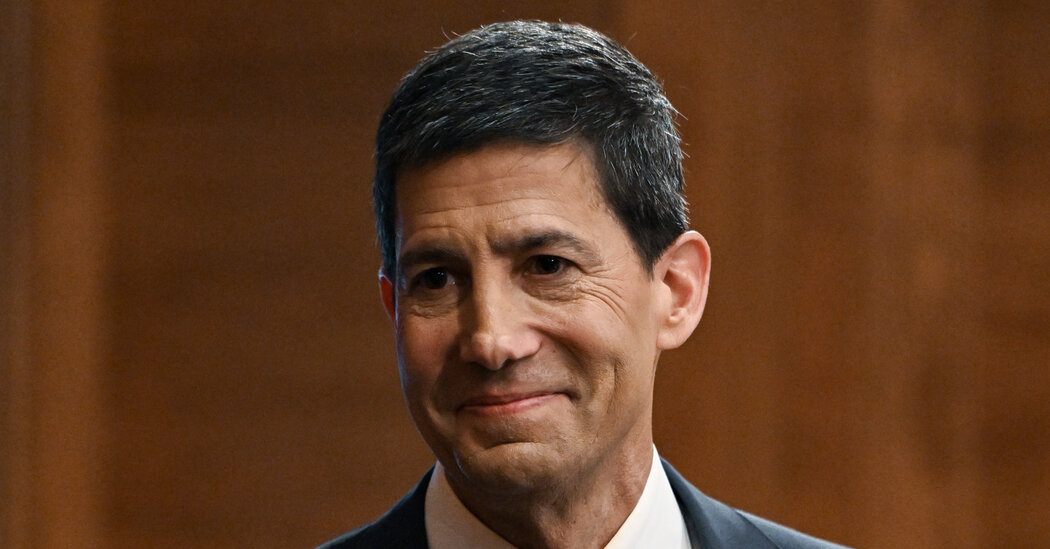
The Fed has a new chairman, Kevin M. Warsh, who has vowed to lead a “reform-oriented” institution. There is a tentative deal in place to end the war with Iran, which has been a source of worry for officials given its impact on inflation. And the labor market has shown unexpected signs of strength.
On Wednesday, the Fed will release a fresh policy statement alongside its rate decision at 2 p.m. in Washington. It will also publish its latest economic projections, including a revised “dot plot” mapping where policymakers see rates going over the coming years. Mr. Warsh will hold his first Fed news conference at 2:30 p.m.
Here is what to watch for:
Goodbye Guidance?
One of Mr. Warsh’s longstanding criticisms of the Fed is that its officials speak too frequently and focus too narrowly on sending near-term policy signals in the form of “forward guidance.” He wants the Fed to stop conveying what it might do next and instead communicate publicly only when there is something noteworthy to say.
“Truth-seeking is more important than repetition,” he said at his Senate confirmation hearing in April. “If one has a press conference, one wants to deliver some important news.”
Mr. Warsh on Wednesday could shift the Fed in this direction in two distinct ways. The first comes in the form of the policy statement. The most recent version from the April meeting contained a specific phrase that detailed the conditions under which the Fed would lower rates again.
“In considering the extent and timing of additional adjustments to the target range for the federal funds rate, the Committee will carefully assess incoming data, the evolving outlook and the balance of risks,” the statement said, referring to the policy-setting Federal Open Market Committee.
Three members of the committee issued a formal dissent against this aspect of the statement, arguing instead that the central bank should make more explicit that a rate increase was just as feasible as a rate cut. Since then, several other policymakers have endorsed the Fed adopting more neutral language in recognition that inflation is moving further from the central bank’s 2 percent target.
This phrase is likely to be removed altogether from the statement on Wednesday, reflecting in part Mr. Warsh’s opposition to the Fed sending any signals about its forthcoming policy decisions.
The second shift could come in the form of the dot plot, which Mr. Warsh has repeatedly denounced for limiting the central bank’s ability to pivot when the economic backdrop changes.
“The Fed tells the whole world what their dots are going to be, what their forecasts are going to be,” he said at his confirmation hearing. “Well, the Fed’s human and then they hold on to those forecasts longer than they should.”
The Fed is still expected to publish a revised set of economic projections, but it could include one less set of estimates if Mr. Warsh opts against submitting his own.
Regardless of what he chooses to do, most officials are expected to scale back their expectations for rate cuts compared with three months ago. Back then, the median estimate indicated support for one quarter-point reduction. Already at that point, seven of the 19 policymakers penciled in no change for the remainder of the year.
More officials are likely to join this cohort on Wednesday, while a number of others are set to pencil in at least one rate increase by year-end.
Inflation and the Iran War
The case for immediate cuts evaporated once the war with Iran broke out. As of May, the ensuing energy shock lifted inflation to a three-year high. Price pressures so far have remained relatively contained to sectors most exposed to surging oil prices, such as transportation and shipping. But the surge has left officials on guard to the prospects that elevated inflation could broaden out.
The announcement of a preliminary deal on Sunday, and the expected resumption of shipping activity through the crucial Strait of Hormuz, will no doubt help to offset concerns. The price of Brent crude, the global benchmark for oil, on Tuesday fell below $80 a barrel for the first time since the early days of the war.
That is likely to alleviate mounting pressure on inflation expectations, which the Fed tracks closely for any indication that Americans are losing faith in the central bank’s commitment to 2 percent inflation. Market measures indicate that this has not yet happened, even though the Fed has missed this target for five years.
Compared with three months ago, officials are likely to mark their forecasts for inflation up significantly in the latest projections.
All eyes will be on Mr. Warsh and how he talks about the inflation problem ahead for the Fed. He has in the past criticized the Fed for how it thinks about inflation, instead emphasizing the importance of alternative measures that strip out volatile outliers.
“What I’m most interested in is what’s the underlying inflation rate, not what’s the one-time change in prices because of a change in geopolitics or a change in beef,” he said at his confirmation hearing.
‘Reform’ Agenda
Changes to the way the Fed communicates publicly and measures inflation are just two ideas that Mr. Warsh has floated as part of his plan to lead a “reform-oriented” institution.
While campaigning for the job, Mr. Warsh said the central bank was in need of “regime change,” a term that has caused consternation for people inside and outside the Fed, who argue that the institution is not in need of a major overhaul.
Among Mr. Warsh’s other priorities include a rethink of the Fed’s interventions in financial markets and its $6.7 trillion portfolio of government bonds and mortgage-backed securities. He has argued that, in buying these assets, the Fed has stoked inflation, worsened inequality and distorted the process of how financial markets are priced.
Mr. Warsh not only wants the Fed to maintain a smaller balance sheet but also for there to be closer coordination with the Treasury Department on what the Fed holds in its portfolio and what the government issues in terms of debt to fund itself. On Wednesday, Mr. Warsh is likely to be asked about his plans to shrink the Fed’s holdings, especially given that the central bank has since December been buying short-dated Treasuries to ensure that there is enough cash circulating in the financial system.
He will also be asked about how exactly he will structure an “accord” with the Trump administration, which has taken aggressive steps to encroach on the Fed’s independence. That includes trying to oust a sitting Fed governor, Lisa D. Cook, as well as launching a criminal investigation into Jerome H. Powell, Mr. Warsh’s predecessor. Mr. Powell in April announced that he would stay on as a governor, a position he can hold until January 2028, to help to protect the institution from additional attacks by President Trump.
Mr. Warsh has in the past spoken directly about the importance of the Fed’s independence as it relates to setting rates. But his proximity to Mr. Trump, and the president’s earlier claim that he would only select someone to lead the Fed who supported rate reductions, have forced Mr. Warsh to defend his credibility.