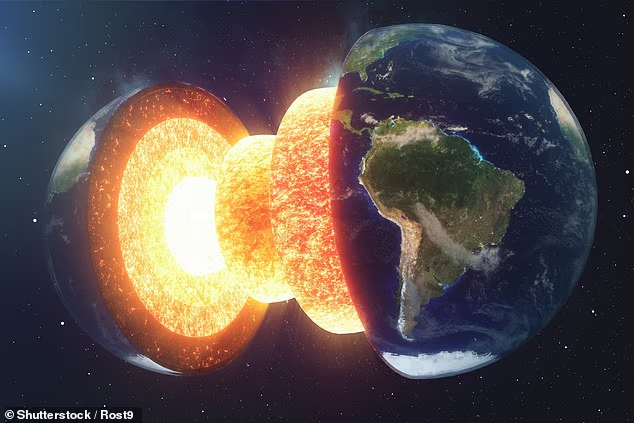
Earth’s inner core is filled with a rare material known as ‘extreme hydrogen’, a study has claimed.
This bizarre substance, known as super–ionic hydrogen, behaves unlike anything found on the surface.
At the extreme pressures found 3,200 miles (5,100 km) beneath the surface, this otherworldly version of hydrogen flows like a liquid through solid iron and even conducts electricity.
Now, researchers say that this flow of extreme hydrogen could play an important role in shaping the magnetic field that makes life on Earth possible.
Although scientists have long suspected there might be hydrogen in the inner core, it has proven challenging to work out exactly how it is distributed.
In their new paper, published in the journal PNAS, the researchers used quantum–mechanical simulations to model how hydrogen might behave in the extreme conditions of the inner core.
They discovered that super–ionic hydrogen isn’t evenly distributed, but is most likely concentrated right on the boundary between the inner and outer core.
At temperatures of 5,226°C (5,500 K), hydrogen makes up 16 per cent of the atoms in the inner–core boundary, dropping to around nine per cent near the centre.
Scientists say that Earth’s solid inner core could be hiding a bizarre form of ‘extreme hydrogen’ that is unlike anything found on the surface
The 102 quintillion–tonne sphere of iron alloy that makes up our planet’s innermost core is one of the most extreme environments in the solar system.
More than 3,000 miles beneath the surface, the core is crushed by more than 3.3 million atmospheres of pressure and heated to temperatures close to the surface of the sun.
This unique part of the planet also has a number of strange and contradictory properties that have baffled scientists for decades.
Scientists know that the planet’s innermost core is made of superheated iron, kept solid by the extreme pressures 3,200 miles (5,100km) beneath the surface.
However, in many other ways, the inner core behaves as if it were almost molten.
Shockwaves from earthquakes passing through the inner core are slowed, and it displays a level of malleability that is closer to butter than steel.
This suggests that there should be some lighter elements mixed in, which allow the inner core to combine the properties of both solids and liquids.
Hydrogen is one of the most likely elements to play this role, since it was common in the universe when Earth formed and can dissolve into iron under the right conditions.

This ‘superionic hydrogen’ is concentrated at the boundary between the solid inner core and molten outer core, where it could make up 16 per cent of the atoms present
At extreme heat and pressure, hydrogen atoms will flow freely through a crystal lattice of iron atoms, which would explain the inner core’s strange seismic properties.
Since humans can’t travel to the inner core to study this strange phenomenon, and the conditions are impossible to recreate in the lab, researchers have used computer simulations to learn more.
They wanted to see what kinds of crystal structures would be the most stable in the inner core and how that would affect the spread of hydrogen.
Their simulations showed that the inner core’s solid iron most likely takes on a shape called a ‘hexagonal close–packed’ crystal structure.
Scientists had thought it could have been squished into another shape called a body–centred cubic (BCC) phase, crystals shaped like cubes with atoms at the corners and one trapped in the centre.
However, these cubes only became stable at temperatures so extreme that they would melt the crystals back into a liquid – meaning they wouldn’t exist in practice.
The authors write: ‘Our calculations show that hydrogen can stabilize a superionic BCC phase at sufficiently high temperature and hydrogen content. However, this stability field is superseded by melting.’
These simulations also revealed the way that hydrogen moves between the solid inner core and the liquid outer core.

The scientists found that the hotter the core is (x–axis), the more strongly the hydrogen tends to stay in the outer core rather than in the solid inner core (y–axis)
As the inner core grows and crystallises, the researchers believe that superionic hydrogen migrates to the outer boundary before passing into the liquid beyond.
Previous studies have suggested that this atomic movement could create ‘buoyancy’ in the liquid outer core, driving the churn of liquid metal responsible for creating Earth’s magnetic field.
Without the magnetic field, Earth’s surface would be bombarded by harmful cosmic radiation that would make it impossible for life to develop.
That means the movement of this extreme hydrogen could be a critical part of the energy sources that keep the planet’s life–preserving shield intact.