Wednesday, August 26, 2026
No Result
View All Result
LJ News Opinions
  • Home
  • U.S.
  • Politics
  • World News
  • Business
  • Entertainment
  • Sports
  • Technology
  • Health
  • Opinions
  • Home
  • U.S.
  • Politics
  • World News
  • Business
  • Entertainment
  • Sports
  • Technology
  • Health
  • Opinions
No Result
View All Result
LJ News Opinions
No Result
View All Result
Home Technology

What D-Day looked like from space: Scientists recreate satellite image of the moment 160,000 troops crossed the Channel and stormed the beaches of Normandy

by LJ News Opinions
August 26, 2026
in Technology
0
Share on FacebookShare on Twitter


Thick cloud hung over France and the Channel on the morning of D-Day as one of the largest and most dangerous seaborne invasions in history got underway, new images reveal.

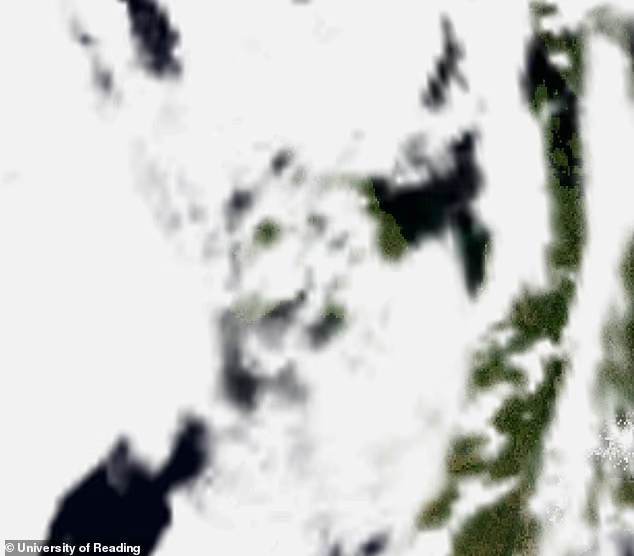
Scientists have turned weather records from 1944 into a recreation of what the world might have looked like from space as 160,000 troops stormed the beaches of Normandy.

It shows cloud stretching across Britain and much of the Channel with patches of southern England and northern France starting to peek through, indicating the sky was clearing.

And just in time – as the mission could have failed if the storm had not eased off.

The weather was crucial to the success of D-Day because the Allied invasion force relied on a rare combination of conditions, including low tide, moonlight and relatively calm seas.

Professor Ed Hawkins, climate scientist at the University of Reading, co-created the images with scientists from the European Centre for Medium-Range Weather Forecasts (ECMWF).

‘Troops set off into a sky that was still breaking up after days of storms into a narrow window of better weather,’ he said.

‘A day earlier, or a few hours either way, and the weather could have stopped the invasion in its tracks and changed the outcome of the war.’

In the early hours of June 6 1944, thick cloud covered southern France and the Channel (left). Pictured: A recreation of cloud cover at midnight 

However, there was a small break in the clouds later that morning, allowing the Allied forces to mount a successful invasion. Pictured: The clouds clearing six hours later

However, there was a small break in the clouds later that morning, allowing the Allied forces to mount a successful invasion. Pictured: The clouds clearing six hours later

On the advice of military planners and meteorologists, D-Day was initially set for June 5.

More than 5,000 ships carrying troops, tanks and supplies were assembled in southern England, ready to launch the largest amphibious invasion in history.

In the days leading up to it, Allied commanders anxiously monitored weather forecasts as powerful storms battered the English Channel.

The stormy weather forced General Dwight D. Eisenhower to postpone the landings by 24 hours.

But a brief break in the conditions on June 6 gave troops their chance to cross the English Channel and reach the beaches of Normandy.

The Germans, believing bad weather made an invasion unlikely, were caught off guard when Allied soldiers landed as part of the enormous seaborne assault.

The new satellite images were built using old weather readings fed into a modern weather reconstruction.

This filled in the gaps between real measurements to recreate a full picture of the sky.

This global satellite recreation shows just how far the cloud cover reached - revealing just how narrow the margin was between success and failure

This global satellite recreation shows just how far the cloud cover reached – revealing just how narrow the margin was between success and failure

A U.S. Army landing craft approaches Omaha Beach on June 6, 1944, where the heaviest fighting took place and thousands were gunned down on both sides

A U.S. Army landing craft approaches Omaha Beach on June 6, 1944, where the heaviest fighting took place and thousands were gunned down on both sides

Why clear weather mattered on D-Day

Calmer seas: Rough waters could swamp landing craft, make soldiers seasick and hinder the delivery of tanks, vehicles and supplies to the beaches.

Airborne operations: Thousands of paratroopers were dropped behind enemy lines before dawn. Clearer skies helped pilots navigate and deliver troops closer to their targets.

Naval bombardment: Good visibility allowed Allied warships to accurately target German gun emplacements, bunkers and coastal defences before the landings began.

Moonlight and tides: The invasion required a specific combination of moonlight for airborne troops and a low tide that would expose German beach obstacles for engineers to clear.

Air support: Fighter planes and bombers needed sufficient visibility to attack German positions and protect the invasion fleet crossing the English Channel.

‘Images like this help us understand what troops, sailors and pilots actually faced that day, in a way written reports alone cannot,’ Professor Hawkins said.

‘They show just how narrow the margin was between success and failure, and how much was riding on a small break in the cloud.’

The remarkable true story behind the weather forecast that helped shape history is the focus of an upcoming film called Pressure.

The film, which explores the pivotal decision to delay the Allied invasion, stars Andrew Scott as Group Captain James Stagg, the meteorologist who advised Supreme Allied Commander General Dwight D. Eisenhower, and Brendan Fraser as Eisenhower.

The synopsis reads: ‘In the 72 hours leading up to D-Day, all the pieces are in place except for one key element – the British weather.

‘Britain’s chief meteorological officer James Stagg (Andrew Scott) is called upon to deliver the most consequential forecast in history, locking him into a tense standoff with the entire Allied leadership.

‘The wrong conditions could devastate the largest ever seaborne invasion, while any delay risks German intelligence catching on.

‘With only his trusted aide Captain Kay Summersby (Kerry Condon) to confide in, and haunted by a catastrophic D-Day rehearsal, the final decision rests with Supreme Allied Commander Dwight D. Eisenhower (Fraser). With only hours to go, the fate of the war and the lives of millions hang in the balance.’

The remarkable true story behind the weather forecast that helped shape history is the focus of an upcoming film called Pressure (pictured)

The remarkable true story behind the weather forecast that helped shape history is the focus of an upcoming film called Pressure (pictured)

In the weeks before D-Day, Allied forces carried out a major rehearsal known as Exercise Tiger off the coast of Devon.

Disaster struck when German E-boats attacked a convoy of American landing ships in Lyme Bay, killing 749 US soldiers and sailors.

The tragedy was kept secret to avoid alerting the Germans to the invasion plans.

But it exposed serious communication and co-ordination problems that commanders worked to fix before the Normandy landings.

The final push to defeat Adolf Hitler: How D-Day began the chain of events that led to the end of WWII

Waged across every inhabited continent, the Second World War was the most costly conflict in history, claiming the lives of around 57 million people.

By 1944, the tide was turning against the Nazis, particularly after the successful D-Day landings of June that year.  

Following Germany’s defeat during the Battle of the Bulge in January 1945, the surviving troops limped back to the Rhine to defend the frontier. They were eventually dislodged by a major Allied attack involving a million men.   

This is a timetable of the main events: 

1944

January 22: British and American troops land at Anzio.

June 4: Rome falls to the Allies.

June 6: D-Day invasion begins on the beaches of Normandy in the famous Operation Overlord.

June 13: First V-1 bombs land on London.

July 20: Bomb plot against Hitler narrowly fails.

August 15: Allies invade the South of France.

August 20: Battle of Normandy ends with the closing of the Falaise Pocket. Advance to the River Seine begins.

August 25: Paris is liberated.

September 3: Brussels is liberated.

September 17-26: Operation Market Garden, the “Bridge Too Far” airborne mission to cross the Rhine at Arnhem, fails with the loss of around 18,000 Allies.

October 5: British forces land in Greece.

December 16: German offensive in the Ardennes region launches Battle of the Bulge.

1945

January 17: Russian forces capture Warsaw.

January 27: Auschwitz concentration camp is liberated by Russian troops and the full horrors of Nazi Germany and the Holocaust slowly emerge.

January 28: The final shots are fired in the Battle of the Bulge, giving victory to the Allies, but at a heavy cost in men and equipment.

February 13: RAF launches carpet bombing raid on Dresden, followed by three further raids by US Air Force.

March 23 to 24: A million Allied troops cross the Rhine during Operation Plunder. 

April 12: US President Franklin Roosevelt dies.

April 30: With Soviet troops marching on the Reich Chancellory in the heart of Berlin, Hitler commits suicide in his Berlin Fuhrerbunker – shooting himself in the head as he bites on a cyanide pill.

May 1: Hitler’s propaganda minister Joseph Goebbels and his wife kill themselves.

May 2: German forces in Italy surrender.

May 4: Montgomery receives surrender of German forces in Holland, north-west Germany and Denmark on the Luneberg Heath.

May 8: Victory in Europe Day (VE Day) as Admiral Karl Donitz, appointed President by Hitler before his death, unconditionally surrenders.

May 9: Nazi Field Marshal Wilhelm Keitel signs unconditional surrender to Red Army in Berlin.

August 6: “Little Boy” atomic bomb is dropped on Hiroshima by US B-29 bomber Enola Gay.

August 9: “Fat Man” atomic bomb is dropped on Nagasaki.

August 14: Emperor Hirohito announces unconditional surrender of Japan and papers are signed on board the USS Missouri in Tokyo Bay.

August 15: Victory over Japan Day (VJ Day), or VP Day (Victory in the Pacific) is celebrated. 

Source link

Tags: dailymailsciencetech
LJ News Opinions

LJ News Opinions

Next Post

What led to 49ers owner Jed York's arrest, according to authorities

Recommended

A U.S. Coast Guard Search and Rescue helicopter flying over a river area.

US Marine missing off Southern California coast during training exercise

2 months ago

Who is Ghassan al-Duhaini, Abu Shabab’s successor? | Israel-Palestine conflict News

9 months ago

Popular News

    Connect with us

    LJ News Opinions

    Welcome to LJ News Opinions, where breaking news stories have captivated us for over 20 years.
    Join us in this journey of sharing points of view about the news – read, react, engage, and unleash your opinion!

    Category

    • Business
    • Entertainment
    • Health
    • Opinions
    • Politics
    • Sports
    • Technology
    • U.S.
    • World News

    Site links

    • Home
    • About us
    • Contact

    Legal Pages

    • Privacy Policy
    • Cookie Privacy Policy
    • Terms of Use
    • Disclaimer
    • California Consumer Privacy Act (CCPA)
    • DMCA
    • About us
    • Advertise
    • Contact

    © 2024, All rights reserved.

    No Result
    View All Result
    • Home
    • U.S.
    • Politics
    • World News
    • Business
    • Entertainment
    • Sports
    • Technology
    • Health
    • Opinions

    © 2024, All rights reserved.