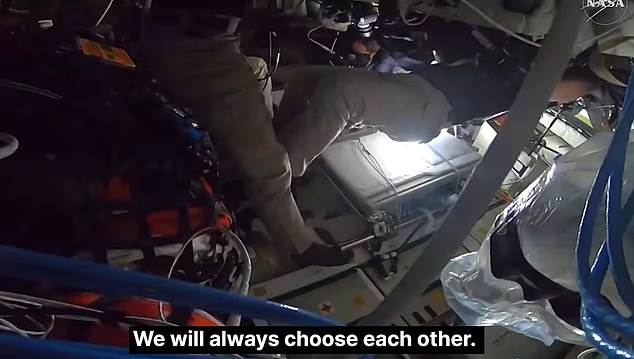
The Artemis II astronauts shared a heartwarming first message as they began the 250,000–mile (402,300 km) journey home.
NASA astronauts Reid Wiseman, Victor Glover and Christina Koch, along with Canadian astronaut Jeremy Hansen, became the first people to travel around the far side of the moon in over 50 years yesterday evening.
As they slipped behind the moon, the Orion crew capsule briefly lost contact with Earth during a planned radio blackout.
After 40 nerve–wracking minutes of silence, Christina Koch re–established contact with NASA mission control, saying: ‘It is so great to hear from Earth again.’
Ms Koch continued: ‘To Asia, Africa, and Oceania, we are looking back at you. We hope you can look up and see the moon right now. We see you too.
‘When we burned this burn towards the moon, I said that we do not leave Earth, but we choose it. And that is true.
‘We will explore, we will build, we will build ships, we will visit again. We will construct five outposts, we will drive rovers, we will do radio astronomy, we will found companies, we will bolster industry, we will inspire.
‘But ultimately, we will always choose Earth, we will always choose each other.’
The Artemis II astronauts shared a heartwarming first message as they began the 250,000–mile (402,300 km) journey home

NASA astronaut Christina Koch (front) told mission control ‘we will always choose Earth, we will always choose each other’
During their six–hour lunar flyby, the Artemis II reached a staggering 252,756 miles (406,771 km) from Earth, surpassing the distance achieved by the Apollo missions and setting a new record.
In doing so, they became the first humans in half a decade to witness the far side of the moon with the naked eye.
From their position 41,072 miles (66,098 km) above the lunar surface, the moon appeared about as large as a basketball held at arm’s length.
However, to make this daring journey, the crew had to endure a period of isolation as the bulk of the moon briefly blocked incoming radio signals from Earth.
During this time, the astronauts continued along their pre–programmed flight path without real–time guidance from Mission Control, relying entirely on onboard systems.
Just before the ‘loss of signal’ began at 6.43 pm ET, Pilot Victor Glover shared a message for Earth: ‘As we prepare to go out of radio communication, we’re still going to feel your love from Earth.
‘And to all of you down there on Earth and around Earth, we love you, from the Moon. We will see you on the other side.’
During the tense silence that followed, NASA mission controllers and the astronauts’ friends and families waited anxiously for the crew to reappear.

During their six–hour lunar flyby, the Artemis II crew briefly lost connection with Earth as the bulk of the moon blocked out radio signals. Pictured: A view of the far side of the moon during the lunar flyby
When the signal finally reconnected, there was another long silence before the voice of Ms Koch revealed that all was well aboard the Orion capsule.
Jenni Gibbons, the capsule communicator in Mission Control, marked the milestone by sending a special message to Wiseman, Koch, Glover and Hansen.
Before launch, the astronauts left mission patches with flight controllers in Houston.
One side of the patch featured the Artemis II logo, showing Earth in the foreground with the moon in the distance.
Now, as Orion rounds the moon, mission controllers symbolically flip the image, placing the moon in the foreground and Earth in the distance, to reflect the crew’s journey to the far side and back.
‘All of your flight controllers and your flight director have flipped their Artemis II patches around. We are Earthbound and ready to bring you home,’ Ms Gibbons said.
With the most fraught part of the historic mission safely over, NASA administrator Jared Isaacman shared a statement on X, saying: ‘Before they left, they said they hoped this mission would be forgotten, but it will be remembered as the moment people started to believe that America can once again do the near–impossible and change the world.
‘Congratulations to this incredible crew and the entire NASA team, our international and commercial partners, but this mission isn’t over until they’re under safe parachutes, splashing down into the Pacific.’

During the flyby, the astronauts took pictures of the moon, sketched what they saw, and made audio recordings of their observations. Pictured: Victor Glover looks out on the moon ahead of the flyby
As the astronauts passed by the far side of the moon, the crew recorded as much as they could about the surface below, taking photographs, sketching, and making audio recordings of their own observations.
The Moon’s far side looks very different from the familiar near side, with heavily cratered terrain, a thicker crust and far fewer of the dark volcanic plains visible from Earth.
As the astronauts swept over the far side in the Orion capsule, they reported seeing striking geometric patterns, winding formations they called ‘squiggles’ and unexpected shades of green and brown across the rugged lunar terrain.
Although satellites have taken images of the moon’s far side, some of these features have never been seen by the human eye.
In particular, astronauts spotted newly formed craters on the lunar surface that stand out like tiny holes in a lampshade.
Ms Koch told the NASA control room: ‘All the really bright, new craters, some of them are super tiny, most of them are pretty small, there’s a couple that really stand out, obviously, and what it really looks like is a lampshade with tiny pinprick holes and the light shining through.’
Canadian astronaut Jeremy Hansen made a special request to NASA mission control to name two of these new craters that they had ‘observed, both with our naked eye and with our long lens’.
The first he asked to name Integrity, after the name the astronauts have given to their Orion crew capsule, and the other Carroll, to commemorate Reid Wiseman’s late wife, who died of cancer in 2020.

The crew embraced each other after deciding to name a new crater Carroll, to commemorate Reid Wiseman’s late wife, who died of cancer in 2020.
Ms Hansen said in an emotional tribute: ‘A number of years ago we started this journey… and we lost a loved one and there’s a feature on a really neat place on the moon… at certain times of the Moon’s transit around Earth we will be able to see this from Earth.’
The announcement prompted the astronauts to embrace, while mission control in Houston fell silent in a rare moment of reflection.
Having passed the moon, the Orion crew capsule will now ride the tug of Earth’s gravity back home over the coming days, with splashdown expected on Friday.
Their final ordeal will be a blazing re–entry into the planet’s atmosphere, as the capsule hits the atmosphere at around 25,000 miles per hour (40,200 km/h) before deploying its parachutes and landing in the Pacific Ocean.