
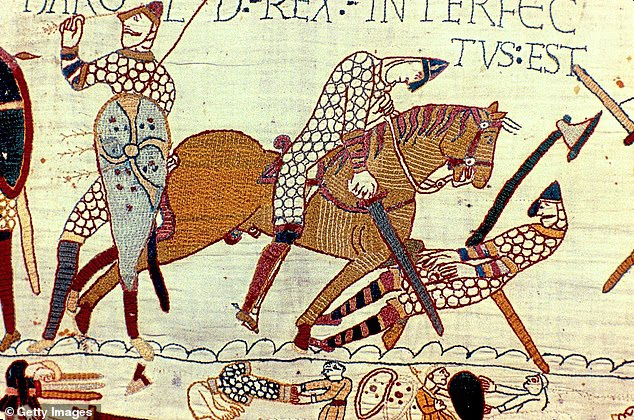
It’s a question that has been debated by historians for centuries: was Harold II really shot in the eye during the Battle of Hastings?
Some experts are certain he did, using a famous scene from the Bayeux Tapestry as evidence.
However, others have poured cold water on the theory, and are adamant that the king’s death by arrow is a lie.
Now, as the Bayeux Tapestry goes on display at the British Museum, its curator has settled the debate once and for all.
Professor Michael Lewis, Curator of The Bayeux Tapestry and former Head of Portable Antiquities and Treasure at the British Museum has shot down the theory – and claims the arrow stitching in the scene was ‘certainly’ added later.
Speaking on BBC Radio 4’s Today programme, he explained: ‘It was certainly added later, in terms of what we have now.
‘The tapestry has been heavily restored in the 19th centrury, and that arrow in the eye has definitely been added. The question is, was it ever there in the first place?’
It’s a question that has been debated by historians for centuries: was Harold II really shot in the eye during the Battle of Hastings?

Now, as the Bayeux Tapestry goes on display at the British Museum, its curator has settled the debate once and for all
The Bayeux Tapestry is a 70–metre–long tapestry that depicts the events leading up to the Battle of Hastings and the Norman Conquest of England in 1066.
One of the most famous scenes shows the moment the Normans killed King Harold.
On the left of the scene you can see a man pulling an arrow from his eye, while on the right, you’ll see a man being cut down by a Norman invader on a horse.
Alongside the scene is the phrase ‘Harold rex interfectus est’, which translates to ‘King Harold is killed’.
Scholars have analysed the scene for years, and their theories can largely be split into three groups.
Some take the scene quite literally, and suggest that Harold really was shot in the eye with an arrow.
Others suggest that Harold is actually the next figure along – the man being cut down by a Norman invader.
Meanwhile, the third group think that both figures depict Harold in consecutive scenes.

France’s President Emmanuel Macron (L) and Britain’s King Charles III (R) attend a preview event for the Bayeux Tapestry Exhibition

The Tapestry is widely regarded as one of the world’s most important cultural treasures and contains 58 surviving scenes, 626 human figures and 202 horses, alongside depictions of ships, castles, weapons, animals and everyday life
‘Scholars are a bit divided about whether that figure with the arrow in the eye or the one that’s kind of been chopped down are Harold,’ Professor Lewis explained.
‘The problem with the arrow in the eye story is it comes around in the 13th century, so some people – myself included – think that originally Harold probably never had an arrow in his eye at all.’
Importantly, the Tapestry was conserved in 1982, at which point the backing fabric was taken off and the stitching studied carefully.
This allowed curators to see the extent of restorations and how they changed the imagery.
‘It seems that the first “Harold” figure originally held a spear,’ the British Museum explained on a blog.
‘This was denoted just by holes in the earliest drawings of the Tapestry by Bernard Montfaucon in the later 1720s.
‘However, when the Tapestry was drawn by Charles Stothard in about 1817, he joined the dots and added an arrow, probably because he knew the tradition of Harold’s death.
‘It’s likely his drawings then guided the later restorers.’
The Tapestry is widely regarded as one of the world’s most important cultural treasures and contains 58 surviving scenes, 626 human figures and 202 horses, alongside depictions of ships, castles, weapons, animals and everyday life.
The final section is missing, meaning the original work was even longer.
It begins in 1064, with Edward the Confessor sending Harold Godwinson to Normandy, and follows the events that eventually led to William, Duke of Normandy, invading England.
It culminates in the Battle of Hastings on October 14, 1066, where Harold was defeated and killed.
The work is generally believed to have been made in England in the 11th century, although exactly who created it remains uncertain.
Royston’s big brother: Epic history of the Bayeux Tapestry, which inspired the three-decade long effort

Nazi connections: Heinrich Himmler (pictured) coveted the Bayeux Tapestry because it is a part of Germanic history
1066: Between seven and twelve thousand Norman soldiers defeat an English army of a similar size at what is now Battle, East Sussex
1476: The embroidered cloth depicting the battle is referred to for the first time in an inventory of Bayeux Cathedral
1732-3: Antiquarian Smart Lethieullier writes the first detailed English account of the tapestry while living in Paris – but it is not published till 1767
1792: During the French Revolution, the precious artwork was declared public property and confiscated to be used as a covering for wagons – but it was saved by a lawyer who hid it in his home
1804: In a move dripping in symbolism, Napoleon – under the impression France was about to invade and conquer Britain – had the tapestry temporarily moved to Paris for display
1870: The tapestry is removed from Bayeux once again during the Franco-Prussian War – but it is moved back two years later
1944: The Gestapo removed the tapestry to the Louvre in Paris – just days before the German withdrawal. A message from Heinrich Himmler – who coveted the cloth because it is a part of Germanic history – is believed to imply the Nazis planned to take it to Berlin
1945: It was returned to Bayeux, where it has been ever since


