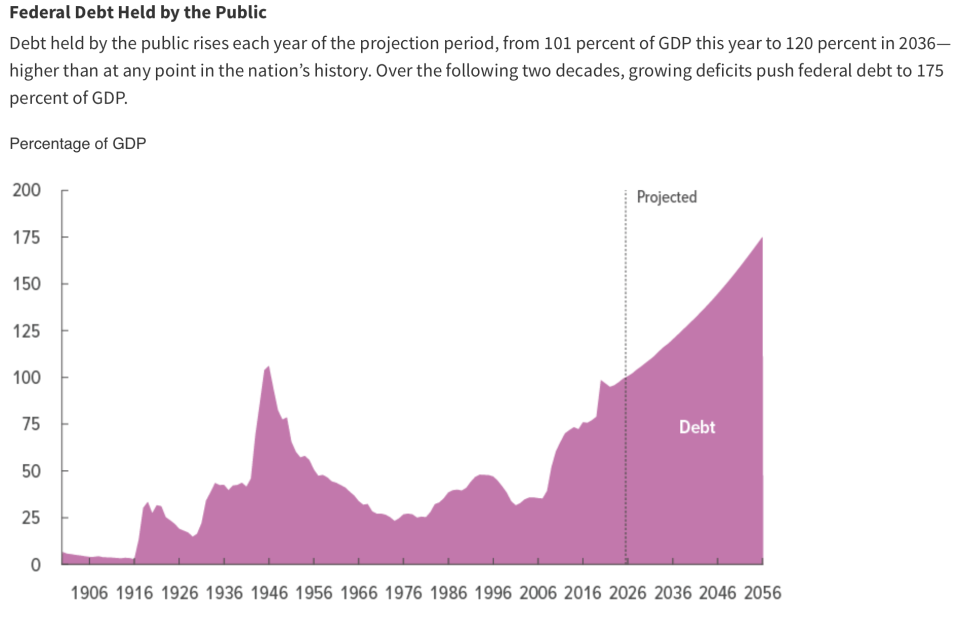
Soaring U.S. debt and projections that put it at astronomical levels in the coming years have set off increasing panic, though the precise level that sparks a crisis is unknown.
But the Penn Wharton Budget Model may have an answer: more than 210% of GDP.
Above that “outer bound” threshold, there’s no feasible tax on labor income that can finance interest payments on U.S. debt at returns acceptable to investors, PWBM warned in a report Thursday.
According to PWBM, the outer bound of federal debt is the solvency limit, beyond which defaulting on either Treasury debt or pay-as-you-go transfers like Social Security becomes a near certainty on an inflation-adjusted basis.
The debt-to-GDP ratio is about 100% today, and forecasts from the Congressional Budget Office see it hitting 175% by 2056—suggesting 210% is decades away on its current trajectory.
But depending on how much healthcare costs rise and boost Medicare spending, that threshold could come much sooner.
The U.S. has 25 more years in a lower-growth scenario, 22 years with medium growth, and 19 years with higher growth, PWBM estimated. But even that may downplay the risk.
“Under the historical growth rate of healthcare costs, there is a 25% chance of hitting the debt maximum in 14 years,” it added.
Fixing federal finances before it’s too late would require a permanent tax hike of about 15 percentage points on all labor income, the report said, meaning there would no longer be caps that exempt income above a certain level.
Other factors could also affect these calculations, such as higher interest rates, a smaller tax base, and labor-supply responses. Rising debt would inflict economic costs, like weaker wages, slower GDP growth, and less consumption.
Capital also becomes scarcer as debt sucks up money that would otherwise go to more productive investments. Meanwhile, sustained tariffs that reduce the inflow of international capital could shorten U.S. leeway by two to four years, PWBM said.
Two big assumptions are baked into the forecast as well. One is that capital market values are efficiently priced and not in bubble territory. But if they aren’t and there’s a sudden market crash, it would increase the overall debt-to-capital ratio, causing debt holders to demand higher yields that add further to debt interest costs.
The other assumption is that financial markets continue to believe Congress and the White House will eventually restore fiscal sustainability until that’s no longer mathematically possible. But once that faith is shaken, timelines shrink.
“Bond markets unravel sooner when investors believe that the government will not restore fiscal sustainability,” PWBM said.
To be sure, pinpointing the exact trigger for a U.S. debt crisis is tricky. That’s because the U.S. retains key advantages, such as the “exorbitant privilege” of the dollar in global finance, the world’s deepest bond market, and the largest economy.
Congressional Budget Office
Meanwhile, skeptics of debt doomsayers point to Japan’s debt, which already exceeds 200% of GDP, though that economy relies much more on domestic bond holders than the U.S. does.
At the same time, Japanese investors collectively own about $1 trillion in Treasuries and are the largest foreign holders of U.S. debt.
But that could change soon as the Bank of Japan has been hiking rates while hotter inflation has lifted Japanese government bond yields, which are now looking more attractive and emerging as an alternative to Treasury bonds.
There are already signs that money is being repatriated as March saw the largest monthly inflow ever into Japanese sovereign bond funds.
“The new money that’s being put to work won’t be put to work overseas,” Mark Dowding, chief investment officer at BlueBay, told the Financial Times. “It won’t be going into U.S. corporate bonds. It won’t be going into U.S. Treasuries. It will be going into those domestic allocations.”
In fact, the Treasury Department has seen a string of weaker bond auctions lately with tepid demand forcing yields to go higher as inflation looks to run higher for longer.
The bond market may also force lawmakers to finally get their house in order, perhaps within the next decade.
The expected insolvency of the Social Security and Medicare trust funds by 2034 will serve as a catalyst, Bernard Yaros, lead U.S. economist at Oxford Economics, said in a note last year.
But that doesn’t mean reform will come easily. To avoid causing voters financial pain, lawmakers may try to take the more politically expedient path by allowing Social Security and Medicare to tap general revenue that funds other parts of the federal government.
“However, unfavorable fiscal news of this sort could trigger a negative reaction in the US bond market, which would view this as a capitulation on one of the last major political openings for reforms,” Yaros wrote. “A sharp upward repricing of the term premium for longer-dated bonds could force Congress back into a reform mindset.”