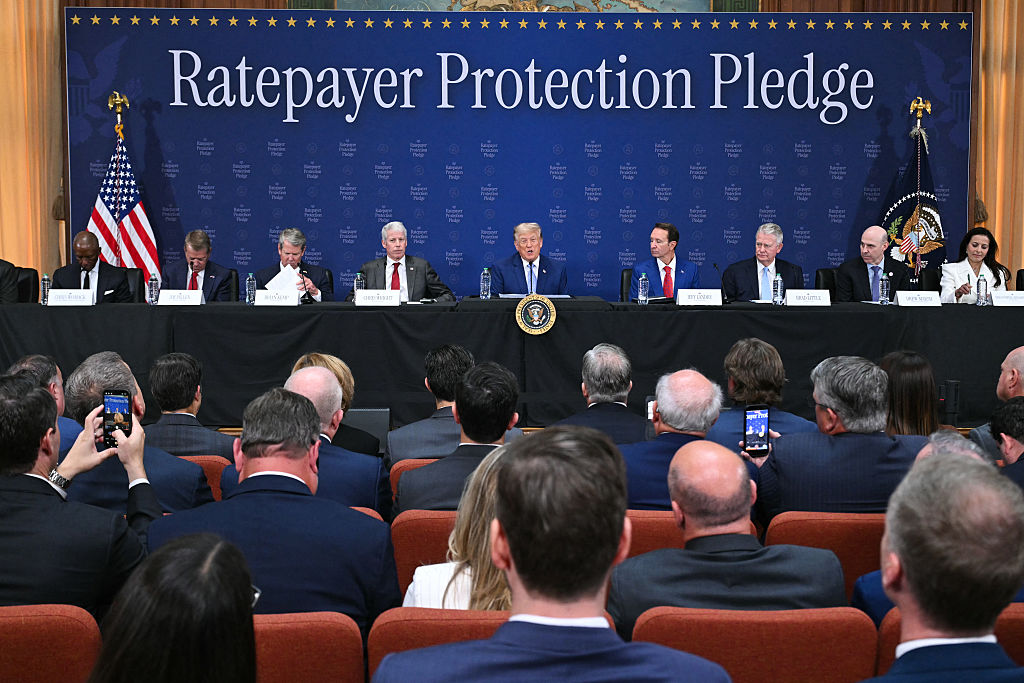
Sitting at the Environmental Protection Agency with a mix of CEOs and cabinet officials, President Trump announced this week that a group of more than 200 stakeholders including governors, utility companies, and data center developers had signed up for his Ratepayer Protection Pledge, vowing to protect consumers from the rising costs of electricity.
The announcement is an attempt to hold off the growing anxiety over electricity bills, which are on the rise in part because of the AI-driven infrastructure buildout. The anxiety has quickly become a liability for industry and politicians alike.
But there’s also little doubt that the pledge, which is voluntary with no enforcement mechanism, is just tinkering around the edges of the issue. And the slower policymakers are to take decisive, substantive action, the more likely it becomes that today’s targeted fixes give way to demands for wholesale restructuring.
Two days before Trump launched his updated pledge, I moderated a panel at the Aspen Ideas Climate summit in Chicago addressing issues of rising electricity costs and reliability issues on the grid. The most interesting exchange came over the needed scale of solutions.
Allison Clements, a former member of the Federal Energy Regulatory Commission, argued that states and utilities should move quickly to insulate customers from the cost of data centers, citing a range of regulatory tweaks. University of Chicago economist Michael Greenstone pushed back, suggesting that instead policymakers should use this moment to rethink the country’s fundamentally inefficient electricity system, reimagining how rates are designed to begin with and giving federal regulators greater authority to build transmission. “One should not waste a crisis,” he said.
In today’s political environment, Greenstone’s call for bold thinking can seem a bit out of touch. Congress can barely keep the government open. It’s hard to imagine the body taking on the extremely complex and politically fraught job of reforming the country’s power system. And yet there is a case for thinking bigger—or at the very least laying the groundwork for bigger thinking.
Right now, the affordability agenda is front of mind and elected officials are responding. In PJM, the Mid Atlantic part of the U.S. grid, officials have implemented a price cap when utilities bid for electricity, even as critics warn the move could discourage new investment. In Indiana, the governor removed the head of the state’s public utility commission after it approved a rate increase. Across the country the political incentive is to keep bills down today even if doing so complicates tomorrow’s reliability challenge.
The system is holding together now. But it’s easy to imagine extreme weather—whether a catastrophic heat wave or deep winter freeze—creating more demand than the system can handle. If demand outstrips supply, rolling blackouts would create a new wave of political anger.
“I can tell you with absolute certainty that if a grid operator has to choose on the hottest day of summer, whether to send power to a data center to run AI 24/7 or to a residential household that needs air conditioning, it’s going to that data center,” says Neil Chatterjee, a former FERC commissioner. “And that’s where the pitchforks come out.”
As alarming as pitchforks may be, they also create an opening for a big picture rethinking of how we produce and distribute electricity in the U.S. Indeed, major infrastructure reforms are more likely to happen because the status quo is intolerable than because someone diligently explained the benefits.
With that in mind, a crisis could unlock much-touted but still elusive permitting reform that makes it easier to build energy infrastructure. It could make the case for a muscular FERC. And I’ve even heard the suggestion that the present moment creates an opportunity to revise the bedrock federal laws that have created challenges in this moment, including the Federal Power Act, the century-old law that governs interstate power transmission.
The implications of such a move are dramatic. If done right, such reform could be a win for efforts to tackle climate change, given how much clean power has been hampered by a lack of transmission. (And climate advocates could end up being a powerful part of a reform coalition). It would also threaten the utility business model, long dependent on monopolies and state policy. It could be a boon for AI companies that want to move faster, though obviously not everyone would support that.
A true crisis may be coming soon. It’s unclear who is ready to use it.
To get this story in your inbox, sign up to TIME’s Future Proof newsletter here.