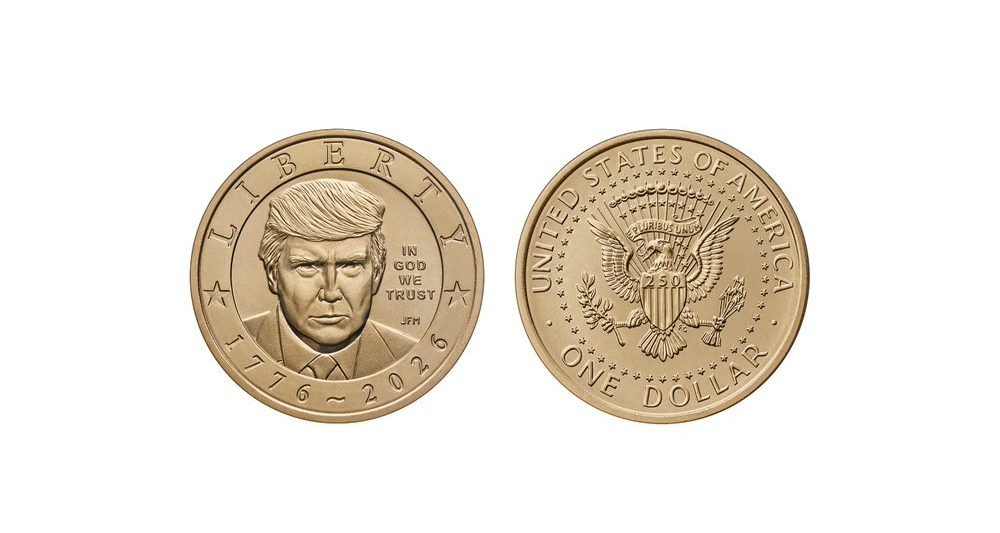
The U.S. Mint began selling $1 coins bearing a likeness of President Donald Trump on Wednesday, making him the first sitting president in a century to have his face on currency.
Celebrating the nation’s semiquincentennial, the gold-colored coins feature a portrait of the president on one side, along with inscriptions of “LIBERTY,” “IN GOD WE TRUST,” and “1776 ~ 2026.” On the other side is an illustration of the presidential seal and inscriptions of “UNITED STATES OF AMERICA” and “ONE DOLLAR.”
Read More: All the Things Trump Has Put His Name and Face on as President
Certain coins will feature an additional commemorative emblem. The U.S. Mint said that 250,000 of the coins were struck on July 4 in Philadelphia, and those are embellished with a special “July 4th” privy mark. The coins have been distributed at random among the rolls and bags that are available for purchase.
The coin, which is being pressed at the Philadelphia Mint, was first announced in July by Treasury Secretary Scott Bessent. He wrote on X that the coin “celebrates the strength of American values, and the promise of a nation dedicated to preserving freedom for all.”
Although this is the first currency featuring Trump to enter production, it is not the first proposed by the Treasury. Earlier this year, Bessent unveiled plans for Trump to appear on a commemorative $250 bill, and the U.S. Commission of Fine Arts voted to approve a 24-karat gold commemorative coin featuring Trump’s face in March.
Can the Trump semiquincentennial coin be used as currency?
The semiquincentennial coin can be used as currency, with a face value of $1 under federal law. However, the U.S. Mint is promoting the item as a collectible, referring to its “once-in-a-generation anniversary design destined to become a standout addition to modern collections.”
Accordingly, they are sold at a premium: Collectors can purchase a 25-coin roll for $61 or a 100-coin bag for $154.50. There is a limit of two of each product per household in place through 2 p.m. Thursday.
The Treasury has also clarified that the 0.286 oz. coins do not contain any precious metal; the golden coloring is derived from manganese brass. The composition of the coins consists of 6% zinc, 3.5% manganese, and 2% nickel, with copper forming the remaining balance.
The coin is legal tender, but federal law does not require private businesses to accept it as payment for goods or services. Businesses may generally establish their own payment policies unless state or local law provides otherwise.
Are Trump $1 coins legal?
Democratic lawmakers have questioned the legality of putting a living president’s face on a coin, pointing to federal law that states: “Only the portrait of a deceased individual may appear on United States currency and securities.”
Lawmakers and experts have also cited the Presidential $1 Coin Act of 2005, which prohibited coins issued under that presidential series from depicting a living current or former president—or a president who had died within the previous two years.
In December 2025, Democratic Sens. Jeff Merkley of Oregon and Catherine Cortez Masto of Nevada introduced a bill seeking to block Trump’s likeness from appearing on the $1 coin. In April, seven Democratic senators also urged leaders of the Senate Appropriations Subcommittee on Financial Services and General Government to prohibit funding for coins or currency bearing a sitting president’s image or signature. The letter pointed to how George Washington “strongly opposed having his image on U.S. coins during his presidency, viewing it as a contradiction to the war for independence from Kings.”
“Placing the bust of a living president on a commemorative or circulating coin contradicts who we are as a nation,” the senators wrote.
Bessent has acknowledged federal law, but has argued that there is precedent for Trump’s likeness on the coin.
“During the 150th there was a Calvin Coolidge coin,” Bessent said on Fox News in July. “So we can put living presidents’ images on a coin.”
Bessent was referring to a half-dollar issued for the nation’s 150th anniversary that featured then-President Calvin Coolidge. Coolidge is the only previous sitting president to appear on a U.S. coin.
The Trump Administration has also pointed to an act from Trump’s first term, the Circulating Collectible Coin Redesign Act of 2020, which explicitly prohibits portraits of living people on the reverse of semiquincentennial coins but does not explicitly impose the same restriction on the obverse, where Trump’s portrait appears. Coolidge’s portrait likewise appeared on the obverse of the 1926 Sesquicentennial of American Independence half-dollar.
But the controversy is a bit more nuanced. The 2020 statute defending the legality of the coin also says each semiquincentennial design “shall be selected by the Secretary after consultation with the Commission of Fine Arts and review by the Citizens Coinage Advisory Committee.”
The Commission of Fine Arts—made up of seven Trump appointees—did suggest a design that is different from the one that currently appears. The advice was meant to be advisory only, so a failure to use the recommended design is not considered a violation of the statute.
The CCAC, which is an 11-person committee established by Congress, did not review the design. The Mint maintains that it repeatedly gave the committee multiple opportunities to review the portfolio and was entitled to proceed after committee leadership declined. Some CCAC members dispute whether the compressed schedule provided a meaningful opportunity to conduct the statutorily required review. One member said the committee received the Trump coin designs five days before a planned meeting, substantially less than the recent average, while the Mint noted that the committee had sometimes reviewed designs on only two or three days’ notice.
The resulting question of legality centers on whether the Mint satisfied the statute by providing the CCAC an opportunity to review the designs—or whether the law required an actual committee deliberation and input.
According to Michael J. Gerhardt, a professor of law at the University of Pennsylvania Carey Law School, says that the coin “violates both federal law and historical practice.”
“The Department of Treasury is bound to follow federal law. Its efforts to maneuver around federal law are illegal,” Gerhardt tells TIME. “The fact that the coin is commemorative does not immunize it from being covered by relevant federal law.”
Daniel Weiner, the senior director of the Brennan Center’s Elections and Government Program, sees this as an issue that goes beyond law, and is much more about an Administration that has continually stretched the bounds of executive power.
“To some extent, its legality is kind of beside the point,” he tells TIME. “There’s the broader context of removing checks on the President’s ability to dominate every action of the Executive Branch. The question is: What are we supposed to do in this situation?”
“In the past, it’s not that this kind of thing would be illegal,” he continues, “but it would be unthinkable.”
The legality of the coin is based on a “hodgepodge of different statues,” Weiner says, but the issue is more about restoring a “tradition of restraint among Presidents.”
Weiner and Gerhardt both point out that even if Trump’s coin is illegal, it would be hard to find plaintiffs that could show they are being harmed by the move, which is required in order to file a lawsuit challenging the issuance of the coin.
“Ultimately, this is a question that’s as much about unwritten rules as written rules,” Weiner adds. “Because the written rules kind of contradict each other, and it’s unclear who is supposed to enforce them.”