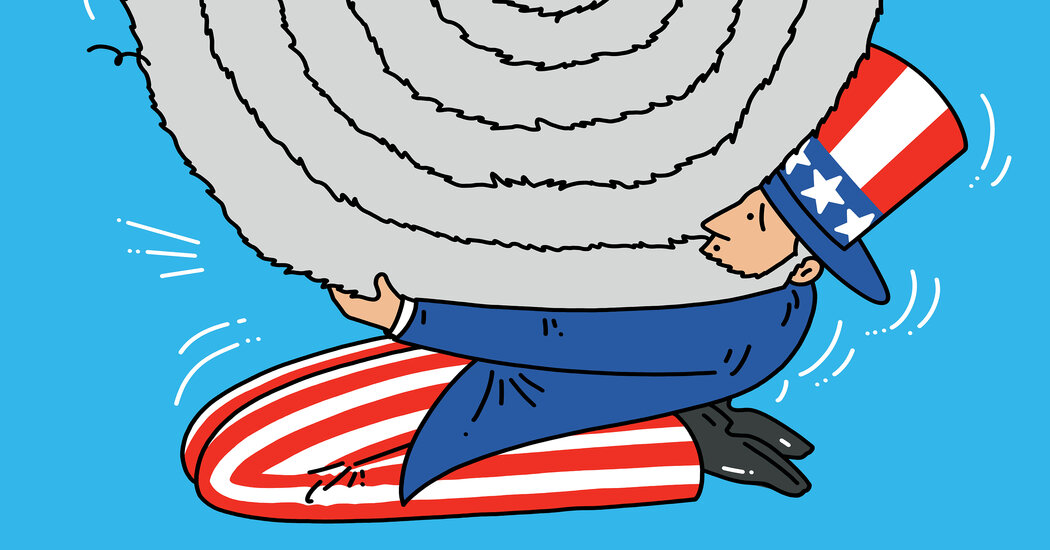
For years, deficit hawks have been groping for ways to shock politicians and the public into getting serious about the skyrocketing federal debt. They hoped they had finally found the right talking point when the United States recently reached a disturbing new milestone: Debt had shot past 100 percent of gross domestic product.
“We’ve heard plenty of alarm bells in the past few years about our fiscal path, but this one rings especially loudly,” wrote the Committee for a Responsible Federal Budget, the organization that calculated the March level of federal debt held by the public as a share of G.D.P. The like-minded Peterson Foundation called it “an alarming fiscal milestone.”
The problem is, few people seemed particularly alarmed, outside of a flurry of somber speeches and opinion essays.
Within a week of the reporting of the statistical landmark, Defense Secretary Pete Hegseth was on Capitol Hill defending the largest Pentagon budget request in American history. And the Senate proceeded with efforts to pass a $72 billion immigration enforcement package through reconciliation, bypassing a potential filibuster and waiving its own rules against deficit-increasing legislation.
It’s not that surpassing the 100 percent milestone has meaningfully changed anything. Debt isn’t like a reservoir that starts overflowing when it exceeds 100 percent of capacity. “Ninety-nine is a bad number. One hundred one is worse than 100. We make a big deal out of 100 because it’s a round number,” said Michael Peterson, the chief executive of the Peterson Foundation.
What should be more disturbing is this: There’s no end in sight. And if debt hawks can’t spur action with even this milestone, what is to be done?
How we got here
Debt has grown because of the costs of fighting the 2007-8 global financial crisis and the Covid-19 recession, the rising expense of caring for an aging population, repeated tax cuts that weren’t matched by spending reductions, and a snowballing interest bill on the debt itself.
The last time federal debt held by the public was higher than G.D.P. was just after World War II. It didn’t stay that way for long. After that spike, the debt-to-G.D.P. ratio declined to 23 percent by 1974 because of strong economic growth, occasional budget surpluses and inflation that eroded the real value of debt.
This time, in contrast, the Congressional Budget Office projects publicly held debt to keep growing and hit 175 percent of G.D.P. by 2056.
For years, ultralow interest rates made mounting debt affordable, but this week 30-year Treasury bond yields hit 5.12 percent, the highest rate since 2007, up from a 2020 low of 1 percent. Net interest payments by the federal government exceed the defense budget. As debt grows, the government has to issue new bonds just to pay interest on existing ones.
Ellen Zentner, the chief economic strategist of Morgan Stanley Wealth Management, said clients constantly asked her if the federal government’s indebtedness was on a sustainable path. “To me, it’s one of the easier questions to answer,” she said. “We are not.”
Those who are less worried like to point out that Japan gets along with much higher debt ratio than the United States is carrying. The International Monetary Fund put Japan’s central government debt at 201 percent of G.D.P. in 2024.
On the other hand, Japan’s debt is held almost entirely by domestic investors, while the United States relies heavily on foreign sources.
Laurence Kotlikoff, a Boston University economist, recently calculated that the United States was in worse shape than Italy once you included Social Security, Medicare and other obligations that don’t appear in the official debt figures. “We don’t have any grown-ups in the room in Washington,” he said. “Nobody picks it up and says, ‘You have a problem.’”
Enrique Mendoza, an economist at the University of Pennsylvania, argues that even stabilizing the ratio wouldn’t be enough. Bringing the ratio back down to 60 percent or below would give the government fiscal space to borrow heavily for the next emergency, and would allow the economy to grow faster because the federal government wouldn’t be competing with the private sector for funds, he said.
Mendoza’s prescription is an extreme long shot at this point. The White House is requesting $1.5 trillion for defense in its 2027 budget, a 44 percent increase, while saying little about the entitlement programs that drive long-run spending. The Elon Musk-led deficit commission last year produced only $1 billion in durable savings, Politico estimated. That was about one-tenth of 1 percent of what Musk aimed for.
Concern but no action
There are signs that Americans are getting restless for action. The rise in Treasury yields has pushed up mortgage rates, hitting Americans where they live and making budget deficits more salient, said Desmond Lachman, a senior fellow at the American Enterprise Institute.
In a Gallup poll in March, half of Americans said federal spending and deficits worried them a great deal, roughly tying it with inflation and the economy among their concerns. The only thing they worried about more was the availability and affordability of health care.
Deficit hawks are trying to figure out how to capitalize on that concern. The press releases about hitting the 100 percent ratio of debt to G.D.P. were one attempt. But Benjamin Larin, an economist at Sweden’s Jonkoping University who has studied how crossing round-number thresholds affects inflation expectations, said he didn’t think that crossing a round-number threshold for debt would be equally impactful.
Government debt is “distant from daily experience, and processed mostly through media and political intermediaries,” he wrote in an email.
Oddly, Gallup found that Americans were more concerned about deficits in 2011, when the debt-to-G.D.P. ratio was only 66 percent and the economy needed the stimulus provided by budget deficits to get growing again. Plus, nothing really happened when the economy blew through 100 percent. The figure has lost its power to frighten.
Jason Furman, a Harvard economist, worries about debt but acknowledges that it’s hard to see much evidence of its harm so far.
“If you had asked someone in 2000 to predict what the economy would look like in a world where the debt was 100 percent of G.D.P. and the deficit was 6 percent of G.D.P., they would likely have expected extremely high interest rates and possibly even a dramatic economic crisis,” he wrote in an article for the Aspen Institute in 2024.
Such a disaster hasn’t happened yet, so at the moment, doing nothing is a lot easier for politicians than doing something, which would involve some painful combination of raising taxes and cutting spending.
That passivity irks Peterson, the deficit hawk. “I think this is a moment where leadership is really necessary,” he said. “It’s not really up to the American people to fix this. It’s up to their elected leaders.”
IN CASE YOU MISSED IT
President Trump’s meeting with Xi Jinping resulted in few deals. Despite optics of cooperation, concrete agreements and breakthroughs were scarce. Trump said that he and Xi had talked about a long-delayed arms sale to Taiwan, that they hadn’t talked about tariffs and that Trump had not asked “for any favors” in reopening the Strait of Hormuz.
The Senate confirmed Kevin Warsh as Federal Reserve chair. One of his first tasks will be establishing credibility as an independent chair, rather than someone under the control of Trump, who has put pressure on the central bank to lower interest rates. Jerome Powell, whose term as chair ended Friday, will serve until Warsh is sworn in and then remain as one of seven members of the Fed’s Board of Governors.
Two inflation measures released this week could complicate Warsh’s job. Tuesday’s Consumer Price Index data showed inflation accelerating to a three-year high, while Wednesday’s Producer Price Index, a measure of the costs businesses pay for goods and services, showed its fastest one-month increase since March 2022.
In 2011, Eric Ries’s book “The Lean Startup” created a popular blueprint for starting companies. Since then, the entrepreneur has been more focused on keeping them alive.
Ries won approval from the Securities and Exchange Commission in 2019 to found the Long-Term Stock Exchange, an alternative market designed to reduce the short-term pressure on public companies. His upcoming book, “Incorruptible: Why Good Companies Go Bad … and How Great Companies Stay Great,” gives strategies for protecting a company’s original mission as it grows.
“We built this financial system that has this gravitational pull down into mediocrity and to extraction and exploitation,” Ries told DealBook’s Sarah Kessler. “You can imagine building a different financial system, but until we get there, my goal is simply to have people be able to build organizations that can resist that.”
The interview has been edited and condensed for clarity.
How does “Incorruptible” connect with your work with the Long-Term Stock Exchange?
I learned a ton about how corporate governance actually works and how financial systems actually work in the building of LTSE.
What did you learn?
This is going to sound nuts to many of your readers, but a large number of the so-called best practices we teach about how companies should be built, structured and governed actually destroy shareholder value. And that’s not my opinion. We have all this academic evidence.
Companies since 2008 that are rated to have bad governance have outperformed the companies that are rated to have good governance.
Which best practices should I ignore while I’m building my company?
Today we think that investors should be able to redirect or take over a company at will. But the data shows that that’s actually not very helpful.
A good example is Costco. Every couple years, Wall Street gets mad at Costco because they deviate from best practices, and they have this structural strength to resist that pressure.
Last year, the LTSE petitioned the S.E.C. for a rule change that would allow companies to report earnings twice instead of four times a year — which the S.E.C. formally proposed last week. How does reducing reporting requirements support companies who want to think long term?
We have really good evidence from other countries that when companies switch from semiannual to quarterly reporting, they lose approximately 5 percent of their market cap. Companies are being run to produce the correct quarterly report instead of for the long-term benefit of anybody, including their shareholders.
Just getting rid of the report is not the win. I hope the proposal, when we finally see it, will also have protections that allow companies to make more long-term disclosures so that long-term investors are better informed.
What would that look like?
Most companies today are being counseled by their legal advisers not to make any forward-looking statements at all, and therefore never to actually talk about what their actual long-term strategy is.
It would be nice if we could develop a liability-limited way that long-term investors and long-term companies could get together and actually talk about the qualitative side of what is happening in the business without triggering a Reg FD violation.
That sounds like a pretty big change.
We already do it when there’s an activist attack. Activists routinely will sign a six-month NDA with a company, in which they can no longer trade. They can come in and get more information.
So why couldn’t we have a simple moratorium that says, yeah, if you give up your right to trade for some period of time, you can get material information that’s not public?
Quiz: Subscription fatigue
This question comes from a recent article in The Times. Click an answer to see if you’re right. (The link will be free.)
Almost 75 percent of companies that sell directly to customers offer subscriptions. according to a 2023 Harvard Business School study. That includes subscriptions for beds, bikes, dating apps and even underwear — and some customers are getting sick of the ubiquitous business model, reports The Times’s Sopan Deb.
What is the average number of subscriptions that Americans have?
Thanks for reading! We’ll see you Monday.
We’d like your feedback. Please email thoughts and suggestions to [email protected].