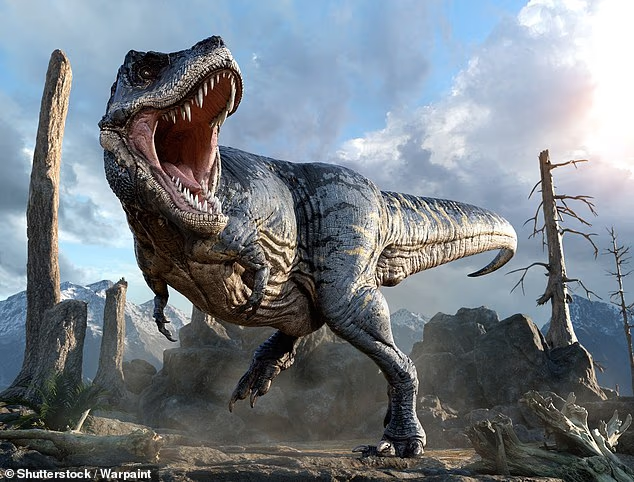
Anyone who has watched Jurassic Park can recall the terror they felt as an escaped T. rex pursued the main characters’ jeep at full pelt.
But those looking to get away from the rampaging dinosaur in Steven Spielberg‘s 1993 hit film may not have needed a vehicle at all, according to a study.
This is because research has found humans would have been able to outpace T. rexes by simply running, as the king of the dinosaurs moved at only 4-5mph.
In comparison, the average walking pace for a Briton in excellent health is 4mph, while if they are running it is around 6.7mph.
And it is also a point of contention whether T. rexes, which went extinct some 65million years ago, were even able to get a jog on.
To understand how the dinosaur moved, scientists analysed a 23ft trackway in the Hell Creek Formation of southwestern North Dakota.
Though T. rexes are often shown to move quickly, the reality could have been very different

Scientists from Liverpool John Moores University and the Denver Museum of Nature & Science have analysed T. rex tracks in America to understand how the dinosaur moved
This contained four three-toed footprints, each measuring roughly 3ft long, which were most likely left by a T. rex due to their exceptional size and narrow toe shape.
The scientists from Liverpool John Moores University and the Denver Museum of Nature & Science found the T. rex would have enjoyed a leisurely stroll at just 3.5 to 4.5mph when it left these tracks.
Lead author Professor Peter Falkingham, of Liverpool John Moores, said: ‘The tracks show it walking at about 2 metres per second, or about 4–5 miles an hour.
‘[That is] a bit quicker than most people stroll. You might’ve had to jog to keep up with it when it made these tracks.’
‘Bones tell us an enormous amount about these animals, but footprints capture a moment of behavior,’ added Tyler Lyson, who contributed to the study.
‘With a trackway, we can actually follow an animal as it moved across the landscape. That is incredibly rare for a T. rex.’
Using 3D surface scanning, the researchers were able to examine the footprints in incredible detail before creating physical reproductions.
The trackway records two left and two right footprints, with a stride of approximately 13ft, according to their analysis.
This suggests the T. rex that left them was walking at a pace of around 3.5 to 4.5mph.

This trackway contains four three–toed footprints, each measuring roughly 3ft in length
The average walking pace for a person with excellent fitness is 4mph, according to the British Heart Foundation.
And the average running pace for British joggers is 8:58 minutes a mile, which equals around 6.7mph.
Whether or not T. rexes could run has also been a matter of contention.
In 2017, scientists from the University of Manchester suggested that the sheer size and weight of a T. rex meant it couldn’t move at high speed.
However, a study earlier this year led by a team at the College of the Atlantic in Maine claimed that a T. rex could reach top speeds of 24.6mph – by running on its tiptoes.
Professor Falkingham suggests that a T.rex could indeed run, but admits there is no conclusive evidence.
He explained: ‘It’s hard to say for certain from bones alone, and we’ve no sprinting trackways of T. rex.’
As for a T.rex’s notoriously short arms, Professor Falkingham says these would not have slowed the dinosaur.
He added: ‘If anything, not having arms waving about might have been a benefit – think Emu, Cassowary etc that all have relatively short arms/wings that they keep tucked close to the body when running. They have no problem running fast!’
KILLING OFF THE DINOSAURS: HOW A CITY-SIZED ASTEROID WIPED OUT 75 PER CENT OF ALL ANIMAL AND PLANT SPECIES
Around 66 million years ago non-avian dinosaurs were wiped out and more than half the world’s species were obliterated.
This mass extinction paved the way for the rise of mammals and the appearance of humans.
The Chicxulub asteroid is often cited as a potential cause of the Cretaceous-Paleogene extinction event.
The asteroid slammed into a shallow sea in what is now the Gulf of Mexico.
The collision released a huge dust and soot cloud that triggered global climate change, wiping out 75 per cent of all animal and plant species.
Researchers claim that the soot necessary for such a global catastrophe could only have come from a direct impact on rocks in shallow water around Mexico, which are especially rich in hydrocarbons.
Within 10 hours of the impact, a massive tsunami waved ripped through the Gulf coast, experts believe.

Around 66 million years ago non-avian dinosaurs were wiped out and more than half the world’s species were obliterated. The Chicxulub asteroid is often cited as a potential cause of the Cretaceous-Paleogene extinction event (stock image)
This caused earthquakes and landslides in areas as far as Argentina.
While investigating the event researchers found small particles of rock and other debris that was shot into the air when the asteroid crashed.
Called spherules, these small particles covered the planet with a thick layer of soot.
Experts explain that losing the light from the sun caused a complete collapse in the aquatic system.
This is because the phytoplankton base of almost all aquatic food chains would have been eliminated.
It’s believed that the more than 180 million years of evolution that brought the world to the Cretaceous point was destroyed in less than the lifetime of a Tyrannosaurus rex, which is about 20 to 30 years.