On Friday, as President Trump announced new global tariffs, the European diamond industry breathed a sigh of relief.
Natural diamonds had once again been exempted from tariffs.
The newly issued exemption followed negotiations with European officials last year, and months of sustained advocacy by a diamond group in Antwerp, which dominates the global industry. It also followed the presentation of a remarkable gift designed personally for Mr. Trump.
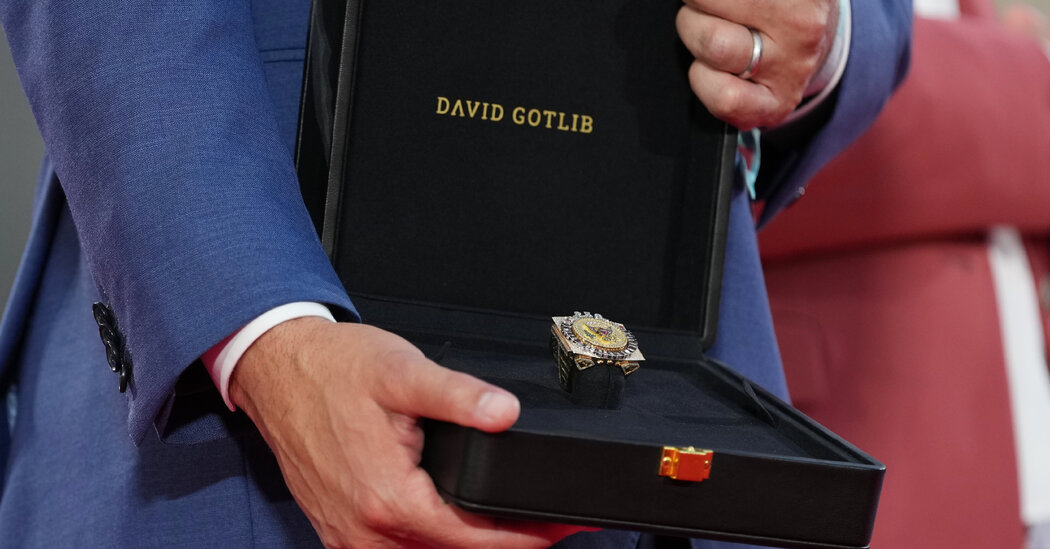
A few weeks earlier, the group, the Antwerp World Diamond Center, which handles most of the world’s rough diamonds and about half of its polished stones, had unveiled an 18-karat gold ring the size of a watch. The ring was encrusted with 321 diamonds and dozens of sapphires, emeralds and rubies, and it was a gift to Mr. Trump to mark America’s 250th anniversary.
The ring features two large diamond “Ts” on either side, and “45” and “47” — references to Mr. Trump’s presidential terms — ringed in diamonds in a Superman-style logo. On its interior is engraved, “Crafted in Antwerp for Donald John Trump.”
“A very special thank you to my friends from Antwerp for the magnificent Freedom 250 ring,” Mr. Trump said in a prerecorded video message played at an America 250 party in Brussels’s Cinquantenaire Park. The festivities featured Budweiser, bourbon and Alexis Wilkins, a country singer and the girlfriend of the F.B.I. director, Kash Patel, performing the national anthem.
The industry had won a reprieve from tariffs last year, after Mr. Trump reached a trade deal with the European Union. But when the Supreme Court struck down those tariffs in February and Mr. Trump replaced them with new ones, diamond imports were penalized again.
The batch of tariffs announced on Friday target more than 80 countries that the Trump administration claims have not imposed or enforced laws banning imports made with forced labor. But the tariffs, which range from 10 percent to 12.5 percent, contain more exemptions than before.
The tariffs will not apply to a wide range of items from oil and gas to copper, chip-making machinery, chemicals and diamonds. Those exemptions will save billions of dollars in tariff costs for U.S. consumers and certain industries, including makers of steel and aluminum, farmers and tech companies.
There is no evidence that the gift of the ring directly affected the president’s thinking on the tariff exclusion for the diamond industry. But the new list of exemptions has renewed questions about which industries should be exempt from tariffs, and why.
Kush Desai, a White House spokesman, said that the Trump administration had agreed to provide preferential tariff treatment for diamonds as part of the trade deal with the European Union that was agreed to last summer.
The exemption of diamonds in the current tariffs “reflects how the administration continues upholding our end of the deal,” he said, adding, “The only special interest guiding the Trump administration’s decision-making is the best interest of the American people.”
An official at the Office of the United States Trade Representative, which negotiates tariffs, said the agency had no awareness of the gift, and it was not an element in determining the exemption.
During Mr. Trump’s first term, the administration set up a process for companies to apply for exclusions, but it was criticized by some as rigged or disorderly.
Early in his second term, Mr. Trump and his supporters often said there would be no immediate exceptions or exclusions to tariffs, arguing that past exemptions created a “Swiss cheese” approach that did little to reduce the flow of imports into the United States.
More than a year later, Trump officials have modified their approach, saying they are working to fine-tune the tariffs and exempt certain categories of goods where they will not have a positive effect. Those include raw materials that could disrupt supply chains, “products that could cause economywide disruptions” if subject to tariffs and goods that cannot be grown or produced in the United States.
U.S. officials said they also issued certain exemptions that other governments, like the E.U, Bangladesh, Switzerland and Taiwan, negotiated for in their trade agreements.
A senior administration official told reporters last week that Mr. Trump had made determinations about which exemptions would make the most sense for American supply chains.
Some of the new exemptions echo earlier carve-outs to the 2025 tariffs that were ultimately struck down by the Supreme Court, including exceptions for products covered by trade deals with Mexico, Canada and Central America. In November, the Trump administration lifted tariffs on beef, coffee, bananas, tomatoes and other products as it tried to prevent the prices of some goods from becoming even more expensive at a moment when Americans were struggling with inflation.
Other exemptions are clearly meant to ensure that strategic industries, like chip manufacturing and data centers, can continue to thrive in the United States.
Tech executives have made their case to Trump officials for months that tariffs on the foreign machinery and components they need will slow their ability to build new factories and A.I. data centers. Farmers, who have also lobbied the administration for help reducing costs, saw equipment and fertilizer exempted.
Dan Anthony, the president of Trade Partnership Worldwide, which researches the impact of trade, said that the administration had exempted about half of all U.S. imports from the forced labor tariffs based on his initial calculations. That is similar to the level of exemptions offered under the previous 10 percent global tariff that expired last week.
The biggest new exemptions were related to metal waste and scrap, which are used to manufacture steel and aluminum; certain chemicals, including those needed by farmers; and machinery for high-tech manufacturing, he said.
Forced Labor Goods
Among trade experts, one criticism of tariffs is that they have exempted many industries that have persistent issues with forced labor, like textiles, coffee, gold, Brazil nuts, cocoa and minerals. Those products are all highlighted in an annual report about forced and child labor compiled by the U.S. Labor Department.
The department has specifically called out palm oil from Indonesia and Malaysia, both of which received exemptions specifically for those products.
“The exemptions list practically reads like a list of products we know to be made with forced and child labor, including many raw materials and finished products made in Xinjiang and in the Democratic Republic of Congo,” said Laura Murphy, a professor of human rights at Sheffield Hallam University in Britain who worked on forced labor enforcement in the Biden administration.
Ms. Murphy pointed to paprika, which is exempted from the tariffs. Paprika is a popular alternative to red food dye among Mr. Trump’s followers in the Make America Healthy Again movement.
But recent testing found that much of the paprika marked as made in the United States is actually made in China, with much of it coming from the Xinjiang region. The United States bans imports from Xinjiang because of concerns about forced labor. The world’s largest manufacturer of paprika, a Chinese company called Chenguang Biotech, was added to a U.S. government list of companies using forced labor in 2023.
U.S. trade officials have responded that their authority is over trade, not labor laws. They say that the recent tariff action represents the most sweeping international labor rights action the United States has ever taken.
They argue that the Trump administration strictly enforces other forced labor laws, and that the new tariffs are directed at getting countries to adopt their own import bans on forced labor goods, not at policing forced labor itself. The tariffs are focused on the trading partners responsible for the largest volume of trade, not small countries that may have worse issues with forced labor.
But to some analysts, that distinction is confusing or even irrelevant.
“You can’t address forced labor concerns when giving a Get Out of Tariffs Free card to the most problematic areas and products,” said Mr. Anthony of Trade Partnership Worldwide.
Mr. Anthony pointed out that the Labor Department had repeatedly flagged forced labor concerns with gold, tin, cobalt, tantalum and tungsten from the Democratic Republic of Congo. But neither Congo nor those minerals are subject to tariffs.
Some domestic manufacturers have also criticized a new mechanism the administration introduced for textiles, which will allow Bangladesh, Cambodia, Indonesia and Malaysia to export some clothing to the United States tariff free, so long as they use U.S. cotton to make it. The program is intended to boost U.S. exports and reduce those countries’ purchases of cotton from China, which the United States has restricted because of forced labor.
But Kim Glas, the president of the National Council of Textile Organizations, a group of U.S.-based textile manufacturers, argued that the measures will further encourage outsourcing of garment production to Asia. Some of the administration’s trade moves would be helpful in combating forced labor in global supply chains, she said, but eliminating textile duties is “a step backward.”
Diamonds, too, frequently appear on government lists of goods made with forced and child labor. Belgium’s diamond sector has among the strictest standards for supply chain monitoring, but human rights organizations claim that some problematic products still slip through.
Diamonds are not commercially mined in the United States or Europe, though Europe plays a major global role in trading, cutting and distributing rough and polished natural diamonds. The tariff exemption will apply to natural diamonds of European origin — meaning they are cut in Europe but could be sourced from anywhere around the globe. Antwerp exports more than $2 billion in polished diamonds to the United States annually.
The U.S. Embassy in Belgium welcomed the tariff exemption, saying in a joint news release with the Antwerp World Diamond Center that it was “the result of constructive dialogue and close cooperation between the United States and Belgium.”
The Antwerp diamond group said on social media that the exemption followed “months of sustained advocacy” aimed at “exactly this outcome.”
As for the diamond-encrusted ring designed for Mr. Trump, it remains in the U.S. ambassador’s residence in Belgium, said Bill White, the ambassador.
An administration official said that the White House had not yet received the item, and that when it did, it would be sent to the National Archives, with an option for Mr. Trump to buy it later.