Geoff Bennett:
For years, researchers and advocates have documented the barriers students from immigrant families face in pursuing higher education. But the Trump administration’s mass deportation campaign has introduced new challenges and new fears, even for many immigrants who are legally in the U.S.
Special correspondent Fred de Sam Lazaro reports now from Minnesota, where federal authorities carried out a sweeping immigration enforcement operation earlier this year.
It’s part of our series Rethinking College.
Fred de Sam Lazaro:
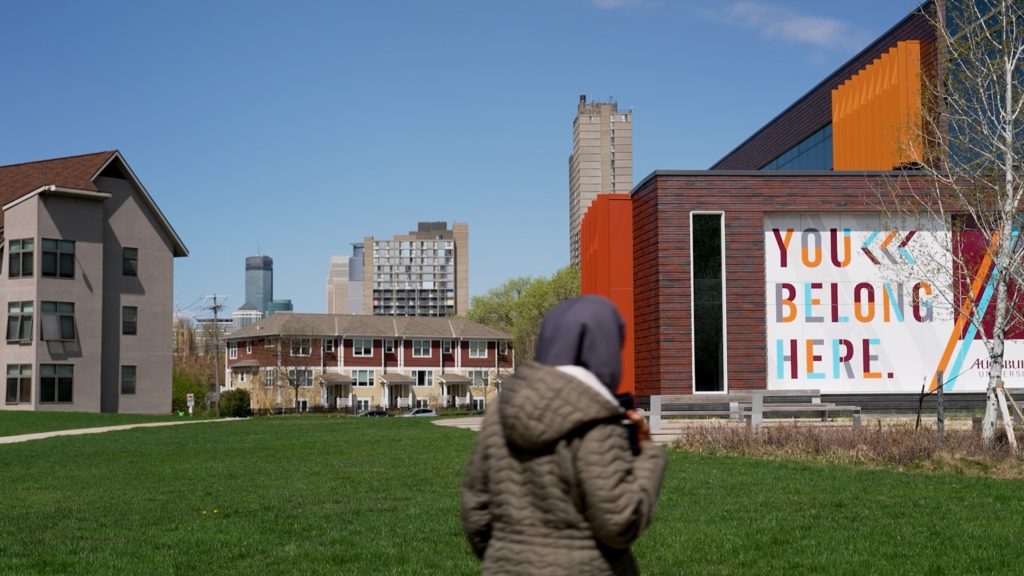
As the spring semester wound to a close, the campus of Augsburg University bustled with students. For the small private school in Minneapolis, IT was a far cry from scenes in the Twin Cities just months earlier, when Operation Metro Surge brought thousands of federal agents to Minnesota, part of a massive immigration crackdown.
Augsburg sits in the heart of the Cedar-Riverside and Minnesota’s Somali population. The school reflects the community, with about 70 percent students of color. Many are immigrants.
Paul Pribbenow has been Augsburg’s president for 20 years.
Paul Pribbenow, President, Augsburg University:
Students who have lived through the experience here over the past several months with the Metro Surge, clearly, that trauma has affected them. I can see it in their faces. You can actually see it, especially here at the end of our semester, the weariness, the fatigue, just the stress.
Fred de Sam Lazaro:
Federal officials detained three Augsburg students, including one on campus in December.
Woman:
A man armed with a rifle standing outside of a residence hall.
Fred de Sam Lazaro:
The Department of Homeland Security called the student a — quote — “criminal illegal alien with multiple offenses.” The “News Hour” independently confirmed an arrest for drunk and careless driving.
Ultimately, courts ordered the release of all three Augsburg students, but the effect of the crackdown lingered, with all campus buildings remaining locked.
Eva Skipwith is a biology major at Augsburg. Born in Ethiopia, she came to the United States at the age of 1. When ICE activity picked up over the winter, she started taking some classes online.
Eva Skipwith, Student, Augsburg University:
It’s exhausting to have to be on guard all the time, to have to worry about whether or not you’re going to be taken from the only home that. Especially students at Augsburg know, like, how much work you put in to get our education.
And, like, you hear the whistles, and my thought is, like, oh, my God, all this work that I have put in, if I’m taken, that’s gone. What am I left with?
Fred de Sam Lazaro:
Colleges throughout the Twin Cities area saw impacts from Operation Metro Surge. At Augsburg, requests for temporary leave double this semester. Elsewhere, new student enrollment declined and virtual learning climbed significantly.
In a statement to the “News Hour,” DHS said: “These students are only afraid because of fearmongering and lies being spread by agitators, sanctuary politicians and the media. Criminals are no longer able to hide in America’s schools to avoid arrest.”
State Rep. Isaac Schultz (R-MN):
I think that Metro Surge never needed to happen.
Fred de Sam Lazaro:
Isaac Schultz is a Republican in the Minnesota House of Representatives.
State Rep. Isaac Schultz:
Had, as an example, Minneapolis-St. Paul and more specifically the counties around them, had they been more cooperative early on, there would have been no need for Operation Metro Surge.
Fred de Sam Lazaro:
What were they not doing?
State Rep. Isaac Schultz:
So, they specifically adopted sanctuary policies which prevented communication and coordination with law enforcement entities at the Department of Homeland Security, with ICE. And because they didn’t do that, it made it more difficult to do the job of immigration enforcement.
Fred de Sam Lazaro:
In recent years, multiple studies have documented the toll of immigration enforcement on college students, especially those from families with mixed immigration status. Researchers have found negative effects on students’ ability to focus, their grades, and on enrollment.
Corinne Kentor is with the Presidents’ Alliance on Higher Education and Immigration.
Corinne Kentor:
If students are not feeling safe, if they are worried about their families constantly, that has a real impact on their personal well-being, even if they are not the primary subjects of immigration enforcement.
Fred de Sam Lazaro:
Miguel Perez Espinoza just received an associate’s degree in accounting, taking online classes from Southern New Hampshire University. He was born and raised in the Twin Cities, but comes from a mixed-status family. The past several months, he says, have been trying.
Miguel Perez Espinoza, Student, Southern New Hampshire University:
He just got this collage of a mess where I’m just trying to keep everything together and trying to make sure my family’s OK. I had to push off a lot of assignments to take care of them, make sure they’re OK, make sure to see where they’re at all times.
Fred de Sam Lazaro:
Perez Espinoza, a corporal in the Army National Guard, put a patrol cap on the dashboard of his father’s car, hoping to lower the chance of an encounter with ICE. He also pulled money out of his savings to install cameras outside his parents’ home.
Miguel Perez Espinoza:
I’m trying to balance my education while trying to balance their safety. It was terrifying.
Corinne Kentor:
Between 2000 and 2023, 84 percent of enrollment growth in U.S. colleges and universities has been driven by first-and second-generation immigrants. We’re talking about a really significant population in higher education. And if that population is not able to continue to flourish in higher ed, then college is going to look very different.
Fred de Sam Lazaro:
In recent years, Kentor has tracked movement around policies that help undocumented students afford college. In 2001, Texas became the first state to offer in-state tuition to undocumented students. By 2024, half of all states adopted similar measures.
But, since then, challenges to those policies have mounted. The Trump administration sued nine states, including Minnesota. A federal judge dismissed that lawsuit in March.
State Rep. Isaac Schultz:
Greetings to each of you.
Fred de Sam Lazaro:
Last year, Representative Isaac Schultz introduced legislation to bar students without legal status from qualifying for state financial aid. He says, next year, about $3 million will go to some 300 undocumented students.
Will it really make that much difference, do you think, or is it the principle that you’re fighting for?
State Rep. Isaac Schultz:
It’s both principle and it’s the actual idea, right? So for those students who have legal status, they are missing out on $50. That’s $50 that is going to someone without legal status.
Fred de Sam Lazaro:
What do you say to many of these students who will tell you that their parents, whilst not documented, are taxpayers?
State Rep. Isaac Schultz:
Yes, they’re taxpayers, for sure. But at the same time, there is no reason that we should have the same playing field for someone with legal status who is a citizen and has gone through just the basics of supporting the United States.
Paul Pribbenow:
We’re only cutting off our own future.
Fred de Sam Lazaro:
Augsburg’s Paul Pribbenow, who estimates the school is home to dozens of undocumented students, disagrees.
Paul Pribbenow:
Our first undocumented student who is now an attorney in the United States has gained his citizenship, is married, and is working in an immigrant law center here in the Twin Cities. And, for me, if that’s the possibility for what these students are going to give back to this country, then it’s worth both our personal institutional resources, but also the support of the state and the federal government to be able to support those students.
Fred de Sam Lazaro:
For his part, Miguel Perez Espinoza to get his bachelor’s degree in the fall. He then hopes to go to the University of Minnesota for his master’s. The last several months have only hardened his resolve to finish his education.
Miguel Perez Espinoza:
I want to be in a position in terms of education and finance where I could take care of my family without having to have that feeling or burdened with it. I love my family to death, and I will — they sacrificed everything to be here to give me an education, and I will sacrifice what I can for them.
Fred de Sam Lazaro:
For the “PBS News Hour,” I’m Fred de Sam Lazaro in the Twin Cities.