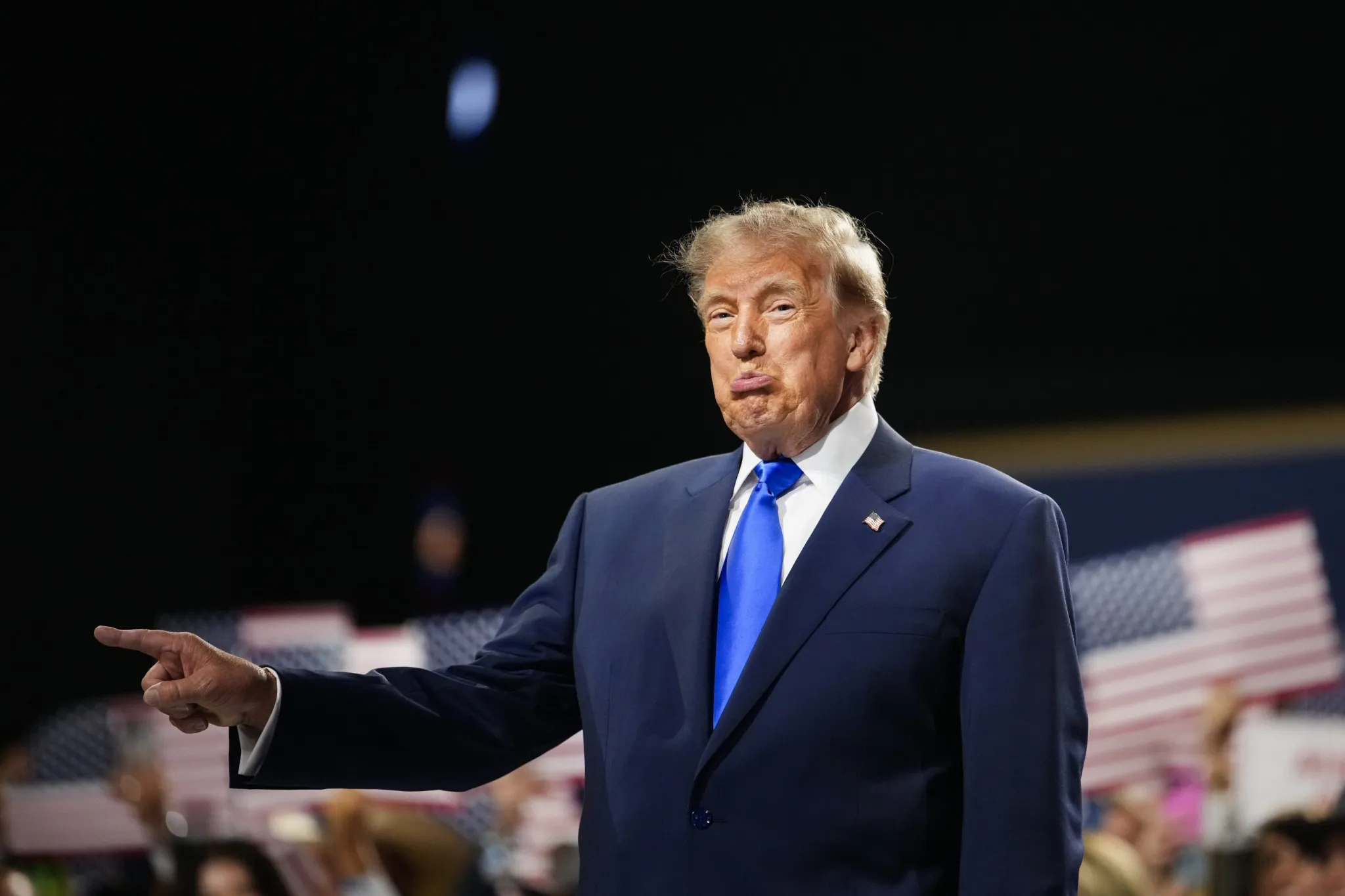
Donald Trump has a message for voters: they’re wrong. And he has a solution for the AI doomsday panic: just trust him, bro.
“The only control or ‘guardrails’ that AI needs is a STRONG AND SMART (High IQ!) PRESIDENT,” Trump wrote on Truth Social, calling out Anthropic CEO Dario Amodei by name while warning of a “SICK conspiracy” against AI and data centers. “WHOEVER WINS AI, WINS!” he added, arguing that China would be the primary winner of an AI slowdown.
Trump also warned Americans not to “kill the Golden Goose,” the term he has used to refer to AI data centers. The president has argued that communities which try to resist the servers would end up “backwards and poor” while the rest of the country will reap the benefits of the extra jobs and added investment. The trouble for Trump is that some 61% of Americans oppose a new data center in their community, along with 54% of Republicans, according to a poll from the Annenberg Public Policy Center at the University of Pennsylvania.
It’s one of a crop of issues where MAGA world finds itself on the wrong side of public opinion as they stare down the midterms that could see them lose control of Congress. One such issue is the Iran War, which only a quarter of Americans support and has driven gas prices up 44% since the war began in February. Another is surveillance. Trump recently said he liked Flock cameras, the rapidly expanding network of always-on automated license plate readers used by police, which Americans have turned against. Nearly 46% of Americans oppose Flock-style cameras in their neighborhoods, as opposed to 38% which support. With his statements on AI, Trump is pulling off a rather remarkable unpopularity trifecta.
The stakes are high. Republicans are now heading into November with a razor-thin cushion in Congress, with Democrats only needing three house seats to take control, and only four to flip the Senate. Democrats are currently at an advantage now as Trump’s approval sits near a low of his presidency. On the economy, in particular, public opinion has soured; a recent consumer sentiment report showed that even Republicans’ view of the economy has sunk.
AI safety debate
That makes the AI fight especially awkward for Trump: another technology he wants Americans to embrace, just as more of the people building it are warning that it may need to slow down. Over the course of one weekend, the AI safety question went from a niche philosophical debate inside Berkley to an enormously consequential economic and political fight.
Amodei has called for the industry to “pace the frontier,” while OpenAI CEO Sam Altman and SpaceX CEO Elon Musk have agreed, arguing for stronger safety measures as frontier models demonstrate increasingly powerful cyber capability. OpenAI has called for mandatory, capability-based national AI safety requirements, while Amodei has proposed independent evaluators, industry coordination, and deeper government oversight as models grow more powerful.
Trump is not happy with any of this. His vice president, JD Vance, has also seemed wary of the lab’s calls for regulating themselves, calling it a “Trojan horse” for their real intentions: regulatory capture.
The White House’s response comes at an apt time, as Wall Street spent Monday trying to parse what the regulatory fight means for equities. Nvidia and other chipmakers fell more than 3% as investors contemplated the possibility that frontier labs could deliberately slow model development, and thus the massive infrastructure buildout thus far designed to support it.
Yet Meta and Alphabet rose, exposing a strange divide inside the AI trade. Cybersecurity firms, such as CrowdStrike, popped 15% or more.
Gil Luria, head of technology research at D.A. Davidson, told Fortune that regulation can only benefit the large labs, which can afford expensive safety teams, lawyers and government compliance workers. Regulation written with significant input from OpenAI and Anthropic, Luria argued, could therefore turn safety rules into a moat around the companies already at the frontier.
Trump’s intervention follows a similar vein. His post claimed the administration already possesses “tremendous CRIMINAL and REGULATORY power over these companies,” while portraying restrictions on AI development as handing the AI race over to Beijing.
The administration has already spent much of the past year wading deeper into the AI economy. A June executive order directed national-security agencies to develop benchmarks for advanced models’ cyber capabilities and determine when a system qualifies as a “covered frontier model.” It also called for a voluntary framework under which developers could give the government access to those models before broader release.
That came after a fight with Anthropic, which restricted access to its advanced models, Fable and Mythos 5, amid a dispute over providing the technology to the Department of War. Trump has also openly floated taking stakes in the AI companies themselves, extending an interventionist playbook his administration has already used in semiconductors, steel, and other strategic industries.
The administration has even tied government permission directly to the economics of the AI supply chain: when it allowed Nvidia to resume sales of advanced chips to China, Trump arranged for the federal government to take a share of the revenue.