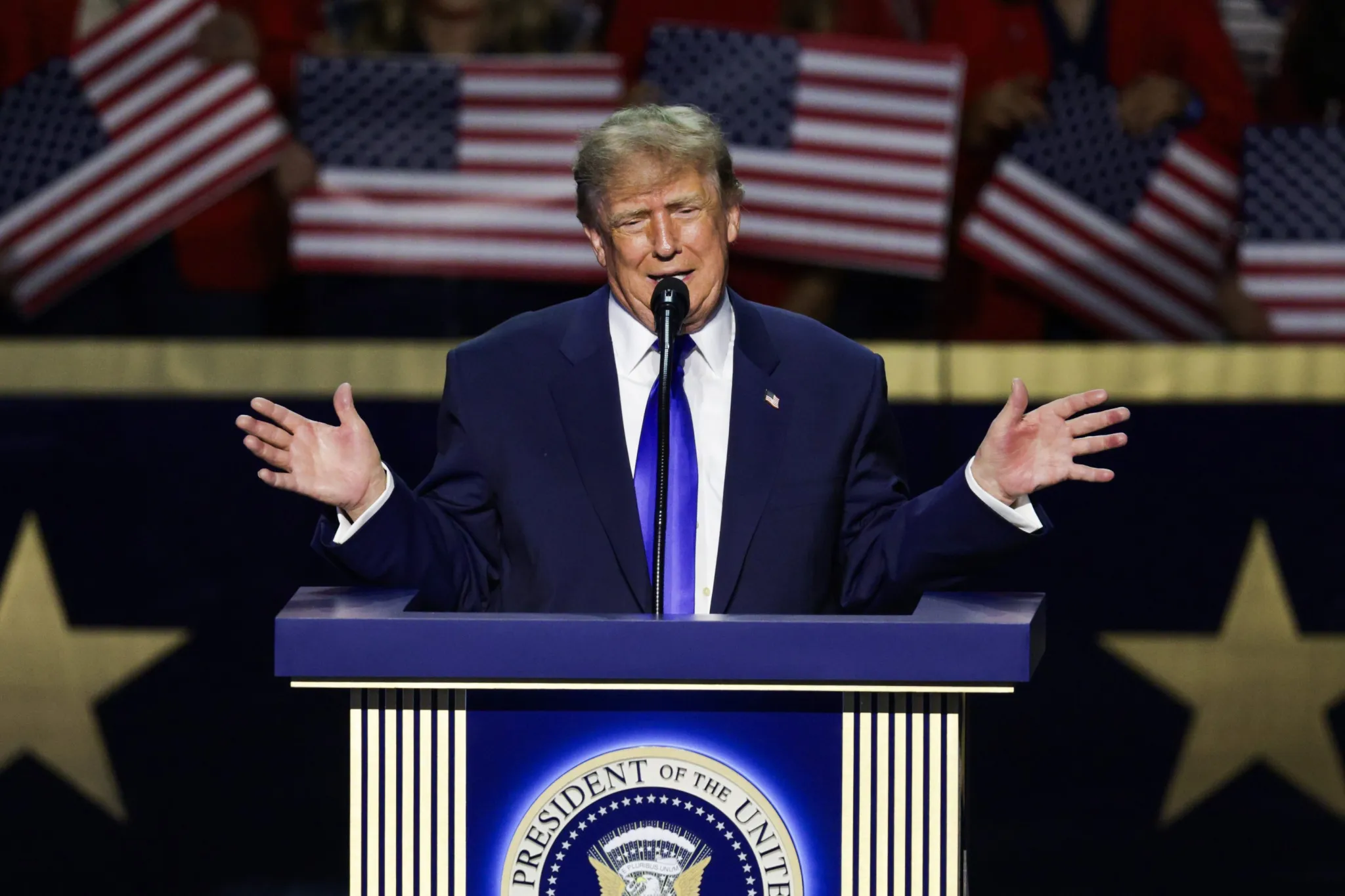
President Trump has promised that every adult American could receive a $5,000 windfall if Republicans win both chambers of Congress in the midterms in November, and, while light on details, the plan would cost more than $1 trillion.
The president did not specify who would pay for the scheme, but said the money would have to be spent on U.S. goods and services. According to Census Bureau data for 2020, there were 260 million adults living in the U.S.—a figure likely to have increased as the population continues to age. Yet even with this more conservative figure in mind, the plan would still cost at least $1.3 trillion.
If the plan were deemed legal and feasible, it would be funded by the U.S. Treasury, which is already financing deficits and the interest payments required to service its public debt.
The Congressional Budget Office’s (CBO) latest monthly budget update, released yesterday, reports the federal budget deficit totaled $2 trillion in the first 11 months of fiscal year 2026, beginning in October and ending in August. This was $6 billion less than the deficit recorded for the same period last year.
However, the CBO points out that this reduction is only due to shifts in payment timings. Payments that had been due to land on September 1, 2025, were instead moved to August of that year—if it weren’t for the reallocation, this year’s deficit would stand at $82 billion more than the same period in 2025.
These deficits add to the pile of debt the U.S. has accrued over decades—now sitting at more than $40 trillion. For the past 11 months, the CBO reports that the U.S. Treasury has spent $1.05 trillion servicing that debt—approximately $95 billion every month.
Interest payments alone have cost the Treasury more than its outlays for the Department of Defense, the Department of Education, the Small Business Administration, the Department of Commerce, and the Environmental Protection Agency, combined. Indeed, interest is still $50 billion ahead of the combined spend.
Hypothetically, President Trump’s $5,000 suggestion would stimulate spending and thus would generate revenue for the Treasury in the long term. However, it’s not clear whether the proposed outlay would be financed ahead of time or rely on further Treasury borrowing.
That being said, it’s difficult to estimate how the plan might shape up. The president’s promise was broad: Speaking at the Republican party’s first-ever midterm convention last night, he said “If the Republicans win, you win with us, and you get $5,000. It will be called the Trump dividend. Congratulations.”
Previous examples
While the premise of Trump’s offer is unusual, as it is based on a political outcome rather than a perceived economic need, it’s not unheard of for governments to put cash in the hands of American households.
Already in his second term, Trump has suggested that tariffs would generate so much cash that it could be shared with the public in the form of $2,000 checks. The president’s math raised eyebrows, as he suggested the duties could both help pay off national debt and leave some over for consumers in the scheme estimated to cost $135 billion.
This was, at the time, nearly half of the tariff revenues expected to be generated annually. However, the proposal was razed when the Supreme Court ruled the basis of Trump’s tariffs was illegal, and ordered the government to refund more than $100 million of the revenues.
In his first term during the coronavirus pandemic, Trump also attempted to increase aid to American households by $2,000—an increase on the $600 agreed by Congress. The motion was knocked down by Senate Republicans, and the proposal never reached a vote.
The plan was later followed through by President Joe Biden, and questions linger over the extent to which the extra soending contributed to rocketing inflation during the period (peaking at 9.1% in June 2022).