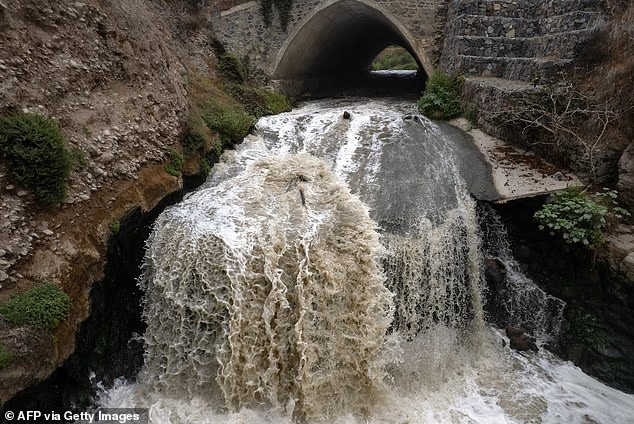
Millions of gallons of bacteria-infested sewage water are barreling up the California coast like a tsunami, threatening both beachgoers and America’s military.
The Tijuana River sewage crisis has been a problem in Southern California since the 1930s, as the Mexican city has been plagued by outdated and overloaded wastewater treatment plants, broken pipes and poor stormwater systems for decades.
This has sent as much as 30 million gallons of sewage-filled wastewater into the Pacific Ocean each day, where it has floated north into US waters.
In recent years, officials in California have warned that pollution has made its way farther than ever before, reaching the wealthy beach community of Coronado, just two miles from San Diego.
Now, several of the state’s most famous beaches are facing repeated closures as bacteria carried in wastewater can cause stomach illnesses, infections, skin rashes, or other sicknesses in anyone who swims or surfs in the water.
Between 2020 and 2025, the San Diego County Department of Environmental Health and Quality revealed that several popular beaches had to be closed regularly because of high bacteria levels, including Imperial Beach, Silver Strand and Tijuana Slough.
The California State Lands Commission said in a statement: ‘This is a necessary measure to protect public health, but it is unacceptable that the community is unable to access clean and safe beaches and coastal waters.’
Aside from endangering beachgoers and vacationers in Southern California, the Pentagon recently revealed that over a thousand illnesses amongst Navy SEALs have been recorded due to their training in the water along Coronado.
As much as 30 million gallons of sewage water are reportedly flowing towards Southern California daily from the Tijuana River

Several beaches throughout the San Diego area have been closed regularly in recent years as the sewage issue gets worse
These issues included 1,168 cases of acute gastrointestinal illness, leading to nausea, vomiting and diarrhea, according to the February 2025 report.
Department of War officials noted that the declining situation in Southern California has already disrupted training for the Navy’s special operations units, forcing them to cancel water exercises whenever the feces-tainted water reaches danger levels.
At Tijuana Slough, the closest Southern California beach to the Mexican border, officials in the state revealed the beach was closed down 333 times over the last five years.
Imperial Beach, which sees around 400,000 visitors each year, had to close 231 times during that same period. Meanwhile, Silver Strand, a major surfing destination, was closed 152 times between 2020 and 2025.
As the toxin sludge heads farther north, beaches around Coronado have begun to catch up. San Diego County revealed there were 73 beach closures around the area over the last five years due to unsafe bacteria levels.
Former resident Whitney David, who left because of the growing sewage problems, told the Wall Street Journal: ‘It was heaven on earth and now I call it paradise lost.’
‘All kinds of trash you would see floating in the ocean – food wrappers, bottles, clothing. Once in a while, you would even see a piece of c***.’
Coronado Mayor John Duncan said that the wealthy community has seen business affected by the reputation that the city is now dirty.

The city of Coronado sits just two miles from San Diego and has been a beach destination for years, but closures are increasing as sewage floods into the Pacific Ocean
From October 2023 to May of last year, the San Diego Coastkeeper estimated that 31 billion gallons of raw sewage, polluted water and trash had traveled along the Tijuana River into the Tijuana River Valley and the Pacific Ocean.
Sewage infrastructure in Tijuana was not designed to withstand the city’s rapid population growth, so it has often spilled into nearby bodies of water during the rainy season.
According to the Sierra Club, one of the nation’s oldest environmental organizations, the earliest reports of sewage reaching the US from the Tijuana River were in 1933, when Tijuana only had a population of roughly 14,000.
Today, the city is home to more than 2.2 million people. President Trump has called on Mexico to address their untreated wastewater issues before it reaches the US.
The two countries have also agreed to speed up projects aimed at cleaning up the sewage problem, including building additional treatment plants in Mexico and expanding the US-owned South Bay International Wastewater Treatment Plant.

The sewage issue in Mexico stems from outdated and overloaded wastewater treatment plants, broken pipes and poor stormwater systems around Tijuana

Beaches near the Tijuana River Estuary are frequently closed due to the city’s weak infrastructure. Pictured: Human waste bubbles at the South Bay International Wastewater Treatment Plant
This facility will continue to serve as a ‘backstop,’ catching and treating as much extra sewage spilling over from Tijuana as possible.
Sewage can also impact air quality, with local counties detecting elevated levels of hydrogen sulfide in the air from wastewater and sewage flows from the Tijuana River Valley earlier this year.
Hydrogen sulfide can worsen existing breathing conditions, including asthma and chronic obstructive pulmonary disease (COPD).
It can also produce a rotten egg smell. Residents have reported headaches and nausea from the odor during exceedingly bad days.