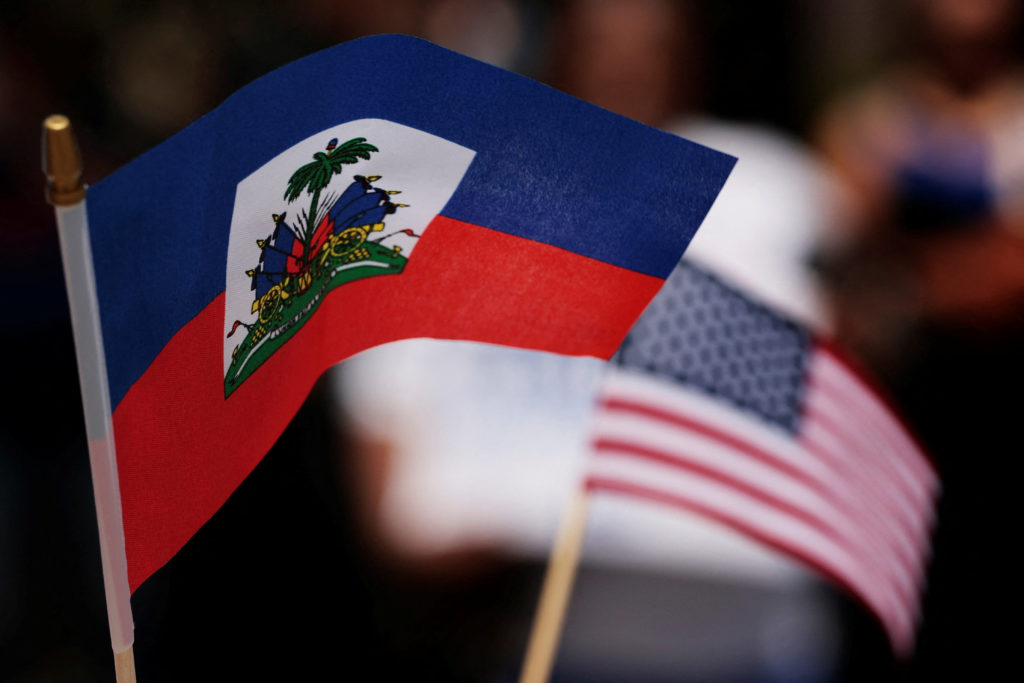
Approximately 350,000 Haitians and Syrians who have remade their lives in the United States are now at a crossroads. Their work permits and legal status have expired, yet their home countries haven’t recovered from the crises that drove them to seek Temporary Protected Status protections.
“It’s not that we don’t want to go back to Haiti,” Harriett Cecilia Joseph, one of the hundreds of thousands of people grappling with what to do next, told PBS News. “It’s just the situation doesn’t allow us to.”
In August 2021, Joseph applied for TPS, a U.S. immigration program that gives temporary legal status to citizens of countries facing war or environmental disasters. Settling in Springfield, Ohio, she built a community, got a job and started her own business as an event planner.
She was filling out paperwork at her job conducting quality control inspections when she learned that the program allowing her to live and work legally in the U.S. was ending.
Her mind suddenly felt empty, she said. She spent the night crying and praying. Everything she had accomplished was now at risk.
In June, the U.S. Supreme Court ruled that President Donald Trump’s administration could end TPS for Haiti, Joseph’s home country, and Syria. The decision also paved the way to end the program for several more countries.
“It’s so hard to verbalize the impact unless you put yourself in that position,” said Murad Awawdeh, president of the New York Immigration Coalition. “The depth of the fear that people are living in right now is unconscionable.”
Returning to Haiti is ‘unimaginable for many’ as crisis continues
Joseph always intended for her stay in the U.S. to be temporary.
She traveled to Florida in March 2021 on a tourist visa. Her dad had asked her to stop working in Haiti as it had become more dangerous. Gang-involved shootings and kidnappings prevented her from going to training for her new job in the Ministry of Commerce, she said.
“I said, ‘OK, I can plan to go (to the U.S.), visit a little bit while things get better in Haiti,'” Joseph recalled thinking. “Because we always have this hope that things will be better in Haiti.”
After spending some time in Florida, she traveled to Springfield to visit a friend who was living there. That’s when her family encouraged her to apply for TPS. Gang members had started pressuring her father and brothers for money, she said, threatening to kill them if they didn’t comply. It wouldn’t be safe for her to return home, they told her.
As the months went on, conditions in Haiti deteriorated. In July 2021, President Jovenel Moïse was assassinated, gang violence exploded and the country suffered an earthquake and tropical storm.
Watch the PBS News Hour segment in the player above.
As of March, gangs controlled 90% of Haiti’s capital, Port-au-Prince, according to the United Nations. Mike Waltz, the U.S. ambassador to the UN, described the city as a “kill zone,” in remarks before the UN Security Council in July.
“I just cannot underemphasize the brutality that these gangs are imparting upon their own people,” Waltz said, recalling a recent trip to Haiti.
Haiti holds a Level 4 advisory from the U.S. State Department, warning Americans not to travel to the country due to risk of crime, terrorism, kidnapping and unrest.
“The idea of returning is just unimaginable for many,” said Leonie Hermantin, director of special projects at Sant La Haitian Neighborhood Center in Miami.
One of Hermantin’s clients fled Haiti with her two teenage children. They escaped gangs by jumping over fences with barbed wire, Hermantin said.
The children are “still carrying the scars,” she said. “Not just the emotional scars, but the physical scars of that experience. They can’t go back.”
Joseph came to terms with her stay in the U.S. becoming longer than she initially intended. Still, being away from family for the first time in a country she didn’t know was difficult and stressful, she said.
“You stop your dreams. You stop your projects,” Joseph said. “You go in a different direction than what you had planned.”
Now she fears she’ll have to start her life over once again.
A flood of calls for help
The end of TPS puts Joseph and hundreds of thousands of other beneficiaries in a precarious spot.
“You can no longer earn any resources to pay for your life, you can no longer work in the formal economy, your health insurance gets canceled, you are now a person who is going to be targeted by the federal government for removal,” Awawdeh said.
Joseph has a pending application for asylum, which would give her a pathway to U.S. citizenship if granted. But asylum can take years to be decided because of a backlog of millions of cases.
She said she’s researching the possibility of migrating to Canada, where her brother lives, since returning to Haiti would be dangerous.
Watch the PBS News Hour segment in the player above.
Hermatin said her organization is getting flooded with calls asking for help and advice. People tell her they can no longer afford to pay their mortgage. Many people Hermantin has spoken with are looking for another country to which to migrate, like Joseph. Others are planning on laying low and hoping a future administration will re-establish TPS.
Staying in the U.S. comes with its own risks. There’s widespread fear of detentions and deportations, she said.
An elderly man suffered a stroke but was too afraid to go to a hospital, Hermantin said. Many teenagers are saying they’re afraid to go back to school in the fall.
Her organization is encouraging TPS holders who have U.S. citizen children to sign temporary powers of attorney to trusted guardians for their children in the event that they’re detained or deported. Around 270,000 U.S. citizens live with Haitian TPS beneficiaries, according to FWD.us, an immigration advocacy organization.
Loss of TPS employees deals a blow to U.S. businesses
Joseph was let go from her job just a few weeks after the Supreme Court ruling, after losing her work permit.
“I didn’t think it was gonna be that quick,” she said.
Business owners across the U.S. have had to fire their TPS employees to remain in compliance with the law. The mass loss of legal status will deal a blow to the U.S. economy, business leaders have said.
Nearly 190,000 Haitian TPS holders are in the workforce and contribute about $5.9 billion to the U.S. economy every year, according to FWD.us.
“For restaurants, TPS-related changes could impact workforce stability and create operational uncertainty,” said Sean Kennedy, chief advocacy officer for the National Restaurant Association. “Restaurants are the nation’s second-largest private employer and we are always struggling to fill open positions.”
Of an estimated 740,000 TPS workers in the U.S. in 2024, about 53,000 were healthcare workers, according to the nonprofit health policy research organization KFF. The end of TPS for Haitians is expected to particularly affect elder care facilities and people who use home health aides.
Watch the PBS News Hour segment in the player above.
“It means that, in one fell swoop, organizations will lose in some cases 40 workers, in other cases 16 workers, all at the same time,” Katie Smith Sloan, chief executive of LeadingAge, which represents more than 5,000 aging services providers, told PBS News in July.
Joseph has not only been affected by the loss of her full-time job. Her event-planning business, which she launched in 2023 with the encouragement of friends, has also suffered.
She had two weddings and a party booked in August and another wedding in November. All four events were canceled because her clients, who are also Haitian, are now in limbo. They’re unsure where they’ll be and are focused on saving money.
“I understand,” Joseph said.
She said she doesn’t like to wallow in a problem. She let herself cry on the day of the Supreme Court ruling, but is now focused on planning for her future. But that doesn’t take away the uncertainty.
“As a human being,” Joseph said, “you can feel like you are not welcome anywhere in this world.”