Comical discoveries including the best way to blow your nose and why teenagers are so smelly have won this year’s spoof Nobel prizes.
The annual Ig Nobel awards recognise scientific discoveries that ‘first make people laugh, and then make them think’.
They are awarded by the science humour magazine the Annals of Improbable Research, which ‘celebrates the unusual and honours the imaginative’.
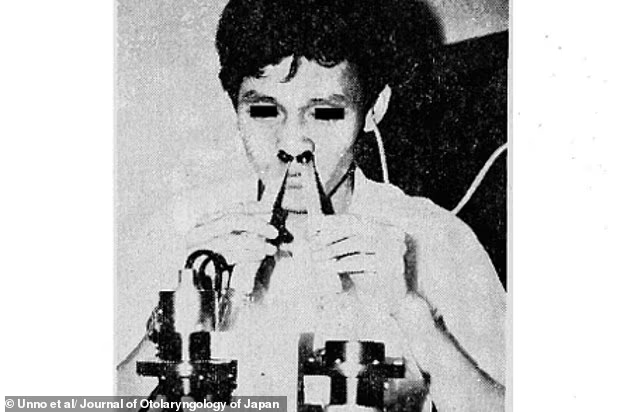
For the nose blowing study, published nearly 50 years ago, Japanese researchers measured the speed and amount of air expelled when people exhaled forcefully.
‘The purpose of this paper is…to give good instructions to those who do not understand how to blow the nose,’ the team, from Wakayama Medical College wrote.
They concluded that a ‘big and long’ nose blow is best at clearing secretions, rather than a short, sharp puff.
The research was awarded the Ig Nobel medicine prize, which was presented posthumously to lead author Dr Tojuki Unno.
The winners were handed prizes by genuine Nobel laureates, before being pelted by paper airplanes as per tradition.
Japanese researchers measured the speed and amount of air expelled when people exhaled forcefully. They received the Ig Nobel medicine prize for their work

Researchers in Germany were awarded the olfaction prize for discovering that while young children were rated as having a nice smell, this rapidly decreased once they hit puberty
The olfaction prize went to a group of researchers from Germany who collected evidence that babies smell wonderful to their parents, but that teenagers do not.
The study, published in 2017, asked 235 parents to assess the personal odour pleasantness of their children.
Analysis revealed that while young children were rated as having a nice smell, this rapidly decreased once they hit puberty.
‘Our study suggests that perception of young children’s personal odour as pleasant may contribute to bonding and thereby caretaking, which is needed to a lesser degree after puberty than before,’ they wrote in the journal Chemosensory Perception.
The Ig Nobel peace prize was awarded to a group of scientists from Oklahoma State University, who discovered that we value friends who are mean to people we dislike.
‘People sometimes prefer friends who are more vicious than prosocial, for instance to one’s enemies,’ they wrote in the journal Evolution and Human Behaviour.
Meanwhile, the economics prize was given to scientists who found upper class people are more likely to steal sweets meant for children.
Their study revealed that, when left with a jar of candy labelled as being for youngsters, higher-class participants sneakily pinched more for themselves than lower-class individuals.

The Ig Nobel peace prize was awarded to a group of scientists from Oklahoma State University, who discovered that we value friends who are vicious to our enemies

A study on the evolution of kissing, published earlier this year, was awarded the biomechanics prize
A study on the evolution of kissing, published earlier this year, was awarded the biomechanics prize.
The paper found evidence that ancient humans were locking lips with Neanderthals 50,000 years ago.
Researchers were praised for ‘devising a more precise definition of kissing’, described as ‘non-agonistic interactions involving directed, intraspecific, oral-oral contact with some movement of the lips/mouthparts and no food transfer’.
Daredevil academics who gently stepped on various venomous snakes to learn what makes them want to bite you were awarded the biology prize.
Meanwhile the chemistry prize was given to researchers who discovered milk proteins from cockroaches pack three times as much energy as milk proteins from cows.
Using 3D printing to recreate a mosquito proboscis – the part that sucks blood – was recognised with the technology prize.
And attempts to design a splash-free urinal were recognised with the physics prize.
In 2022, a team from the University of Waterloo designed a device that promised zero urine splash-back, regardless of where the user aimed.

Scientists were praised for designing a ‘splashless’ urinal that minimises mess from users of all heights (second from right)

The soil science prize was awarded to researchers who investigated soil health by burying 1,000 pairs of underpants and analysing how they decomposed
The final award, the soil science prize, was handed to researchers who buried 1,000 identical pairs of underpants in more than 25 countries, then dug them up after two months.
The project was designed to help assess the health of soil, and the worms, insects and bacteria that reside in it.
‘We provided the citizen scientists with personalized feedback, including soil analysis results, interpretation tools, and tips for sustainable soil management,’ the team, from the University of Zurich, said.
‘Hopefully, the sensory experience of recovering a decomposed pair of underwear from their own land has inspired the participants to see soil as a living system and a vital resource and empowered them to serve as conscientious soil stewards’.