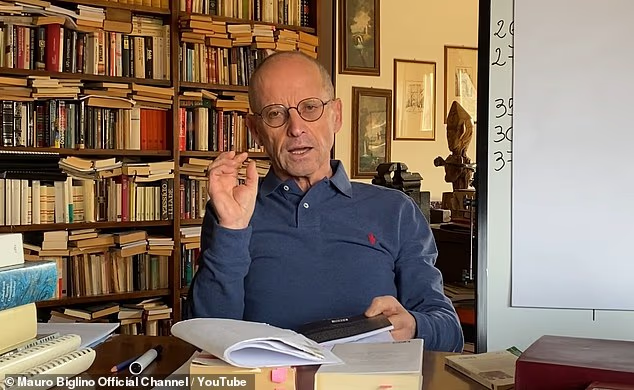
An Italian translator who says he was ‘fired by the Vatican’ for his interpretation of the original Hebrew Bible has revealed a radical reinterpretation of what God in scripture really is.
Mauro Biglino pointed to the word ‘Elohim,’ found 2,570 times in the Holy Book, which translates to ‘God’ or, in his opinion, ‘Gods.’
Biglino, an Italian scholar who worked as a biblical translator for Edizioni San Paolo, a major Catholic publishing house linked to the Vatican, suggested that instead of detailing encounters with one God, the Bible describes encounters with a group of mortal, alien beings armed with high technology.
In a podcast interview with Project Unity, he said: ‘When I started to write what I really read in the Hebrew Bible, I was fired in one minute.’
According to Biglino, his conclusions stem from translating the original Hebrew text literally rather than through centuries of theological interpretation.
He argued that many of the Bible’s best-known passages have been reshaped by later religious tradition, masking what the ancient authors actually intended to convey.
Pointing out that Elohim is often treated as a singular name for God despite its plural form, he argued that the Bible describes multiple divine figures rather than one supreme being.
‘There are multiple divine figures, with different names of God,’ he said. ‘If Elohim are not God, the Bible is another Book.’
Mauro Biglino pointed to the word ‘Elohim,’ found 2,570 times in the Holy Book, which translates to ‘God’ or, in his opinion, ‘Gods’
Rather than viewing the Elohim as supernatural spirits, Biglino believes they were advanced beings of flesh and blood.
‘The Elohim were flesh and blood, but with a longer lifespan, but still mortal, with higher technology and higher powers,’ he told podcast host Jay Anderson.
His theory builds on the controversial ancient astronaut hypothesis popularized by Swiss author Erich von Däniken, who argued in his 1968 bestseller Chariots of the Gods that extraterrestrials visited ancient civilizations and shared advanced technology with humanity.
Before his death earlier this year, von Däniken collaborated with Biglino on the book Skies Aflame.
Unlike von Däniken, whose work centered on monuments such as the Egyptian pyramids and other archaeological mysteries, Biglino bases his conclusions on his own translations of the Hebrew Bible, arguing that key words have been misunderstood for centuries.
In his book Gods of the Bible, he notes that ‘Elohim’ is routinely translated simply as ‘God’ in modern Bibles, even though specialist editions often leave the Hebrew word untranslated because its meaning remains disputed.
‘Where people read “God” and were led to believe that the biblical authors had written the word “God,” scholars read the untranslated term “Elohim” and were made aware that this term is problematic,’ he wrote.
Hebrew dictionaries, he argues, offer a far broader range of meanings for Elohim, including ‘gods,’ ‘judges,’ ‘rulers,’ ‘superhuman beings,’ ‘angels,’ ‘children of God,’ and ‘those from above.’

Biglino, an Italian scholar who worked as a biblical translator for Edizioni San Paolo, a major Catholic publishing house linked to the Vatican, suggested that instead of detailing encounters with one God, the Bible describes encounters with a group of mortal, alien beings armed with high technology
The word also appears throughout the Old Testament with both singular and plural verbs, which he says suggests it cannot always refer to a single deity.
One passage central to his theory is Psalm 82, where God appears to stand among other divine beings before declaring: ‘You are “gods”; you are all sons of the Most High.’ But you will die like mere mortals; you will fall like every other ruler.’
To Biglino, the passage describes an assembly of the Elohim rather than a lone, all-powerful God.
He argued it reflects a council of powerful beings, not a single divine ruler. Biblical scholar Michael S Heiser also interpreted Psalm 82 as describing a divine council, although he viewed its members as spiritual beings rather than extraterrestrials.
The Italian author extended that interpretation beyond the Psalms, arguing that several biblical passages traditionally viewed as supernatural visions are better understood as eyewitness descriptions of advanced technology.
Among the most famous examples, he says, is the Book of Ezekiel, which describes ‘wheels one inside the other’ that ‘moved in every direction without moving.’
While mainstream biblical scholars regard the passage as a symbolic vision of God’s glory, Biglino believes the prophet was describing a craft using the limited language available more than 2,500 years ago.
‘The ancient Hebrew term “ruah” had a very concrete meaning, as it stood for “wind,” “breath,” “moving air,” “storm wind,” and thus, in a broader sense, for “that which moves swiftly through the air space,”‘ he said.
In his view, later theological interpretation transformed the word into ‘spirit,’ obscuring what was originally intended as a literal description of something moving rapidly through the sky.
Rather than recording a mystical experience, Biglino insists Ezekiel was documenting a real historical encounter.
‘We have a description of a very close encounter with an unidentified object that was undoubtedly in the air,’ he wrote.
‘It looked like a thundercloud coming from the north; in its center, the prophet saw a fire (a propulsion system?) rotating around itself, like luminous radiation.’