The history of an iconic British treasure could be rewritten after a tiny artefact was unearthed in a field in Kent.
For decades, the Sutton Hoo helmet – which was buried with a Suffolk king around 1,400 years ago – has been suspected of being an import from Sweden.
But the ‘extraordinary’ discovery of a small object suggests it may have been made much closer to home.
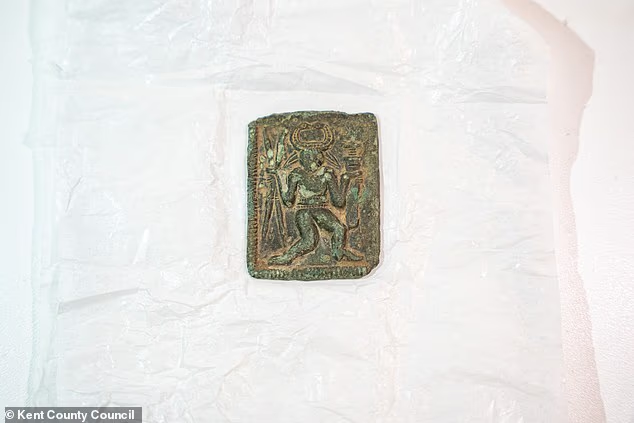
A copper–alloy die stamp, unearthed by a metal detectorist in a field near the Kent village of Lynsted, dates from the late 6th or early 7th century.
It appears to have been used to press decorative panels for high–status Anglo–Saxon military equipment, such as helmets.
Analysis reveals it is closely comparable in size and design to panels on the famous Sutton Hoo headgear.
Crucially, it is the only confirmed example of its kind found in Britain – and indicates that helmets previously thought to be Scandinavian may have actually been made in England.
Dr Andrew Richardson, Finds Liaison Officer for Kent County Council, said: ‘This small but remarkable find provides important evidence that helmets like the Sutton Hoo example could have been made in Kent, highlighting the skill and connections of early medieval craftworkers in the country.’
The small copper–alloy object, found by metal detectorist Stephen Newbury, is the only confirmed example of its kind found in Britain

The artefact, which had broken into more than 100 fragments, took the conservation team at the British Museum many years to reconstruct into a replica (pictured)
The Sutton Hoo helmet was first discovered in 1939, when archaeologists unearthed an Anglo–Saxon ship filled with buried treasure.
The artefact had broken into more than 100 fragments, meaning it took the conservation team at the British Museum many years to reconstruct it into a replica.
Today, it holds great significance for our understanding of the Anglo–Saxon ‘Dark Ages’ – showing that the society was highly sophisticated and capable of extraordinary craftsmanship.
Made from iron, it is inlaid with garnets and decorated with embossed panels. It has long been thought it was of Scandinavian origin, as similar helmets and the tools required to craft them have been found in Sweden.
The design on the newly–discovered die closely resembles the Sutton Hoo helmet decoration. It features a naked figure wearing a horned headdress ending in two birds’ heads.
The pose of the figure’s legs suggest movement, such as running or dancing, and it carries two spears in one hand and a sword in the other.
‘This little bronze die stamp is the first evidence from the British Isles that this iconic helmet, or helmets like this, might have been made in Britain,’ Dr Richardson said.
‘There’s no reason now not to think that helmets like the Sutton Hoo helmet – perhaps the Sutton Hoo helmet – could have been made in the Kingdom of Kent.’

The design on the newly–discovered die closely resembles the Sutton Hoo helmet decoration. It features a naked figure wearing a horned headdress ending in two birds’ heads

Dr Richardson explained that this die probably would have been used to make the panels on the top and front of a helmet
Dr Richardson explained that this die probably would have been used to make the panels on the top and front of a helmet.
‘The horned figure…closely matches the figures on the panels above the eyebrows (of the Sutton Hoo helmet),’ he added.
The die’s figure has pagan origins with links to Woden, the Old English form of the Norse god Odin.
It is thought the Sutton Hoo helmet was worn by Rædwald, king of the East Angles, who some scholars argue kept altars to pagan gods.
Dr Richardson said as well as serving as battlefield armour, the helmet likely had symbolic importance and was possibly a cult object.
He explained the imagery may have been seen as a way of connecting its wearer directly to Woden, from whom Anglo–Saxon societies claimed descent.
The discovery has now been officially declared treasure by a coroner due to it being an object of significant historical interest.
Jamie Henderson, Cabinet Member for Environment, Coastal Regeneration and Public Health, said: ‘This is an exciting discovery for Kent, strengthening our reputation as a county with a rich and internationally significant heritage.

The die’s figure has pagan origins with links to Woden, the Old English form of the Norse god Odin

This image shows the ‘weapon dancers’ that appear on a panel on the Sutton Hoo helmet. They bear striking similarity to the newly–discovered die stamp
‘Our county has played a vital role throughout history, and this is another piece of evidence showing Kent’s importance in the story of early England, as a place of craftsmanship, culture and international connections.
‘Finds like this help tell the story of our past, connect people with the remarkable heritage on their doorstep, and show why it is so important that we continue to protect and celebrate our historic environment.’
Last year, a separate discovery indicated the Sutton Hoo helmet may have originated in Denmark.
Of the many decorations on the shattered helmet are two small panels which show warriors riding on horseback.
According to an analysis by the National Museum of Denmark, those panels bear a striking resemblance to a small metal stamp found on the Danish island of Taasinge.
Peter Pentz, a curator at the National Museum of Denmark, told the Ritzau news agency: ‘When the likeness is as strong as it is here, it could mean that they were not only made in the same place but even by the same craftsmen.’