Footballers and tattoos go hand–in–hand – but what do the inkings really say about them?
Ahead of the World Cup, scientists from Boston College analysed hundreds of the most common tattoos to uncover what they tell us.
Their analysis revealed that footballers’ tattoos fit into four broad categories.
‘Religious tattoos’ include depictions of the Virgin Mary, Jesus, Buddha and crosses, while ‘loved one tattoos’ include texts, dates and stars.
‘Professional tattoos’ include things like jersey numbers, team crests, and trophies, while ‘aspirational tattoos’ represent things like clocks, animals, compasses and roulette wheels.
According to the experts, these themes suggest footballers use their tattoos to reveal what’s important to them.
Writing in their study, the researchers explained: ‘Players assert a degree of control over their bodies by getting tattoos; their bodies are not mere assets for others to use, maintain, and profit from.
‘In a highly regulated profession – where clubs and investment funds protect their assets – tattoos provide a space for footballers to express their worldview, making statements about what they hold sacred. Through their ink, players reveal who they aspire to be, who they love, the achievements that have shaped their lives, and their religious commitments.’
Ahead of the World Cup, scientists from Boston College analysed hundreds of the most common tattoos to uncover what they tell us

‘Religious tattoos’ include depictions of the Virgin Mary, Jesus, Buddha and crosses. Pictured: Brazil’s forward, Neymar, at the 2018 World Cup
While tattoos were once seen as a sign of rebellion or deviance, they are now widely accepted as a form of personal expression around the world.
In fact, figures have shown that more than a quarter of Brits now have tattoos – ranging from full tribal sleeves to dainty flowers.
In their new study, published on Religiao em debate, the researchers set out to understand the role of tattoos among footballers.
The team analysed the tattoos of Argentina’s men’s team, who won the last World Cup in Qatar in 2022.
In total, they analysed around 200 pictures, and found 226 tattoos spread across 20 of the 26 players.
Firstly, the experts ‘coded’ each player’s tattoo designs.
Names were found to be the most common theme, ahead of lions/tigers, flowers, quotes, numbers, people, and footballs/jerseys.
Less common inkings included a tribal design, a roulette wheel, a lighthouse, a dream catcher, and a cathedral.

The team analysed the placement of tattoos on the body, creating heat maps of the most common locations

Names were found to be the most common theme, ahead of lions/tigers, flowers, quotes, numbers, people, and footballs/jerseys. Pictured: Enzo Fernandez’s lion tattoo
Meanwhile, three players even had tattoos related to popular culture, from TV series such as Breaking Bad, Prison Break, Vikings, Peaky Blinders, The Walking Dead, Pokémon, Frozen and The Simpsons.
Next, the researchers grouped the designs into wider groups, settling on four main categories.
Fifteen players had ‘religious tattoos’, typically covering their shoulder or bicep, or the upper or lower leg.
Sixteen had tattoos dedicated to ‘loved ones’, including numbers, dates, and stars.
‘We checked the names and dates online and discovered that tattoos including names and dates were linked to family: parents, partners, daughters, sons, grandparents, and also pets,’ the researchers explained.
Fifteen players had tattoos related to their professional careers – usually on their dominant leg.
And 16 had ‘aspirational tattoos’, including clocks, human figures and animals.
The team added: ‘We speculate that these animals (associated with strength and power) represent the players’ self–perception or aspirations.’

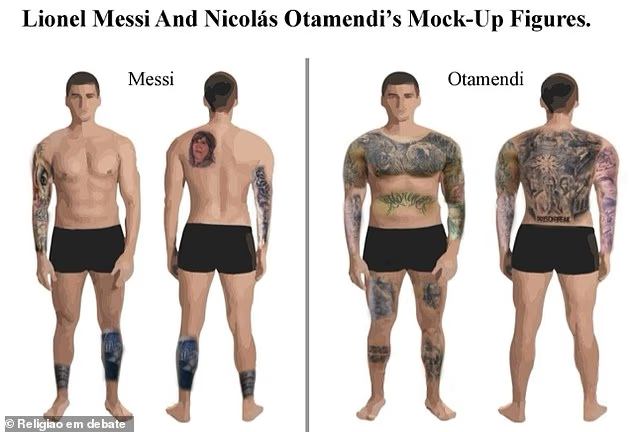
The study revealed that 16 players had tattoos dedicated to ‘loved ones’, including numbers, dates, and stars. Pictured: Lionel Messi’s inkings
In the next part of the study, the team analysed the placement of tattoos on the body, creating heat maps of the most common locations.
‘Our “tattoo map” reveals that the areas with the most ink are the front of the left arm, the front of the left forearm, and the front of the right arm (each with 11%), and the front of the right forearm (9.35%),’ they said.
‘The body areas with the fewest tattoos are the front of the right thigh (2.88%), the back of the head (0.72%), and the back of the neck (0.72%).’
So, what do these tattoos and their placements tell us?
According to the researchers, the tattoos ‘preserve a record of what is important to footballers: their loved ones, their religious beliefs, their professional achievements, and their life aspirations.’
They added: ‘These were the “sacred” elements that structured their lives.
‘Football served as a platform for expressing morals and values; the tattoos reflected the players’ systems of meaning.’