Scientists have found the remains of a soldier in Scotland’s Stirling Castle who may be one of the unluckiest people in history.
This man in his 20s has the dubious honour of being the first confirmed victim of a trebuchet attack, according to new evidence presented at the European meeting of the Paleopathology Association.
These fearsome weapons of war are similar to a catapult, and capable of hurling a projectile weighing over 100 kg hundreds of metres over castle walls.
Now, archaeologists have uncovered the grisly reality of what happens to someone unfortunate enough to catch a direct hit from one of those flying stones.
The soldier, known to scientists as skeleton 150, bears the evidence of an enormous, high-velocity impact that shattered his bones and pinned him to the ground.
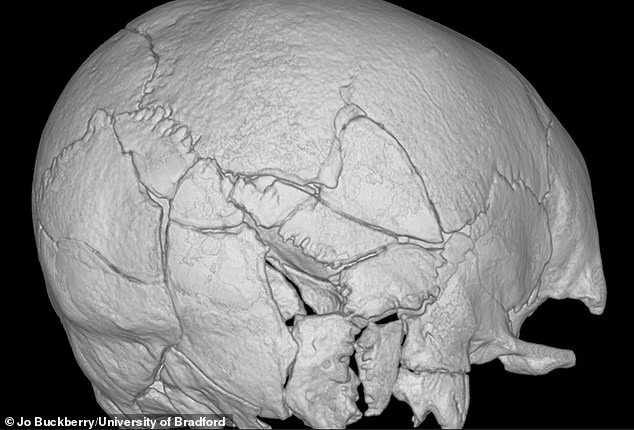
Dr Jo Buckberry, from the University of Bradford, found over 160 different fractures on the 160-cm-tall remains.
The skull was cracked in 61 places, there was a deep, zigzag break on the shoulder, and nearly 60 bizarre, jagged breaks on his ribs.
Dr Buckberry told Science: ‘The breaks indicate a very large area of impact and devastation. It’s likely the individual was killed by a siege engine.’
A skeleton of a soldier found in Scotland’s Stirling Castle has been identified as the first confirmed victim of a trebuchet attack, which broke their skull (pictured) in 60 places

During the siege, English forces deployed the largest trebuchet ever constructed, a terrifying weapon known as War Wolf . Pictured: A modern reconstruction of War Wolf
Skeleton 150 was discovered in 1997, when scientists unearthed the graves of nine skeletons beneath the chapel in Stirling Castle.
Five of these were found to date back to the early 1300s, and all bore the injuries and cut marks that indicated violent lives and deaths.
However, those signs of violence were hardly surprising, given that Stirling Castle was besieged and changed hands five times between 1296 and 1304, when it finally fell to English forces.
The end of the 13th Century was an extraordinarily violent time, as Scotland waged a bloody war of independence against the English.
Stirling Castle was located on a key road towards Edinburgh, and was often seen as the gateway to Scotland, making it a prime target for attack.
Working alongside researchers from Historic Environment Scotland, Dr Buckberry found that the skeletons beneath the chapel bore cut marks, penetrative injuries, and blunt force trauma.
This indicated that they likely died in battle, but what made them so unusual was that they were buried in graves within the castle’s chapel, rather than outside the walls.
Together, these pieces of evidence suggest that they might have fought and died in the final siege of 1304, when Edward I deployed a vast force against the castle.

Scientists believe that the soldier was killed during the siege of Stirling Castle in 1304, when King Edward I attacked the Scottish forces inside (artist’s impression)
However, that didn’t explain the absolutely baffling level of injury that skeleton 150 seemed to have sustained.
The injuries to his ribs and shattered right leg ruled out the most likely explanation, which was a tumble from the castle wall.
Likewise, the shape and distribution of the breaks ruled out being trampled by horses or the bones being broken up after his death.
‘It looks like he was hit from behind by something travelling at a great velocity,’ says Dr Buckberry.
‘The most similar cases I was finding were car crashes and people hit by trains.
‘But how do you get from there to a guy in medieval Scotland? What is large and moving very, very quickly in 1304?’
She soon found the answer hidden in historical accounts of the battle, which revealed that the siege of 1304 had witnessed the rise of a new, and awe-inspiring weapon.
Historical accounts report that English forces led by Edward I deployed trebuchets, which were a relatively new invention at the time.

The stone thrown by an English trebuchet (artist’s impression) broke the soldiers skull in 61 places, left a deep, zigzag break on the shoulder, and caused nearly 60 bizarre, jagged breaks on his ribs
In particular, the English deployed a trebuchet named ‘War Wolf’, which is believed to be the biggest trebuchet ever built.
Contemporary accounts describe the trebuchet launching a stone that flew through the castle’s two stone walls ‘like an arrow flying through cloth’.
If skeleton 150 had a direct impact from one of those stones, it is no wonder that his bones bear such striking breaks.
Lukas Waltenberger, a forensic osteologist at Vilnius University who researches blunt force trauma but was not part of the research, says: ‘It’s convincing. It seems like a high-velocity, high-force, high-speed impact in a short amount of time.’