A British satellite that can see inside Iran‘s nuclear sites will be launched into space this week.
The device, made by London–based SatVu, can pick up high–resolution thermal images and videos of activity even through thick walls and smoke.
It could help intelligence services ‘see inside’ buildings of strategic importance such as nuclear sites and munitions factories to provide valuable information.
And it can do this during the day or at night – to allow agencies to ‘make informed decisions’ amid escalating global tension.
SatVu’s cameras are so precise they can show the capacity of airfields, whether a ship is being loaded and even when individual pumps on a nuclear reactor are switched on.
Experts said the move opens up ‘remarkable opportunities’ for national security and will enable important intelligence to be easily shared among allies.
‘High-resolution thermal data is no longer a “nice-to-have”; it is a fundamental requirement to complete geographical intelligence assessments,’ Anthony Baker, SatVu’s chief executive, said.
‘Unlike thermal data captured from airplanes or drones, SatVu can capture data from any point on the Earth’s surface, including inaccessible or restricted areas, and it can do this in a uniform way,’
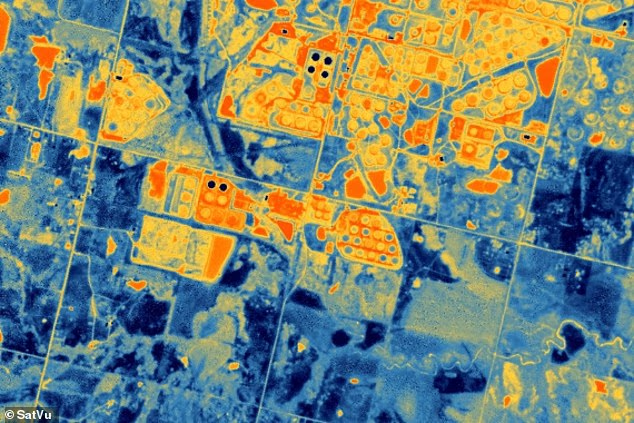
The device can pick up high–resolution thermal images and videos of activity even through thick walls. Pictured: Oil storage in Oklahoma

The satellite will be fired into orbit on SpaceX’s Falcon 9 rocket, which is due to take off this weekend
The satellite will be fired into orbit on SpaceX’s Falcon 9 rocket, which is due to take off from California on Sunday.
The company, backed by £30million in Nato funding, will soon have two satellites in orbit and plans to launch a total of eight, allowing it to recapture any location on Earth every two hours.
SatVu has previously taken images indicating increased levels of activity at the Yongbyon Scientific Research Centre in North Korea.
In a statement, the company explained that a series of pictures captured over three months revealed thermal signatures from reactors and the discharge of warmer water from a pumping station.
‘Monitoring this site is important as…when operating at full capacity, the Experimental Light Water Reactor could significantly increase North Korea’s fissile material stockpile,’ it said.
The findings suggested that the reactor ‘may be undergoing pre–operational testing or is in the early stages of operation’, which could support North Korea’s nuclear programme, it added.
Although the US is already thought to be able to take high–res thermal images from space, sharing information more widely is seen as a security risk and is highly classified.
A commercial provider, such as SatVu, could allow for intelligence to be shared with allies in the Middle East without raising the same security concerns.

SatVu has previously taken images indicating increased levels of activity at the Yongbyon Scientific Research Centre in North Korea

The satellite can monitor the capacity of key energy infrastructure. Pictured: Thermal imagery shows evidence of activity at the Middle East’s largest oil refinery, the Ruwais Refinery, in the UAE
Its thermal images could also help stabilise fluctuating fuel prices by giving energy providers a clearer picture of the extent of the damage to infrastructure in the Middle East.
Oil facilities in Kuwait and Saudi Arabia have been struck by Iran in recent days, as well as the world’s largest liquified natural gas export facility in Qatar’s Ras Laffan Industrial City.
‘If you see a big explosion at Ras Laffan in Qatar, you don’t know how much of it has gone up in flames,’ Mr Baker told The Telegraph.
‘Our imagery lets you know with much more certainty what part has been hit and has gone offline.’
The company currently has deals with the US government, Japan and a number of European nations including Poland.
However, despite government backing, it does not yet have a contract with the UK.
‘HotSat–2 is designed to measure what’s operating, what’s idle and how these patterns change over time, whether it is day or night,’ Mr Baker added.
‘With the satellite now integrated for launch, we are moving closer to delivering a dependable new intelligence layer from orbit. We need that capability in the UK.’

Oil facilities in Kuwait and Saudi Arabia have been struck by Iran in recent days, as well as the world’s largest liquified natural gas export facility in Qatar’s Ras Laffan Industrial City (pictured)

The technology can also be used to track the movement of vessels during the day and night, as seen in this image of the Yokosuka Naval Base in Japan
UK space minister Liz Lloyd said: ‘SatVu is a shining example of British innovation at its best – and proof that government investment in our space sector pays dividends.
‘The ability to monitor thermal activity from orbit, around the clock, opens up remarkable possibilities for national security, climate resilience and market intelligence. ‘
Apart from national security, SatVu’s machines can be used for economic monitoring and climate resilience.
The company said its satellites can monitor urban heat and environmental change, and the data can be used to understand the impact of extreme heat incidents.