The apocryphal quip attributed to Mark Twain, “the rumors of my death are greatly exaggerated,” rings true for certain companies in the software space amidst widespread but premature fears of AI-driven obsolescence.
Over the last year, approximately $2 trillion in software value has been torched on fears that AI will render many software businesses obsolete in the years ahead, in what has become known as the “SaaSpocalpyse,” prematurely announcing the death of the software as a service (SaaS) sector.
The original SaaSpocalpyse thesis of “death,” or at least massive disruption, was how bears were thinking in the early part of the year, but that bearish thesis has now morphed into a less drastic, but still incorrect, theme of how software companies will have to pay more for customer acquisition moving forward with far less pricing power, compressing margins and hindering profitability.
Just as the classic 1979 Francis Ford Coppola film Apocalypse Now was based on a fictional delirium, so, perhaps is the SaasSpocalyse now.
Yes: there is no question that many high-flying technology winners will be under increasing competitive threat from autonomous AI agents moving forward, and the list of companies that look vulnerable is a long one.
At the same time, the panicked investor stampede to the exits across software firms has wrongly punished several of the clearest beneficiaries from AI as if they were obvious casualties. Three examples – Salesforce, Booking Holdings, and IBM – illustrate how, contrary to short-term market fears, there are certain software companies well positioned to become big AI winners in the long term, with greater profitability and pricing power from AI-driven wins, not less.
Salesforce
The misleading bearish AI scenario has an appealing simplicity for some anxious analysts.
Salesforce, the leading customer relationship management (CRM) system, was wrongly predicted to be facing obsolescence by LLM companies like OpenAI and Anthropic, whose autonomous AI agents would presumably manage customer relationships from beginning to end. This led misinformed critics to demote Salesforce from its robust position as the central command center of a business to that of merely a passive database sitting in the background that agents occasionally query. The erroneous presumption was that the AI models would capture all the value, and Salesforce would be relegated to being an interchangeable commodity if not entirely redundant. Down roughly 20% this year and 40% from its high, the stock has been priced for precisely that faulty diagnosis.
These confused critics read the dynamic backwards. Salesforce isn’t what’s being commoditized; it’s the LLMs, and in this new world, data is the new moat – and Salesforce has the data. As analysts at Wells Fargo declared, “lower cost of intelligence increases value of incumbent data.”
At the end of the day, AI agents are only as good as the data on which they operate. An AI agent working on closing a sale still needs somewhere to research the customer, log new interactions, store the contract, and customize the terms – and it needs decades of customer data and history to understand what all of it means. That’s where Salesforce comes in, as the ultimate repository of customer data.
Despite analysts’ delusions, Salesforce in reality has processed over 216 trillion customer records this year alone, and still counting. All that customer data, ranging from key customer contacts, to deal histories, to support tickets, to marketing interactions and histories, already lives inside Salesforce for virtually every major company. There is no way to just rip that out and store it inside a LLM instead of Salesforce – nor would anyone want to trust a LLM as the repository of all their proprietary customer data. Clean, unified, trusted data is exactly what AI agents need to function well, and Salesforce has more of it than anyone, with built-in security and confidentiality protections far surpassing LLMs.
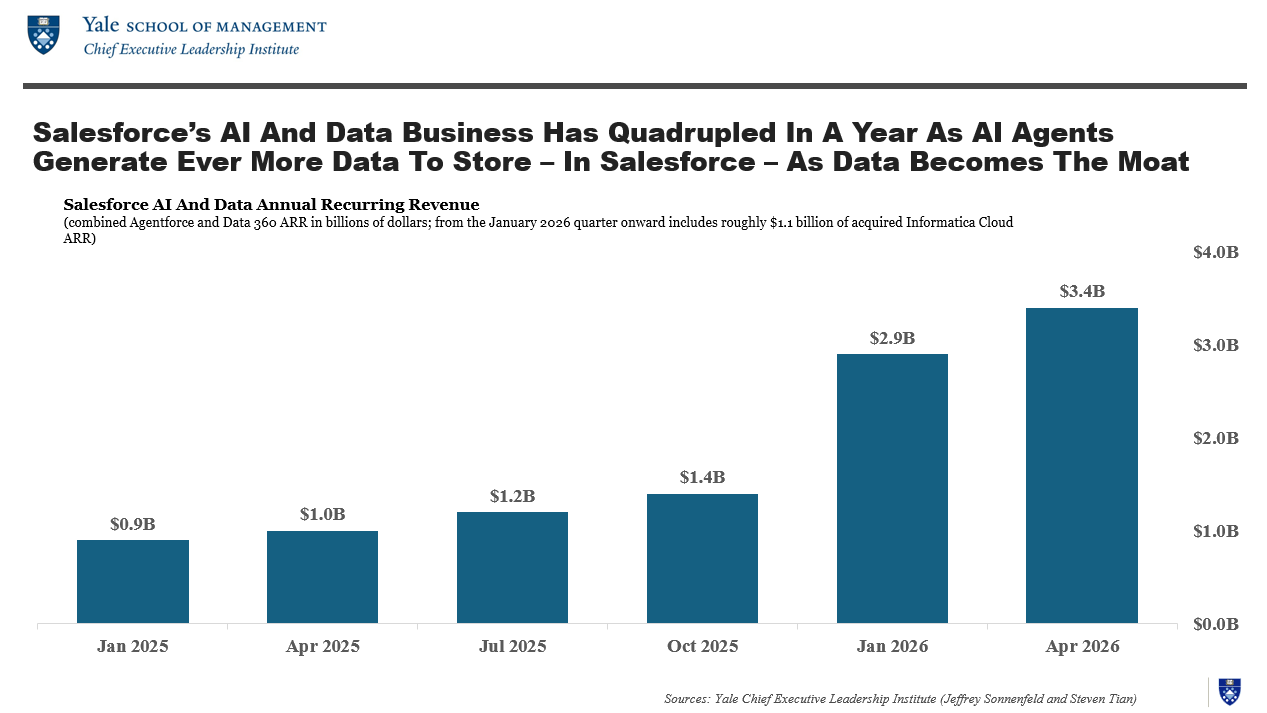
No wonder the results reflect Salesforce’s position as an emerging AI winner. Agentforce, Salesforce’s AI agent platform, has gone from $100 million to $1.5 billion in annual recurring revenue within 18 months of launch, with well over 30,000 Agentforce deals already closed amidst exciting new partnerships with Anthropic’s Claude as the premier agent inside Agentforce. All those AI agents are producing more and more data by an exponential factor, which conveniently needs to be stored within Salesforce, with Salesforce ingesting 104 trillion records last quarter alone, double that of just last quarter.
And interestingly, the long-underestimated acquisition of Slack has become extraordinarily important to Salesforce’s AI future, as Slack is where key decisions are argued out, providing agents with critical context and human insights they would have never been able to glean from a database field alone. It is why Slack is growing at a record rapid clip, just delivering its fastest quarterly Net New Annual Order Value (“NNAOV”) growth since acquisition as Slackbot users grew over 150% Q/Q; and when Salesforce opened Slack up to outside AI agents, a million users plugged in within a month. Visionary founder/CEO Marc Benioff’s decision to spend $25 billion buying back his own stock in a single quarter earlier this year — the largest repurchase in company history, roughly a fifth of its market capitalization – is looking incredibly savvy for the largest repository of customer data on the planet.
The balance of power shifting to Salesforce, with Salesforce getting more pricing power, not less, is why leading frontier LLMs such as Anthropic are now rushing to strike partnerships with Salesforce, exemplified by the debut of “Claudeforce,” Salesforce and Anthropic’s exciting new partnership allowing full integration of Claude within Salesforce, a win-win partnership which will increase usage of both platforms and push customers toward the highest-end premier subscription plans.
Booking Holdings
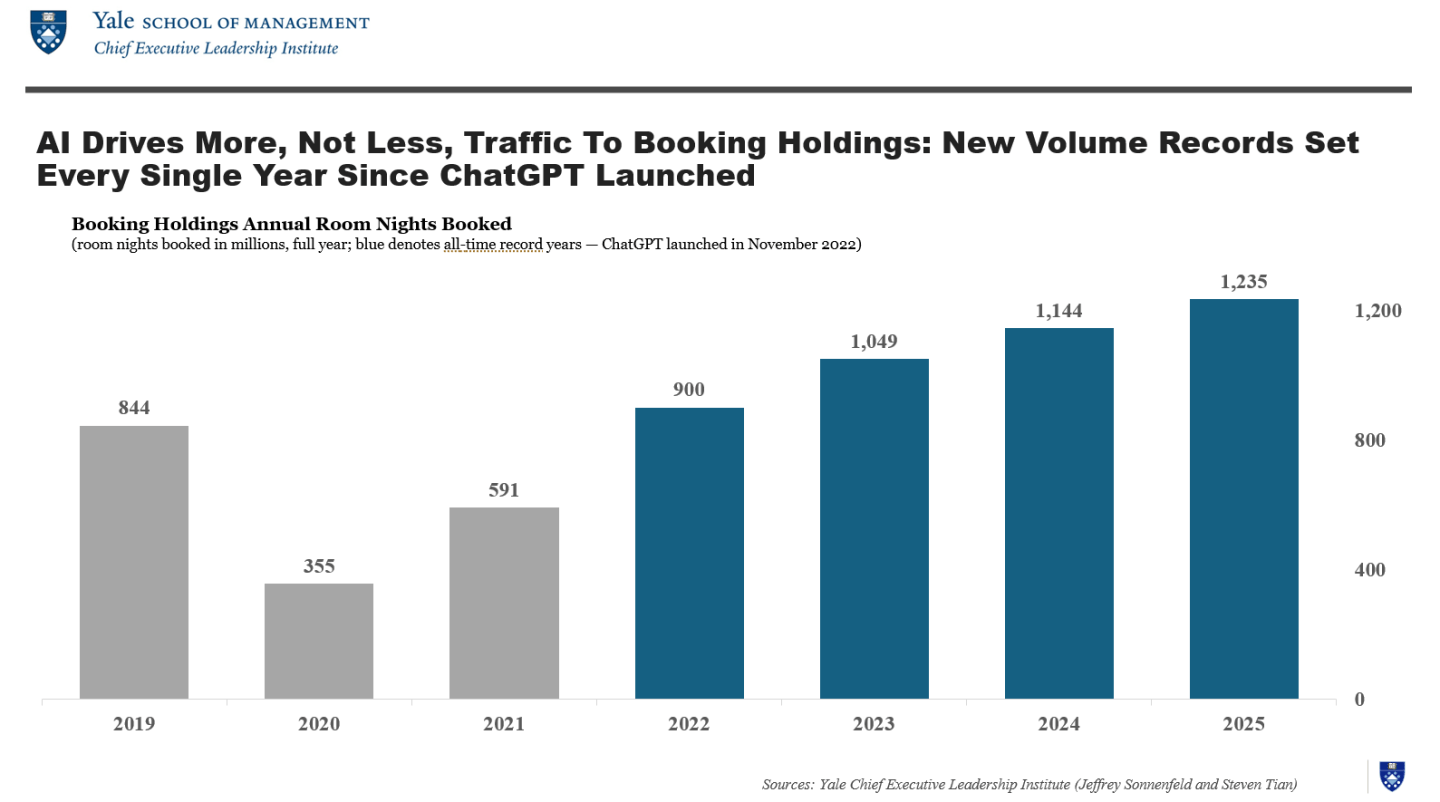
The bearish AI narrative here is also deceptively simple – and wrong. Earlier this year, some analysts presumed that if a traveler can ask a chatbot for a hotel or flight, who needs Booking.com? But time has shown just completely wrong those skeptics were, with Booking Holdings stock having now bounced back to near all-time highs, just as other OTA rivals such as Expedia have as well. The mistake these wrongheaded skeptics made was simple: they mistook Booking Holdings as a search engine when in reality, it is a differentiated travel transaction platform enjoying a strong competitive moat.
The distinction that matters, and which is too often overlooked, is between the top of the travel funnel, where trips are discovered, and the bottom, where money changes hands and the trip actually planned and executed. Travelers are indeed turning to AI for recommendations, and that is genuinely ominous for metasearch and referral businesses whose entire function was comparison. It is not ominous, however, for the company that is merchant of record on roughly three-quarters of its bookings — a share up four points in the past year and still fast rising — settling more than 100 payment methods across 50 currencies and adjudicating the thorny disputes and complex last-minute cancellations that AI platforms have shown no appetite to touch.
Indeed, Google’s own leadership declared that the company has “no intention of becoming an OTA (online travel agency)” and has zero interest in acting as merchant of record. OpenAI reached the same conclusion the hard way, retreating from in-chat checkout this spring after a badly botched rollout was widely panned.
Furthermore, contrary to popular perception, almost all of Booking.com’s room nights come from independent properties and smaller hotels, to the tune of 90% of all bookings, rather than large hotel chains. These smaller properties would never be able to run global payment processing, multi-currency settlement, and dispute resolution even if they are somehow able to surface independently through AI searches. This is the critical gap that Booking’s infrastructure fills, and why Bookings’ hotel partners are so loyal and not going anywhere anytime soon. The importance of this structural advantage shielding against LLM disruption can be seen in how Airbnb’s stock price is up 40% YTD, partly because its inventory of exclusive properties is seen as a strong moat against LLM disruption.
However, those same bears, undeterred by their prior mistakes as the overwrought SaasPocalypse “death” narrative faded, have now pivoted towards believing that just like with Salesforce, Booking Holdings will have less pricing power moving forward, and will have to pay more for customer acquisition than it did before with less direct customer loyalty, compressing margins and hindering profitability. But this margin compression thesis is equally wrong, as accelerating AI changes will only increase the relative power of Booking Holdings in the marketplace and make its value proposition more singular and irreplaceable.
Simply put, Booking Holdings is well positioned to use AI to gain even more market share from its less tech-savvy competitors. With Booking Holdings’ moat secure as the travel infrastructure provider of choice, there is every reason to think that AI will only drive greater traffic towards Bookings’ unique platform in the years ahead, rather than less. We are still in the earliest stages of this pivot, as AI-driven traffic has been remarkably limited for OTAs thus far. On its August earnings call, Booking disclosed that traffic sourced from large language models remains well below 1% of room nights, with no material change over recent quarters, while direct traffic held steady in the mid-60% range and grew in absolute terms.
But in a future where AI drives an inevitably greater share of discovery, building on the lessons it has learned bidding for web browser search traffic for 20 years, Booking Holdings is the best positioned of its competitors to apply those lessons to bidding for preferential AI traffic and advertising – with the same tried-and-true machinery for converting a click from search traffic, regardless of whether from AI or from a search engine, into a direct, repeated, loyal Booking customer. That is the same exact singular playbook Booking has pioneered to perfection under the continued leadership of Booking’s widely admired CEO, Glenn Fogel, who is seen as one of the best capital allocators of our era – all of which are unique advantages that position Bookings to be the biggest AI beneficiary of any of its competitors.
IBM
IBM bears wrongly believed they’d stumbled onto gold last month when IBM stock fell 25% in a single day, the worst in the company’s history, as several large clients redirected capital budgets towards memory amidst a severe memory crunch. Although a third of those supposedly lost deals ended up closing within the next few weeks, and IBM CEO Arvind Krishna won widespread plaudits for his honest transparency.
Nonetheless, a common misguided bearish narrative is that AI is poised to disrupt IBM’s $21 billion consulting business as well as its hugely profitable legacy software business, on which runs the core systems of many banks, insurers, and airlines.
But what some critics miss is that AI has actually been a boon for IBM’s consulting business: AI now accounts for half of all new consulting signings and is one of the largest components of IBM’s backlog — at far higher margins than traditional consulting, thanks to IBM now being able to bill on the basis of outcomes and productivity rather than brute hours worked. And Red Hat, the software that enables a company’s AI agents to run across any cloud and any platform, grew 11% as paradoxically, AI creates new needs for software powers continued revenue growth in the subscription software business.
Simply put, IBM is being paid to build the AI transition, not run over by it, which is why IBM’s AI business has more than doubled over the last year.
Paranoia and Panic Are Different
Everybody – ourselves included – concedes that AI is disrupting legacy technology and software companies. But financial markets seem to be tossing out the baby with the bath water, looking past vital software companies which own things that AI agents cannot run without. The key question now, is whether a company still owns something that AI agents need, and where the power in the marketplace lies. And we believe that power is rapidly shifting back to software firms which just months ago were seen as the biggest losers but are now quickly transforming into the biggest winners from AI.
Salesforce owns the data that AI agents cannot operate without. Booking Holdings owns the travel platform that agents cannot execute travel bookings without. IBM owns the underlying technological infrastructure that AI agents run on. Every one of these is a differentiated moat, which is worth more in a world of AI, not less. These are just three particularly compelling examples of several prominent software companies poised to benefit from AI, with ServiceNow under the capable and experienced leadership of CEO Bill McDermott and Snowflake also standing out as core examples.
As legendary Intel CEO Andy Grove famously quipped, “only the paranoid survive.” But paranoia and panic are very different, and amidst widespread panic across markets, commendable prudence has turned into reckless lack of discrimination in discerning AI winners and losers in the software space, with software bears missing the transformation taking place before our eyes as software firms turn into some of the biggest beneficiaries of AI.
The opinions expressed in Fortune.com commentary pieces are solely the views of their authors and do not necessarily reflect the opinions and beliefs of Fortune.