The Iran conflict has confirmed a transformation in the economics of warfare toward cheap, mass-produced weapons, forcing a wholesale rethinking of military procurement, according to a recent report.
While the U.S. and Israel have decimated Iran’s military, the Islamic republic still has enough combat power to inflict meaningful economic and physical damage, said Noah Ramos, chief innovation strategist at Alpine Macro, in a note earlier this month.
In particular, the regime has leveraged its Shahed drones, which cost only $20,000-50,000, forcing the U.S. and its allies to shoot them down with $4 million PAC-3 missiles or THAAD interceptors that cost $12 million-$15 million.
“Even with interception rates above 90%, the value of asset protection is diminished given the obscene economics,” Ramos wrote. “This imbalance has haunted Western military planners since the early days of Russia’s invasion of Ukraine.”
He explained that such lopsided attrition is the opposite of the West’s model of precision lethality and is a deliberate part of Iran’s strategy: mass losses are a feature not a flaw, because even the most advanced defenses can be overwhelmed with sufficient volume.
The cost asymmetry is worsened by severe production and supply-chain constraints. For example, no new THAAD interceptors have been delivered since August 2023, and the next batch is due in April 2027.
At the same time, the U.S. has rapidly drawn down stockpiles of its most expensive munitions during the Iran war. The Center for Strategic and International Studies put the tally at 45% of its Precision Strike Missiles, 50% of its THAAD interceptors, and almost half of its of PAC-3 missiles. CSIS estimated it would take one to four years to restock seven major munitions to prewar levels.
“The diminished munitions stockpiles have created a near-term risk,” the report said. “A war against a capable peer competitor like China will consume munitions at greater rates than in this war. Prewar inventories were already insufficient; the levels today will constrain U.S. operations should a future conflict arise.”
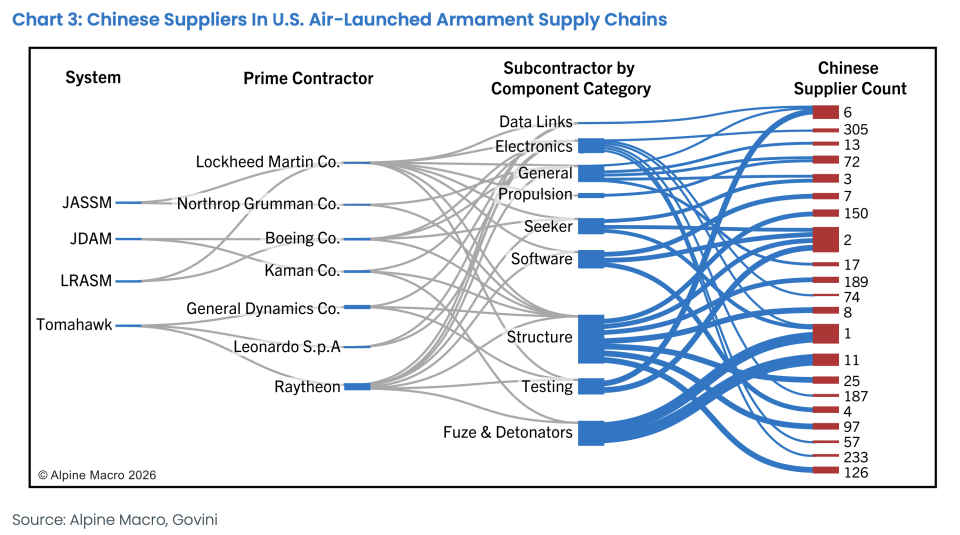
In fact, Alpine Macro’s Ramos pointed out that many critical components for a variety of U.S. munitions are deeply exposed to Chinese supply chains.
That includes the stealthy Joint Air-to-Surface Standoff Missile, the Tomahawk cruise missile, the Long-Range Anti-Ship Missile, and the Joint Direct Attack Munition guidance kit.
The U.S. military’s reliance on Chinese suppliers “poses a grave threat given geopolitical fragmentation or a conflict over Taiwan,” Ramos warned.
Despite the emergence of mass-produced munitions, Ramos still expects legacy platforms like fighter jets, strategic bombers, precision missiles, and warships to continue enabling force projection.
Rather than displacing so-called “exquisite” weapons, the more expendable systems will sit along side them and even amplify them, he predicted.
Cheaper weapons can exploit specific vulnerabilities, prevent expensive assets from being depleted, and carry out riskier missions unsuitable for traditional platforms, Ramos suggested.
“Going forward, supremacy will belong to the force that deploys the right tool for the right task at the right cost, not the one that defaults to multi-billion dollar platforms for every engagement,” he added. “The Iran conflict is proving this in real time.”
The Pentagon also understands the new economics of warfare that bring to mind a quote attributed to Joseph Stalin during World War II as he weighed the Red Army’s numerical advantage against Nazi Germany’s superior weapons: “quantity has a quality all its own.”
Efforts at cheaper, mass-produced platforms are underway while upstart defense contractors like Anduril are developing manufacturing innovations to enable hyperscale production.
The U.S. has even incorporated a copycat version of the Shahed drone, using the American version against Iran during the war. Emil Michael, the undersecretary of defense for research and engineering, said at an industry conference last month that the Pentagon plans to go big with the LUCAS drone.
“After only a few years, we continue to refine that and make that something that we can mass produce at scale,” he said. “They’ve worked very well so far and it’s proven out to be a useful tool in the arsenal.”
U.S. Army