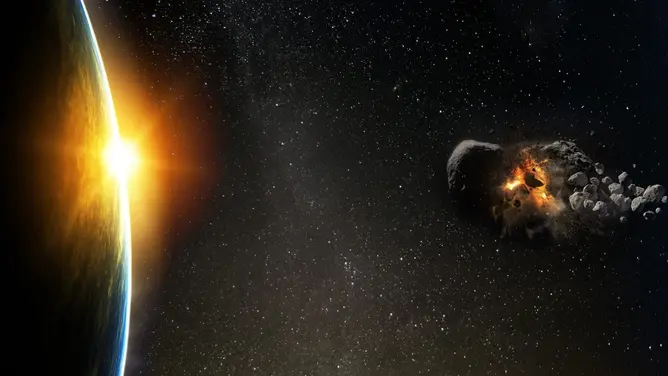
A meter wide asteroid collided with Earth’s atmosphere and exploded with light as it burned up near Nennhausen, Germany. Scientists at the SETI Institute forecasted the event which is how the photographer caught the spectacle.
If an asteroid was ever threatening Earth, the best way to stop it might be with a nuclear explosion, according to a new study published by Chinese scientists. But how exactly would this work?
That’s the question the research team, consisting of members from China Academy of Launch Vehicle Technology, Beijing Institute of Technology, and China Academy of Engineering Physics, has been trying to answer, focusing on asteroid targets of 328 feet or greater.
Asteroid flies near the earth orbit. Meteorite approaching Earth. Elements of this image furnished by NASA.
(Elen11/Getty Images / Getty Images)
If an asteroid of this size was ever on a direct path towards Earth, researchers theorize that one of two “defense modes” could be used to protect our planet from impact.
DANGEROUS ASTEROID NO LONGER EXPECTED TO HIT THE MOON IN 2032
Direct rendezvous impact blasting mode
This first mode would be used for any sized asteroid with short warning impact times.
In this mode, a large rocket with a nuclear device inside and a front end kinetic impacter would be launched and guided towards the targeted asteroid at full speed.
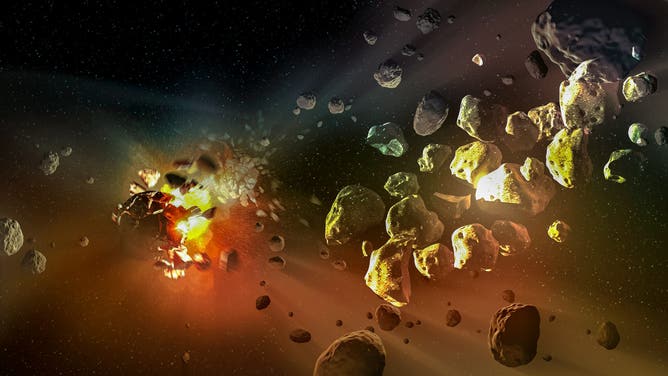
Meteorites in a deep space, science fiction fantasy, Elements of this image furnished by NASA.
(Elen11/Getty Images / Getty Images)
Once the rocket hits the asteroid, the front-end kinetic impacter creates a crater on the asteroid due to the force of the impact. The nuclear device would then be detonated inside the crater, changing the course of the asteroid.
The advantages of this mode include the ability to launch instantly, and the relatively simple system.
The fourth meteor in one week was spotted streaking across the night sky from Warren, Michigan, on Monday night.
EVERYTHING SCIENTISTS WOULD WANT TO KNOW IF AN ASTEROID WAS HEADING TOWARD EARTH
A downside of this mode would be the randomness on location and size of craters created on the asteroid due to the high speed impact and timeline. Another would be the possibility that the impact was not strong enough to create a deep enough crater.
Companion flight deepening crater blasting mode
This option is meant for asteroid targets that are larger and have ample warning time.
In this mode, a rocket is launched into orbit. The defense module is then deployed from the rocket, which does a flyby orbit of the asteroid to gain observations determining the place the penetration device can hit the asteroid.
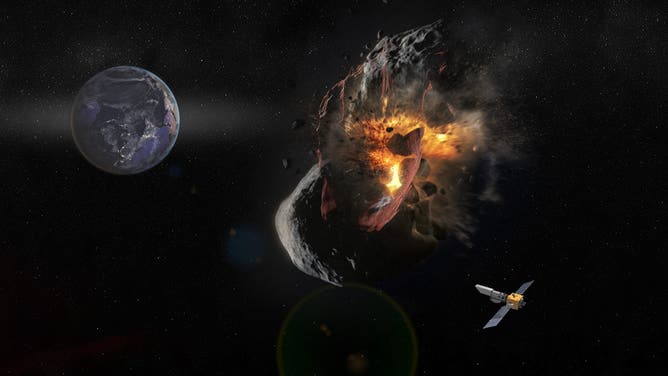
Saving planet Earth from asteroid. Explosion on a meteorite flying to the Earth. Spaceship flies away after a successful mission. Collage. Elements of this image furnished by NASA.
(Elen11/Getty Images / Getty Images)
Once the crater is made, the nuclear device autonomously enters it and detonates itself.
The advantages of this mode include the increased energy from the nuclear device, the site selection for the crater and the reliable detonation at lower speeds.
NASA SPACECRAFT SET TO INTENTIONALLY CRASH INTO AN ASTEROID TO HELP SAVE EARTH
Some disadvantages include the complex systems needed, and the demanding capabilities needed for the rockets.
Through modeling, the researchers concluded that both modes could destroy asteroids with a diameter below 100 meters, while providing “good defense effects” against asteroids up to a kilometer in diameter.
A video shared from the Philippines shows a bright asteroid burning through the atmosphere on Sept. 5, 2024.
In a real life scenario, scientists would have to weigh between the quicker mode that might not create enough impact on the asteroid, or the slower option to maximize the amount of energy directed towards the asteroid.
There are also numerous effects scientists would have to weigh, including downstream asteroid rubble hitting Earth and any technological issues that would come up with the complex technologies in real time.
While this study posed an interesting and important question for researchers to answer, hopefully we never truly have to test out how to stop an asteroid threatening our planet.