Monday, July 13, 2026
No Result
View All Result
LJ News Opinions
  • Home
  • U.S.
  • Politics
  • World News
  • Business
  • Entertainment
  • Sports
  • Technology
  • Health
  • Opinions
  • Home
  • U.S.
  • Politics
  • World News
  • Business
  • Entertainment
  • Sports
  • Technology
  • Health
  • Opinions
No Result
View All Result
LJ News Opinions
No Result
View All Result
Home Technology

The Milky Way is even BIGGER than we thought: Research reveals how our galaxy’s gigantic spiral arms stretch 10% further than previously believed

by LJ News Opinions
July 13, 2026
in Technology
0
Share on FacebookShare on Twitter


By SHIVALI BEST, SCIENCE & TECHNOLOGY EDITOR

Published: 06:58 EDT, 13 July 2026 | Updated: 07:06 EDT, 13 July 2026

The Milky Way is even bigger than we thought, a new study has revealed. 

Scientists from the European Space Agency spotted the aftermath of three bright explosions echoing through the outer spiral arms of our galaxy. 

By measuring the distance to those echoes, they found that the outer arms are actually 10 per cent further away than previously believed. 

‘We usually model the Milky Way’s outer arms indirectly based on what we know of how our galaxy rotates, but doing it this way leaves room for error,’ explained Beatrice Vaia of Istituto Nazionale di Astrofisica (INAF), Italy, who led the research. 

‘Instead, we did something new. 

‘We looked at the aftermath of three cosmic explosions that took place in far more distant galaxies. 

‘These explosions flung out X–rays that echoed through several of the Milky Way’s outer arms – and we measured the distances to these echoes directly.’

The findings could help to shed light on the structure of our galaxy’s outer regions.

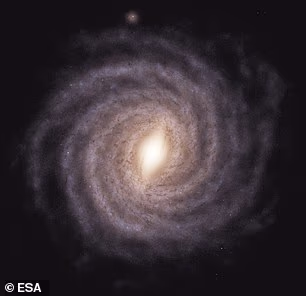
AFTER: Two of the Milky Way galaxy's arms (far left) ¿ Outer Scutum¿Centaurus Arm and Outer Arm ¿ lie up to 10 per cent further away than we thought

Scientists from the European Space Agency spotted the aftermath of three bright explosions echoing through the outer spiral arms of our galaxy. By measuring the distance to those echoes, they found that the outer arms are actually 10 per cent further away than previously believed

While our solar system sits within the Milky Way, scientists still don’t know much about its structure. 

However, this is changing, as new telescopes offer fresh views of our galaxy.

For example, scientists were previously unsure if the Milky Way had two or four arms. 

In 2020, observations by the Gaia space telescope confirmed that the answer is four. 

In their new study, the team used the XMM–Newton and NASA’s Chandra X–ray space telescopes to study the gamma–ray bursts thrown out by three bright explosions in the outer spiral arms of the Milky Way.

By studying how these bursts slowly expanded over time, the team was able to pinpoint the distance of the scattering dust grains. 

As these lie in clouds within the arms of our galaxy, the researchers could then directly measure the distance of the arms. 

The results revealed that two of the Milky Way galaxy’s arms – Outer Scutum–Centaurus Arm and Outer Arm – lie up to 10 per cent further away than we thought. 

By studying how these bursts slowly expanded over time, the team was able to pinpoint the distance of the scattering dust grains. As these lie in clouds within the arms of our galaxy, the researchers could then directly measure the distance of the arms

By studying how these bursts slowly expanded over time, the team was able to pinpoint the distance of the scattering dust grains. As these lie in clouds within the arms of our galaxy, the researchers could then directly measure the distance of the arms

‘This finding is a great example of how ESA’s longer–standing missions – such as XMM–Newton, which launched in 1999 – still have a hugely important role to play in exploring the Universe,’ said Erik Kuulkers, ESA XMM–Newton project scientist.

‘Now in its third decade, XMM–Newton continues to return a steady stream of groundbreaking science on everything from the brightest–ever GRB, to stars being shredded by black holes, to X–ray snapshots of Mars. 

‘It’s even more exciting when missions team up, as they did here. 

‘Together, they can reveal huge amounts about the skies around us.’

THE MILKY WAY’S OLDEST STAR

A star discovered in 2018 is thought to be one of the oldest in the Milky Way.

Scientists at the Instituto de Astrofísica de Canarias (IAC) in Spain believe that it might have formed about 300 million years after the ‘Big Bang’.

IAC researcher Jonay González Hernández said: ‘Theory predicts that these stars could form just after, and using material from, the first supernovae, whose progenitors were the first massive stars in the Galaxy.’

Researchers hope the star, known as J0815+4729, which is in line with the Lynx constellation, will help them learn more about the Big Bang, the popular theory about the galaxy’s evolution.

IAC director Rafael Rebolo said: ‘Detecting lithium gives us crucial information related to Big Bang nucleosynthesis. We are working on a spectrograph of high resolution and wide spectral range in order to be able to measure (among other things) the detailed chemical composition of stars with unique properties such as J0815+4729.’

Share or comment on this article:
The Milky Way is even BIGGER than we thought: Research reveals how our galaxy’s gigantic spiral arms stretch 10% further than previously believed


Source link

Tags: dailymailitalysciencetech
LJ News Opinions

LJ News Opinions

Next Post

CM Punk wins the Undisputed WWE Championship from Sami Zayn on Raw

Recommended

OCEARCH’s “most followed” shark pings of South Carolina coast

6 days ago

Cheers actress Shelley Long, 75, is all smiles in rare sighting a day after her longtime co-star was seen wheeled out of a dialysis clinic

1 year ago

Popular News

    Connect with us

    LJ News Opinions

    Welcome to LJ News Opinions, where breaking news stories have captivated us for over 20 years.
    Join us in this journey of sharing points of view about the news – read, react, engage, and unleash your opinion!

    Category

    • Business
    • Entertainment
    • Health
    • Opinions
    • Politics
    • Sports
    • Technology
    • U.S.
    • World News

    Site links

    • Home
    • About us
    • Contact

    Legal Pages

    • Privacy Policy
    • Cookie Privacy Policy
    • Terms of Use
    • Disclaimer
    • California Consumer Privacy Act (CCPA)
    • DMCA
    • About us
    • Advertise
    • Contact

    © 2024, All rights reserved.

    No Result
    View All Result
    • Home
    • U.S.
    • Politics
    • World News
    • Business
    • Entertainment
    • Sports
    • Technology
    • Health
    • Opinions

    © 2024, All rights reserved.