Many people like to start their day with a takeaway coffee – but a new study might convince you to rethink your order.
Researchers warn that single–use takeaway cups release millions of microplastic and even smaller ‘nanoplastic’ particles when exposed to hot liquid.
While these cups are mainly being made out of paper, they often include a thin plastic inner coating to keep them from leaking.
In a new study, experts warn that this lining is a ‘previously overlooked’ source of microplastic pollution.
Experts compared two types of single–use cups: one lined with fossil fuel–based polyethene (PE), and another lined with biodegradable polylactic acid (PLA).
Although it might seem like the greener option, the biodegradable PLA–lined cups actually release 12 times more microplastics than their PE–lined counterparts.
Co–author Dr Elvis Okoffo, an environmental health scientist from the University of Queensland, says: ‘This does not mean that people should necessarily stop using paper cups, or that PLA is inherently unsafe.
‘But the impact of plastic particles on human health is unclear, and we know that the chemicals in plastic are not meant to be consumed.’
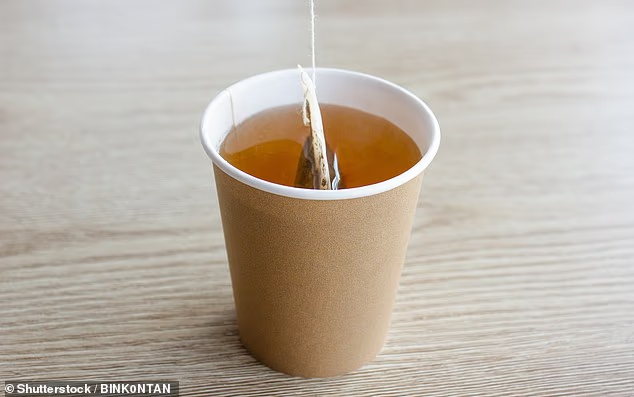
Researchers warn that single–use takeaway cups release millions of microplastic and even smaller ‘nanoplastic’ particles when exposed to hot liquid (stock image)

Despite these cups mainly being made out of paper, they often include a thin plastic inner coating to keep them from leaking. This is either made from fossil fuel–based polyethene (PE) or biodegradable polylactic acid (PLA)
Microplastics are tiny pieces of plastic ranging between one micrometre and five millimetres in diameter.
Nanoplastics, meanwhile, are even smaller – measuring around a thousand times thinner than a human hair.
Together, these microscopic plastic pollutants have been found almost everywhere on Earth, including inside the human body.
Since microplastics and nanoplastics are so small they can sometimes pass through the barriers in our guts, lungs and skin.
From there, the plastics enter the bloodstream and hitch a ride on red blood cells, travelling around the body and lodging in our organs.
While they now come from many different sources, what we eat and drink is a major way that these plastics enter our bodies.
In their new study, published in ACS Food Science & Technology, the researchers looked at whether single–use cups could be another possible source of pollution.
The researchers exposed plastic–lined paper cups to hot water, just like you would while making a cup of tea, and analysed the water after a short soak.

Biodegradable PLA–lined cups (red) released 12 times more microplastics than their PE–lined counterparts (blue)
They found that water kept in a PE–lined cup contained 2.7 million plastic particles per millilitre.
Meanwhile, water from the PLA–lined cup contained 4.3 million particles per millilitre, combining to 12 times the total mass released by the PE–lined cup due to the larger particle size.
Dr Okoffo says: ‘The materials used in food–contact products need to be evaluated not only for their environmental sustainability but also for their particle–release behaviour during everyday use.
‘Our results show that plastic–lined paper cups release substantial quantities of micro– and nanoscale plastic material when exposed to hot water.’
Scientists are only just starting to understand what impacts microplastic exposure might have on our bodies, and whether they are likely to be harmful.
Microplastic particles have been found in multiple organs, including the brain, testicles, heart, stomach, lymph nodes and placenta.
There is now growing evidence that this level of contamination could prove to be harmful.
Studies conducted on animals and cells in the lab have linked microplastics to inflammation, an impaired immune system, deteriorating tissues, abnormal organ development, and cell damage.

This comes after scientists from Universitat Autònoma de Barcelona warned that a single tea bag can release billions of dangerous microplastics (pictured) into your body
A large–scale review of the evidence conducted by the University of California, San Francisco, suggested that microplastics could harm our reproductive, digestive, and respiratory health.
The researchers even suggested a link to colon and lung cancer, while other papers have found a direct link between microplastic contamination and a higher risk of heart attack and stroke.
However, microplastic contamination is fairly new, and data is still somewhat limited.
What scientists do know for certain is that many plastics contain toxic chemicals which can ‘leach’ into your bloodstream.
However, not all plastics contain these harmful chemicals, and not all materials are equally prone to leaching.
Although the researchers don’t suggest that customers give up using paper cups just yet, they’re calling for regulators to consider implementing safety guidelines or product warnings.
‘Nanoplastic release should form part of the safety assessment of food–contact materials, particularly products designed for hot beverages,’ says Dr Okoffo.
‘Product manufacturers could also consider developing cup linings that release fewer plastic particles when exposed to hot liquid.’