The Gulf Stream may be on the verge of collapsing as a key ocean current weakens, scientists have warned.
The Atlantic Meridional Overturning Circulation (AMOC) is a vast network of ocean currents which drives warm water northwards through the Gulf Stream.
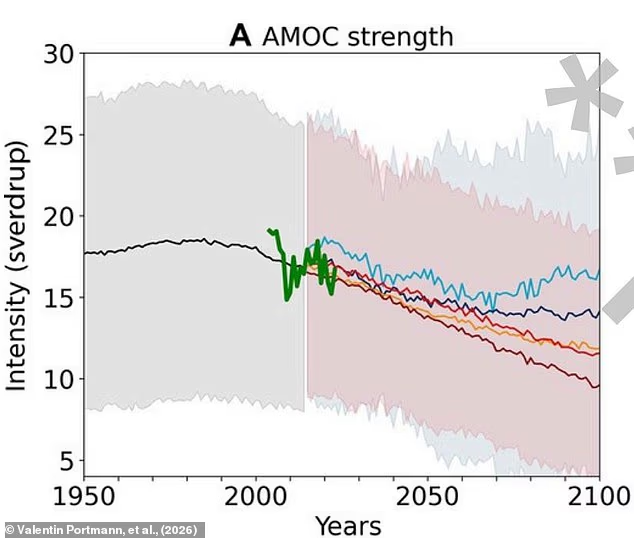
In a new study, scientists from the University of Bordeaux say that AMOC is on track to weaken 50 per cent by the end of this century.
Scientists previously thought AMOC would only reduce in strength by around 32 per cent over this time period.
This has raised concerns that the world may be unprepared for the rapid climate changes that this dramatic weakening will bring.
In their new paper, published in Science Advances, the researchers say this will trigger ‘significant modifications’ to the global climate in the future.
The slowdown could lead to ‘extensive drying’ in Africa’s drought and famine–stricken Sahel region, according to the experts.
Meanwhile, temperatures in the Northern Hemisphere will plummet as the Gulf Stream fails to bring warm water up from the Tropics.
In a new study, scientists from the University of Bordeaux say that AMOC is on track to weaken 50 per cent by the end of this century
The AMOC functions like a giant ocean conveyor belt, transporting water and heat all around the globe.
The ‘engine’ that powers this conveyor belt is the sinking of cold, salty water in the freezing oceans around Greenland.
As warmer water freezes, it becomes saltier and denser, sinking to the bottom of the ocean and pulling more warm water northwards in its wake.
However, as fresh water from melting glaciers pours into the ocean, the water around the poles is becoming less dense, gradually slowing the AMOC’s steady flow.
Previous studies have already warned that AMOC is slowing, leaving the system teetering on the edge of a tipping point.
However, the researchers say that these earlier studies actually underestimated just how fast AMOC is slowing down.
This is because simulations of the ocean current made assumptions about the ocean’s surface temperature and salinity that were more optimistic than the real data suggests.
Scientists had thought that there had been a steeper ‘salinity gradient’ between the very salty water near the poles and the less salty surrounding water.

A decline of 50 per cent is considered ‘substantial weakening’ by the UN’s Intergovernmental Panel on Climate Change, bringing AMOC dangerously close to the point of collapse
The researchers write that this ‘might lead them to overestimate the future gradient, leading to a too strong AMOC in the future.’
In particular, the researchers noticed a bias in salinity levels for the surface of the South Atlantic.
To correct this, the researchers created a new model of AMOC that is designed to match the best real–world data we have.
Once this model corrected the temperature and salinity biases, the rate at which AMOC is expected to slow sharply increased.
If AMOC slows, it will reduce the amount of warm water being distributed around the planet, leading to severe changes in global weather patterns.
The researchers say this will ‘have important implications for future adaptation plans in various regions affected by the AMOC’ and cause ‘significant modifications to the climate change projections’.
Additionally, the experts warn that this unexpectedly rapid decline will introduce new weather risks, such as drought in Africa, that governments must be ready for.
Most concerningly of all, the slower that AMOC becomes, the greater the risk that this key current collapses for good.

Studies suggest that the collapse of AMOC could lead to a new ‘Ice Age’ in the Northern Hemisphere as temperatures over Europe plumet and ice encroaches from the Arctic just like the disaster movie ‘The Day After Tomorrow’ (pictured)
According to the UN’s Intergovernmental Panel on Climate Change, a slowdown of 50 per cent is considered a ‘substantial weakening’, increasing the risk of total collapse.
Studies have shown that this collapse would trigger rapid cooling in the Northern Hemisphere, making the chilliest winters in the UK could become up to 7°C (12.57°F) colder on average.
Meanwhile, the Southern Hemisphere would warm, with temperatures over the Antarctic soaring more than 10°C (18°F).
This could spell disaster for the continents’ already–fragile ice sheets and glaciers, threatening to increase global sea levels.
Studies have predicted that the collapse of Antarctica’s Thwaites Glacier, known as the Doomsday Glacier, could increase sea levels by a staggering 65 centimetres.
Professor David Thornalley, a climate scientist at University College London, previously warned that temperatures would plummet if the AMOC collapsed.
‘An AMOC collapse could cause more weather extremes, so as well as overall colder–than–average conditions, we also expect that there would be more winter storms caused by stronger westerly winds,’ he told the Daily Mail.
‘Unfortunately people would die due to stronger winter storms and flooding, and many old and young would be vulnerable to the very cold winter temperatures. ‘