
Star-gazing mania gripped the nation on Wednesday night as millions marvelled at the once-in-a-generation solar eclipse.
As Britain sweltered in the fifth heatwave of the year, an eerie yet welcome chill descended as the Moon blocked out the unrelenting 30C sunshine.
Throughout human history, eclipses have stirred wonder, fear and reverence. The uncanny sensation – as day briefly turned into a strange twilight – caused temperatures to drop, shadows to appear at odd angles and animals to behave unusually.
The spectacle of our Moon ringed by a fiery halo set pulses racing across the world. Millions watched the sky show in awe, starting when the Moon took its first bite out of the Sun’s right-hand edge shortly after 6pm in the UK.
It began at 6.08pm in Edinburgh, 6.17pm in London and 6.18pm in Cornwall. The Moon gradually slid across the face of the Sun until it all but snuffed out the light around an hour later. The best place to witness the phenomenon was the Spanish city of Burgos, which enjoyed 100 per cent totality lasting nearly two minutes.
Laura Stewart, a 35-year-old lawyer, was among 500 gathered on London’s Primrose Hill. She told the Daily Mail: ‘It feels utterly enchanting.’ Aja Lilit, 24, of Uxbridge, west London, added: ‘I can see the Moon and the Sun. I am nothing – but also a part of this. This is just so amazing.’
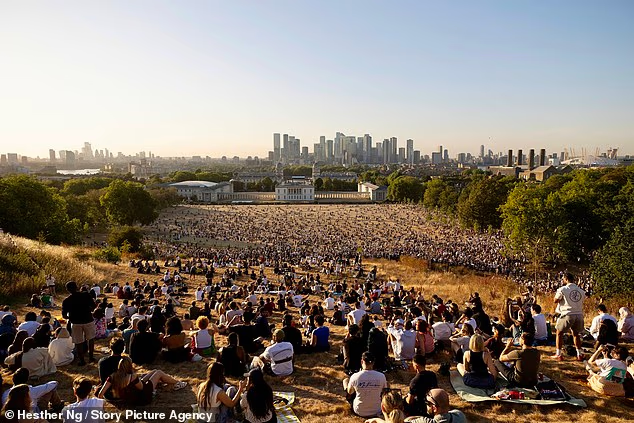
Gasps of ‘wow’, ‘oh my god’ and ‘this is so cool’ rang out at Greenwich Park in south-east London.
It was the first proper solar eclipse in Britain since August 1999. That was blighted by clouds, ruining the experience for many, but on Wednesday night, most of England enjoyed beautifully clear skies. The frenzy swept the UK from Inverness to Penzance and beyond. The best place to see it was Bishop Rock in the Isles of Scilly, where 96.5 per cent of the Sun was obscured.
Londoners gather at Greenwich Park to witness the rare solar eclipse on Wednesday evening, with the moon covering more than 90 per cent of the sun

People watching the solar eclipse at the Royal Observatory Greenwich, London, the first total solar eclipse visible over mainland Europe since 1999

As Britain sweltered in the fifth heatwave of the year, an eerie yet welcome chill descended as the Moon blocked out the unrelenting 30C sunshine at Northala Fields in London

The Moon passes in between the Earth and the Sun 7.13pm, during the solar eclipse as seen from King’s Stairs Gardens in Bermondsey, south London

People view a partial solar eclipse beside St Michaels Tower on Glastonbury Tor, in Glastonbury

The solar eclipse by Canary Wharf as seen from near the 02 Arena, Greenwich
Devon, Cornwall and the westernmost parts of Pembrokeshire in Wales also got fantastic views. For those in Scotland and Northern Ireland, whose views were spoiled by clouds, the Royal Observatory Greenwich live-streamed the event online. A crowd at the National Space Centre in Leicester erupted into cheers after counting down from ten. Benjamin Firmager-Lee, 12, who wants to work for Nasa, said: ‘It’s really quite rare so it’s quite cool to see.’
On Crosby beach in Merseyside, a DJ played Here Comes The Sun by The Beatles.
The next partial eclipse visible in the UK is not until November 14, 2050, and the next total eclipse is not until September 23, 2090, when a baby born today will be aged 64.
On Wednesday night, for a few minutes, temperatures dipped noticeably in a brief respite from the UK heatwave which is on course to make 2026 the hottest summer since the famous scorcher of 1976.
Excited Britons had queued for hours throughout Tuesday night and Wednesday in a bid to get their hands on solar eclipse glasses – the only safe way to directly watch the Sun. Looking at the Sun for a short amount of time can cause permanent damage to the retina, which does not register pain.
Police in Bristol were called when a queue for free specs grew ‘unruly’ in what was dubbed ‘a scene from the movie Independence Day’. One canny salesman was seen selling them in London’s West End at £50 a pop.
In Rayleigh, Essex, Steven Hickey, 51, of Hickey’s DIY, said: ‘It’s been non-stop. It’s chaos. I’ve never had anything like this since the [Covid] lockdown.’ Cambrian Photography, in Colwyn Bay, Conwy, had people queuing down the street as customers snapped up 500 pairs in just a few hours.
John Lewis said colander sales had soared 40 per cent after Nasa recommended the kitchen essential as a way to view the shadows of round holes turning to crescents, rather than staring at the sun.

At 18.28, Greater Manchetser could see the moon begin transiting between the Earth and the Sun

By 19.08, the moon had covered the sun by more than 90 per cent, plunging Manchester city centre into darkness

People watch the solar eclipse during the European Athletics Championships Birmingham 2026

A family gathers on the moor to watch the solar Eclipse through home made welding glasses in Blackwood, Wales

Molly the dog is held with eclipse glasses over her eyes during the solar eclipse at King’s Stairs Gardens in Bermondsey, south London

People queue on the downs in Bristol to watch the partial solar eclipse

Arsenal fans are seen using cardboard and a colander to try and see the solar eclipse prior to the pre-season friendly match between Arsenal FC and Como Calcio at Emirates Stadium

People gathering to watch the solar eclipse on Calton Hill, Edinburgh, the first total solar eclipse visible over mainland Europe since 1999

Spectators don welding masks ahead of the solar eclipse in an effort to protect their eyes while watching the rare natural phenomenon

Crowds gather at the Gateshead Angel of the North to watch the most significant solar eclipse since 1999
Following the 1999 eclipse, hundreds called hospital helplines with blurred vision. The Royal College of Ophthalmologists said around 70 cases of people had suffered vision problems after looking at the two-hour phenomenon for less than a minute.
It is only due to an incredible cosmic coincidence that perfect solar eclipses can occur on Earth. While the Moon is about 400 times smaller than the Sun, it also happens to be about 400 times closer to Earth – allowing it to perfectly obscure the giant star.
As an astronomical encore, a few hours after the eclipse, the sky was filled with shooting stars as the Perseid meteor shower approached its annual peak, as the Earth ploughed through dust left behind by the Swift-Tuttle comet.
Nasa scientists used Wednesday night’s eclipse to unlock secrets of the Sun, sending a high-altitude WB-57 aircraft from Iceland to follow the Moon’s shadow, and launching balloons to study how the sudden darkness and cooling affect the lower atmosphere.


