Utqiagvik, Alaska—known as the land of the
June has a vibrant lineup of celestial events that will offer unforgettable viewings for skywatchers to start off the summer.
THE BEST CELESTIAL EVENTS IN 2026 YOU WON’T WANT TO MISS
From the conjunction of two of the brightest plants in our galaxy to the June Solstice, this month has countless opportunities to witness life-changing astronomical events.
Here is everything you can look forward to this month.
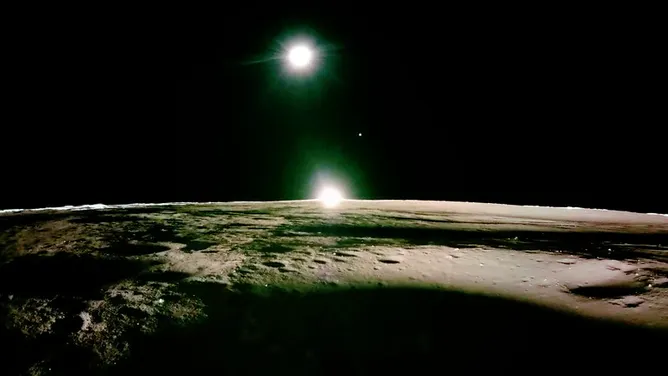
Sunset with Earth and Venus on Horizon taken by Blue Ghost on March 16, 2025.
(Firefly Aerospace)
June 9 — Venus-Jupiter Conjunction
May is kicking off with the Venus–Jupiter Conjunction, which is when both planets will appear a little more than one degree from each other in the sky.
This is about the width of a thumb held at arm’s length.
LOOK UP: RARE BLUE MOON AND 4 PLANETS WILL SHINE ACROSS THE SKY AT THE END OF MAY
Skywatchers will be able to view the two brightest planets in the western sky just after sunset.
As a bonus, Mercury may also make a rare appearance just below the two bright planets.
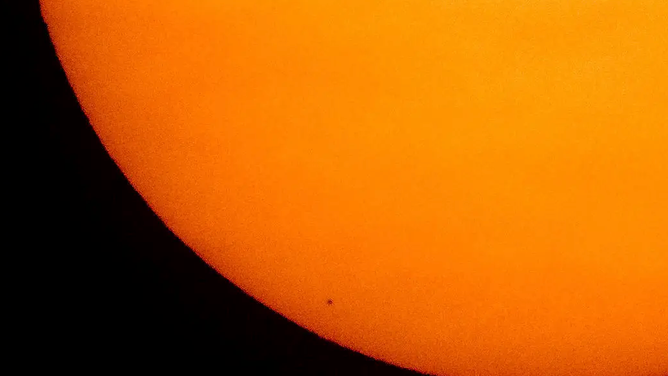
Mercury can be seen crossing the face of the Sun at the bottom of this picture.
(NASA/Bill Ingalls)
June 15 – Mercury at Greatest Eastern Elongation
Just a few days after the Venus-Jupiter Conjunction, Mercury will reach its widest apparent separation from the sun.
This means that the planet will be at its greatest eastern elongation of 24.5 degrees from the sun.
WHAT ARE THE PHASES OF THE MOON?
This will be the best time for skygazers to view Mercury since it will be at its highest point in the evening sky.
June 15 – New moon
On the same day that Mercury reaches its greatest eastern elongation, a new moon cycle will begin.
This moon will not be visible in the night sky, making it the best time of the month to observe galaxies and star clusters.

The sun rises behind the skyline of midtown Manhattan and the Empire State Building in New York City, a day ahead of the summer solstice and an expected heatwave on June 19, 2025, as seen from Jersey City, New Jersey.
(Gary Hershorn / Getty Images)
June 21 – June solstice
At the June solstice, the sun will reach its northernmost point. During this solstice, the Northern Hemisphere is more tilted towards the sun.
This means that in the Northern Hemisphere, the June solstice marks the shortest nights and longest days of the year. For the Southern Hemisphere, however, it marks the longest nights and shortest days.
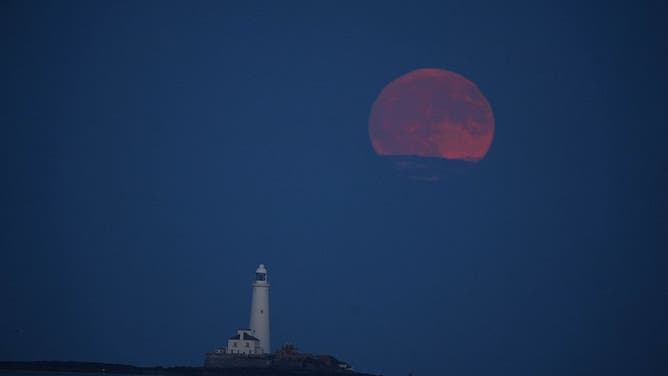
The full moon, also known as the Strawberry Moon rises rises over St Mary’s Lighthouse in Whitley Bay.
(Owen Humphreys/PA Images via Getty Images / Getty Images)
Once the solstice passes, the sun will begin to move towards the south.
June 29 – Full moon
June is ending with a full moon known as the Strawberry Moon.
This moon was named for the traditional strawberry harvest in parts of North America.
MEET RISE, THE BELOVED ARTEMIS II MASCOT THAT TRAVELED TO THE MOON AND BACK
This will be the first full moon of summer in the Northern Hemisphere and will be the second-smallest full moon of the year.