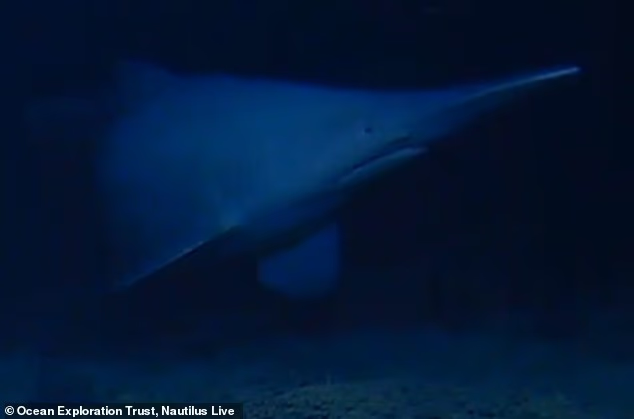
A goblin shark has been seen alive in its natural habitat – not just once, but twice.
Scientists were reviewing footage captured at a seamount near Jarvis Island in 2019 when they spotted the elusive animal.
Then, a second observation was made during an expedition to the Tonga Trench in 2024.
These creatures have only previously been seen after being hooked on fishing lines and brought to the surface – where they soon died.
With a long, prominent snout, the species is certainly unusual to look at, with one researcher even joking that it has a face ‘not even a mother would love’.
‘The goblin shark is a deep–sea charismatic animal, and I never thought we’d see one alive,’ said Professor Alan Jamieson, co–author of the study.
‘It’s not only seeing it alive that was fascinating, but also the fact the Tonga Trench goblin shark was 700 metres deeper than previous known, making it the deepest–known white shark.
‘On that expedition we filmed over 50 days of continuous footage between depths of 800 and 10,800 metres and this observation was a little over 20 seconds long which is testament to how elusive this species is, and how special it is to have two observations in the same study.’
A goblin shark has been seen alive in its natural habitat – not just once, but twice. Pictured: a goblin shark spotted in the Tonga Trench in 2024

Scientists were reviewing footage captured at a seamount near Jarvis Island in 2019 when they spotted the elusive creature
Goblin sharks are often referred to as ‘living fossils’, as they’re the only living representative of their family – a lineage of sharks that is nearly 125 million years old.
Until now, they’ve only been seen at the surface.
However, in a new study led by researchers from the University of Hawaii at Manoa and the University of Western Australia, the species has been documented twice.
In 2019, a deep–sea rover was filming around Kingman Reef, Palmyra Atoll, and Jarvis Island within the Pacific Remote Islands Marine National Monument.
After hearing about a potential sighting, the researchers combed through the footage, and confirmed that the shark spotted was in fact a goblin shark.
Then, in 2024, a second observation was made during an expedition to the Tonga Trench.
‘Seeing the most iconic of all the deep–sea sharks alive and looking healthy in its natural habitat is a unique honour,’ said Aaron Judah, lead author of the study.
‘I was also very surprised about how deep this species was found.

With a long, prominent snout, the species is certainly unusual to look at, with one researcher even joking that it has a face ‘not even a mother would love’

Goblin sharks are often referred to as ‘living fossils’, as they’re they only living representative of their family – a lineage of sharks that is nearly 125 million years old. Until now, they’ve only been seen at the surface
‘The observation from the slope of the Tonga Trench is nearly 700 meters deeper than this species was known to live.’
The researchers hope the findings will highlight just how little of Earth’s oceans have been explored.
‘It is really important that we still perform natural history work,’ Mr Judah added.
‘New discoveries like this demonstrate that there is still so much to explore in our deep ocean home.
‘Given the newly–expanded geographic range of the goblin shark, this species can be included in regional management and a nationʻs biodiversity list, whereas, beforehand we didnʻt know it was even there!’
Speaking to The Guardian, Professor Calum Brown, an expert in fish at Macquarie University, called the goblin shark the ‘ugliest shark on the planet’.
He said: ‘They are ridiculously horrendous to look at. Not even their mother would love their faces.
‘They have these really weird long noses and bizarre protrudable jaws, so when they detect prey with their long snout, their jaws can shoot forward and grab on to it.
‘It’s like something out of a horror movie.’
HOW SHARKS EARNED THEIR RUTHLESS REPUTATION
Sharks are the most efficient predators on earth and have long terrified humans.
Their basic design has never really changed over the course of 200million years and they are considered to be complex and intelligent.
Their teeth are fear factor number one, with the great white’s teeth growing up to two-and-a-half inches in length.
Their prey are impaled on the pointed teeth of the lower jaw where they saw away sections of the flesh. The serrated edges of the teeth help with this process.
Their teeth are brittle and are constantly breaking off but are also constantly regrowing and on average there are 15 rows of teeth present in the mouth at one time.

Sharks are the most efficient predators on earth. Their basic design has never really changed over the course of 200million years
Their speed is fear factor number two.
They are very fast in the water compared to humans with the mako shark able to reach an incredible 60mph in bursts.
The great white can reach speeds of 25mph.
By comparison, 5mph is the fastest a human being can reach.
A shark’s power and size terrifies us, too.
The great white shark can grow up to 20 feet and while it has no particular taste for humans even an exploratory bite is enough to cut a man in half.
Most sharks release a human after its first bite but sometimes, that’s all it take to kill a person.
However, sharks have far more reason to be afraid of humans. We kill up to a million of them a year, often just cutting off their fins to make into soup and throwing the rest of the shark back into the water, where it starves or drowns.