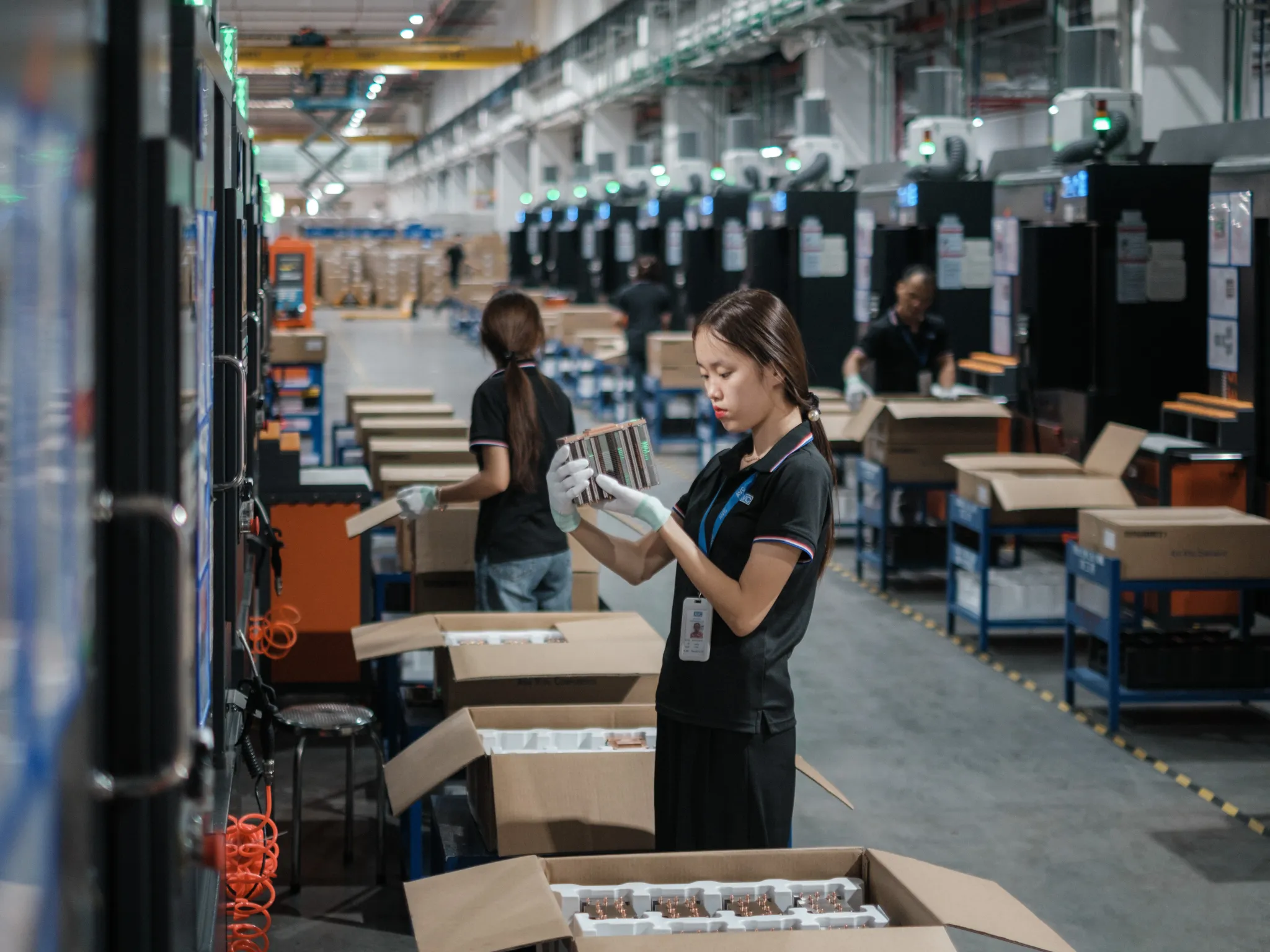
Taiwan is on track for its first year of double-digit GDP growth since 2010, thanks to surging demand for AI hardware exports. It’s not the only economy reporting surging growth and export numbers. Japan, Malaysia, Singapore and mainland China all reported over 20% growth in exports in July. Exports from South Korea, home to chipmaking giants SK Hynix and Samsung, surged by more than 60%. Second-quarter GDP growth also beat expectations in economies like Singapore, Hong Kong and Taiwan, thanks to electronics exports.
Equity markets, too, are experiencing the AI boom. Shares in both chipmaker ChangXin Memory Technologies and robot manufacturer Unitree surged more than 450% on their first days of trading, on July 27 and August 19 respectively. Japan’s Nikkei 225 and Thailand’s SET index are both up around 25% for the year; even after recent declines, South Korea’s KOSPI is almost 60% higher year-to-date.
Yet economists who study the region are worried that AI’s gains won’t be evenly shared across Asia—and that for Southeast Asia’s economies, which sit on the lower end of the value chain, the boom could be more of a “short-term blip.”
“The sugar rush economic boom that Southeast Asia is experiencing is from providing the supporting—not leading-edge—semiconductors, and the power and resources to drive data centers,” Danny Quah, an economist from Singapore’s Lee Kuan Yew School of Public Policy (LKYSPP), tells Fortune. “But these are commodifiable, and no one will have a sustained comparative advantage in them.”
Southeast Asia’s AI opportunity
For now, at least, Southeast Asian nations are benefiting from the AI boom.
On August 11, Singapore sharply lifted its annual economic growth forecast from 2-4% to 4.5-5.5%, citing a boost from AI-related sectors and exports. The city-state’s deep bench of semiconductor talent has made it a regional base for global developers and cloud providers.
Malaysia is also tapping its established position in chip assembly, testing and packaging, while Thailand and Vietnam have also attracted investments in data centers, cloud computing and electronics.
Kuala Lumpur, specifically, is rolling out a National AI plan that hopes to push local firms to move into higher-value segments of the AI supply chain. “Malaysia is not merely a user of AI; we must build our own capabilities, strengthen the ecosystem and compete globally,” the country’s communications minister Fahmi Fadzil wrote in an April Facebook post.
Yet experts warn that Southeast Asia’s competitive edge—its abundance of cheap, low-skilled labor—could trap it at the bottom rungs of the AI tech ladder. This edge could also erode further as the region’s populations age, or if it loses workers to brain drain. Malaysia, for instance, has long seen an outflow of skilled talent to Singapore and the West, and is projected to become an “aged nation” by 2048, when 14% of its citizens will be aged 65 and above.
“Malaysia has largely consolidated its pre-existing niches in the back-end phase of semiconductor manufacturing,” explains Guanie Lim, an associate professor at Japan’s National Graduate Institute for Policy Studies (GRIPS). “The country’s perennial inability to escape the middle-income trap is partly a function of its hosting of industries where competitive advantage lies primarily through low-cost labor.”
Grid reliability and water shortages also limit data center buildout in Southeast Asia. The region, which imports much of its oil and gas from the Middle East, has been hard hit from supply disruptions from the U.S.’s war with Iran.
“Energy is a key constraint, especially where grids are congested, and Southeast Asia may add data center capacity faster than its electricity networks and expertise can expand,” says Ramikshen Rajan, a professor at the LKYSPP. “Data center investment also only delivers lasting benefits when it develops local suppliers and skills, while giving domestic firms access to computing capacity.”
These structural shortcomings mean that Southeast Asian governments can’t be too ambitious in their AI strategies.
“In AI, only China and the U.S. can generate frontier models. We need to recognize that in this game we are consumers, not competitors, and users, not producers,” argues Quah.
Geopolitical faultlines deepen
Economic capacity is one fault line in Asia’s AI boom. Geopolitics is another.
Last week, a Reuters report revealed that the U.S. was preparing to tell dozens of countries to pick a side in the AI race with China, as the two superpowers launched competing multilateral collaboration frameworks: the U.S.-led Pax Silica, and China’s WAICO, or the World Artificial Intelligence Cooperation Organization.
“To be part of everything is to be part of nothing. The signature of the Pax Silica Declaration is not merely a membership subscription, but a commitment,” the draft of the letter prepared by the U.S. State Department and reviewed by Reuters, read. “It cannot be held alongside membership in duplicative initiatives whose expectations conflict with our own.”
The letter was penned after the Central Asian nation of Kazakhstan had reportedly joined both initiatives, a move which set off alarm bells in Washington.
China is also building its own full-stack AI ecosystem, while reducing reliance on U.S. tech. The country is investing widely in chips, computing infrastructure, frontier models and embodied AI applications.
According to testimony to the U.S. Congress by Kyle Chan, a fellow at Washington-based think tank Brookings Institution, “the goal of Chinese policymakers is not to achieve artificial general intelligence, but to leverage it as a powerful, general-purpose technology that will turbocharge a wide range of sectors and services.”
Yet this escalating rivalry spells trouble for Southeast Asia, whose economic model has long been built on openness, cross-border networks and investments from multiple sources.
“The concern is that competing frameworks could increasingly link access to technology, investments and markets to participation in one ecosystem or the other,” says Denis Hew, a senior research fellow at LKYSPP. “Smaller economies with limited technological capabilities and bargaining power may have little choice but to pick a side; if this happens, it will constrain ASEAN’s longstanding approach to strategic hedging and economic diplomacy with the major powers.”
A fragile hedge
To some experts, the ASEAN Digital Economy Framework Agreement, or DEFA, presents a possible solution. It’s the world’s first region-wide digital economy treaty, which unifies rules for digital trade and e-commerce across Southeast Asia, and is set to be signed in November.
“Geopolitical fragmentation makes DEFA considerably more important because ASEAN needs a mechanism for maintaining economic interoperability, even when its members adopt different technological alignments,” explains Tan Kong Yam, an emeritus professor of economics at Singapore’s Nanyang Technological University.
Ultimately, Asia’s middle powers will have to continue walking the tightrope between the two global superpowers. “They need to seek selective alignment, cooperating with Washington on sensitive technology while preserving commercial links with China as a major market and infrastructure partner,” Rajan concludes. “But demands for exclusivity from either side will narrow their room for maneuver.”