
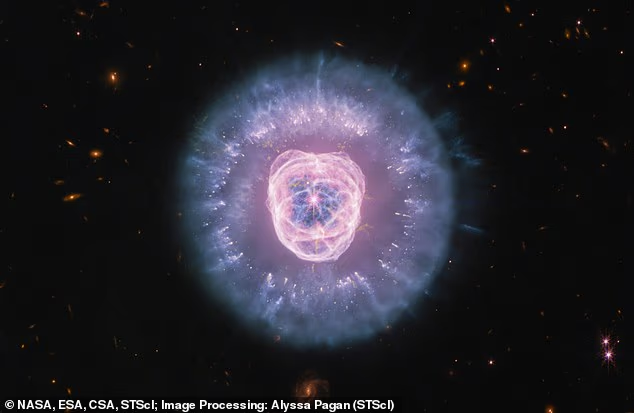
NASA‘s James Webb Space Telescope has snapped stunning new images of the ‘Lion Nebula’.
Officially known as NGC 2392, the nebula gets its nickname thanks to its resemblance to a lion.
Around the edge of the nebula, hazy structures form a ‘mane’, while the stellar core, located at the centre, looks just like a button nose.
The Lion Nebula was first photographed in visible light by the Hubble Space Telescope back in 2000.
Now, James Webb has provided an even sharper look at the cosmic object in infrared.
‘Webb’s imagery “freezes” this planetary nebula in time, though the star’s death, and its tumultuous effects, go on,’ NASA explained.
‘NGC 2392 will continue to undergo changes as its gas and dust migrate away from the stellar core.
‘Astronomers estimate the lion will eventually disperse in approximately 10,000 years – a relatively short period in astronomical terms.’
NASA’s James Webb Space Telescope has snapped stunning new images of the ‘Lion Nebula’. Pictured: the NIRCam and MIRI image

James Webb has provided an even sharper look at the cosmic object in infrared. Pictured: the photo taken by the MIRI camera
The Lion Nebula is located around 5,000 light–years from Earth, in the constellation Gemini.
It formed when the star at its centre died, shedding its outer layers into space, and leaving behind a stellar core called a white dwarf.
‘In the Lion Nebula, the oxygen–rich central star has died and left behind a white dwarf that is effectively “cooking” the nebula from within,’ NASA explained.
‘Its intense radiation is creating a bubble of ionized gas that makes up the lion’s recognizable face.
‘As this bubble grows, it sweeps outward and destroys dust in its path.
‘Astronomers are still working to understand why this swept–up gas forms such complicated arrangements of rings and shells, structures that are commonly seen in planetary nebulae.’
James Webb observed the nebula with two cameras – the NIRCam (Near Infrared Camera), and MIRI (Mid Infrared Instrument).
The photos reveal several elements in incredible detail.

The Lion Nebula was first photographed in visible light by the Hubble Space Telescope back in 2000
Located at the centre is the remains of the star itself.
NASA said: ‘Though it looks like the button nose of the lion, its energy and radiation are powering the intricate structures seen here.’
Meanwhile, the lion’s mane corresponds to the inner region of a dust shell.
‘Within it are structures that resemble tufts of hair or comet–like tails,’ NASA explained.
‘These features are actually compact clumps of dust that have managed to withstand radiation from the stellar core.
‘By blocking some of that radiation, the dense clumps also shield material located behind them.’
WHAT WILL HAPPEN TO EARTH WHEN THE SUN DIES?
Five billion years from now, it’s said the Sun will have grown into a red giant star, more than a hundred times larger than its current size.
Eventually, it will eject gas and dust to create an ‘envelope’ accounting for as much as half its mass.
The core will become a tiny white dwarf star. This will shine for thousands of years, illuminating the envelope to create a ring-shaped planetary nebula.

Five billion years from now, it’s said the Sun will have grown into a red giant star, more than a hundred times larger than its current size
While this metamorphosis will change the solar system, scientists are unsure what will happen to the third rock from the Sun.
We already know that our Sun will be bigger and brighter, so that it will probably destroy any form of life on our planet.
But whether the Earth’s rocky core will survive is uncertain.


