We share many things with the great apes – opposable thumbs, complex social lives and even a fondness for the occasional family squabble.
But scientists have discovered another thing we have in common with our closest living relatives: our laugh.
Researchers say the distinctive rhythm of human laughter has remained largely unchanged for at least 15 million years.
That means the chuckles, giggles and belly laughs we experience today may have their roots in an ancient ancestor shared with chimpanzees, gorillas, bonobos and orangutans.
The findings could offer a rare clue to one of science’s biggest mysteries – how humans evolved the ability to speak.
Study author Dr Chiara De Gregorio, from the University of Warwick, said: ‘Speech leaves no fossils and complex language exists only in our own species.
‘But we’ve found a 15-million-year-old clue in an unexpected place: our laughter. Unlike speech, laughter is shared by all living great apes.
‘By comparing how different species laugh, we can see that a basic rhythmic structure has remained unchanged since our last common ancestor. That’s extraordinary.’
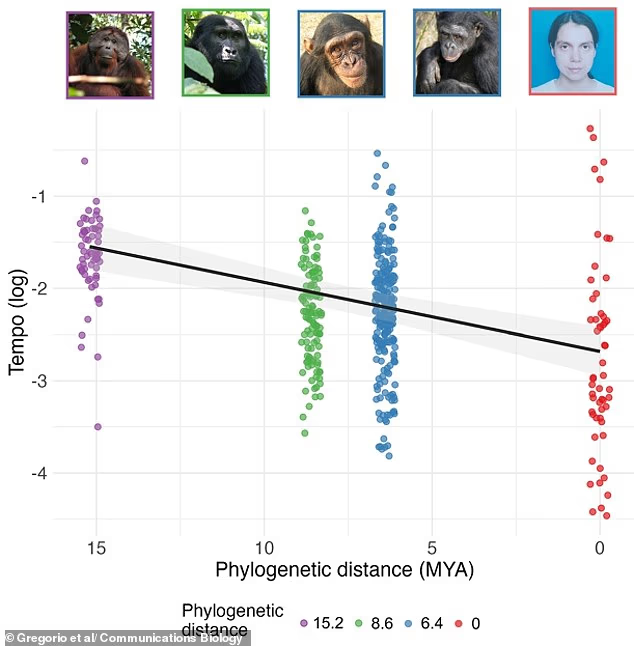
Across 140 laughter sequences, they found that all species produce laughter with evenly spaced rhythmic intervals between successive sounds
In the study, the researchers analysed laughter recordings from four orangutans, two gorillas, three bonobos, four chimpanzees, and four humans.
Across 140 laughter sequences, they found that all species produce laughter with evenly spaced rhythmic intervals between successive sounds.
Analysis reveals that while the basic rhythm stayed constant, human laughter has become faster, more variable, and gained sophisticated context-dependent control.
Of the great apes, humans alone have the ability to control when and how they laugh depending on context.
For example, an uncontrollable laugh when tickled differs sharply from a polite laugh in a meeting, a nervous laugh after a mistake, or the infectious laughter that spreads through a group of friends.
These all have the same underlying rhythm, but it is shaped by conscious control to communicate different emotions and intentions.
The findings of this study suggest that throughout great ape evolution, our ancestors gradually developed greater control over the timing of their vocalisations, including laughter, the researchers said.
They propose this basic rhythmic structure was already present in a shared common ancestor 15 million years ago and has remained remarkably conserved with all living great apes still showing the same underlying pattern.

It means the chuckles, giggles and belly laughs we experience today may have their roots in an ancient ancestor shared with chimpanzees, gorillas, bonobos and orangutans. Pictured: A Bonobo smiling
They published their findings in the journal Communications Biology.
‘It is impossible to assess the precursor forms of language directly from our extinct ancestors,’ Dr Adriano Lameria, who also worked on the study, said.
‘Laughter, being evolutionarily older and having remained shared between all living great apes, provides a rare evolutionary window into the vocal transformations that unfolded across hominid evolution until the first humans appeared on scene.
‘Contrary to the classic notion that the first humans suddenly acquired vocal control capacities remarkably different from their predecessors, laughter evolution tells us that humans lay on a continuum, a prolongation of vocal control capacities that were already being cumulatively honed in for 15 million years.’