

If you are one of Ya Lili’s 183,000 followers on her “@findgadgetswithme” Instagram account, you may have seen this video she posted recently: A man stands on a sunny beach, dressed only in swim shorts, his back covered in dirt. “This won’t come off!” he shouts as he rubs futilely at the brown filth covering his arm. Suddenly, out of nowhere, a fully dressed woman walks into the frame and says, “Because you’re doing it wrong!” She then takes a bath mitt and wipes away a large swathe of the soil.
“If you’re still using your bare hands, you are missing out,” the voiceover says, as the action switches to a close-up of a woman using the sponge glove to clean a series of inexplicable squiggly lines from her bare thighs.
But if you want to buy this shower scrubber, there’s a link under the video where you can find them for sale on Temu.
Ya Lily is the top creator for Temu’s partnership ads on Meta platforms in the U.K. and Europe, according to research seen by Fortune. The problem is, Ya Lily almost certainly does not exist. She’s a fake account.
In fact, of the top 100 creators boosted by Temu’s partnership ads, 73 are likely fakes, the research suggests.
It is not clear whether Temu is doing this deliberately or is being fooled by scammers into spending money on influencers who don’t exist. But the likely fake accounts potentially set up a legal quagmire for Temu, as European law bars the use of misleading formats for advertising.
Neither Temu nor Ya Lilly responded to multiple requests for comment from Fortune. Meta declined comment when reached.
Above: One of YaLily’s Temu partnership ads on Instagram.
Real money going to fake accounts
Ya Lily has a further 129,000 followers on Facebook, where she goes by a completely different name, “Must good.” That page gives her location as “England, Birmingham, MO, United States.” Her bio says “You are my dream of dead.” And her email address appears to be Chinese.
And yet her posts—which all contain links to a random assortment of Temu products—were boosted by Temu and seen more than 1 billion times across both platforms in 16 months ending in April 2026, according to Online Risk Labs. ORL is an independent non-profit based in the Czech Republic, which researches cybersecurity and systemic risk online.
Ya Lily’s content ran in nearly 109,541 Temu ad campaigns in that period, the data show. That’s about 225 campaigns per day.
Using creators on Facebook and Instagram to churn out an endless stream of low-effort AI promotions is one of Temu’s main ways to reach people on social media, ORL’s data suggest. Temu spent as much as $962 million on ads like these in the period, in the U.K. and 27 E.U. countries, according to ORL.
Its estimate is based on total impressions and average cost per reach. The group estimates that in any given quarter Temu alone forms nearly 2% of all the revenue Meta earns from the continent.
Fortune asked two experts in social media advertising to check ORL’s data and estimates. Both found them plausible.
The ORL data focuses only on the U.K. and Europe because the Digital Services Act, which covers those countries, requires large platform providers to publish a public library of all the ads they run, allowing researchers to identify trends or problematic commercial behavior. No such database exists for the U.S.
“Among the top 100 influencers collaborating with Temu, there are certainly some real people among them. In my estimate, however, they account for no more than 15–20%. By contrast, I have serious doubts about the authenticity of accounts that, according to the platform, are based in Russia, China, or Iran,” ORL’s manager, Vendula Prokůpková, told Fortune.
Legally questionable
That could raise legal issues, according to Stuart Lester, the partner who leads law firm Mishcon de Reya’s advertising and marketing group, in London.
“By all means utilize Facebook and Instagram and influencers, but know that there are rules that you have to abide by, and you certainly can’t be creating fake accounts and portraying these as real individuals. That’s misleading on many levels.”
There are several laws and regulatory agencies that might see the use of fake accounts—by scammers, advertisers, or even their mere existence on Meta’s platforms—as potentially infringing the law. In the U.K., the Digital Markets, Competition & Consumers Act of 2024 bans advertising that is misleading. The European Parliament recently passed the new E.U. AI Act, which requires publishers of AI-generated content to label it transparently.
Creating a fake account to carry advertising is likely to be a breach of regulations in multiple European jurisdictions, Lester told Fortune. “That will be misleading. I would say, certainly, in the U.K. and I strongly suspect in the E.U. as well.”
A $10 billion business for Meta
Partnership ads like Ya Lily’s work by allowing creators to enable their posts to be used as ads if they recommend a brand and include a link where viewers can buy the product. If a marketer like Temu approves of the post, it can spend money on it as if it were an ad, and boost it in Meta’s algorithms. The creator gets paid either via a contractual agreement or a cut of sales generated.
Meta booked $10 billion in revenues from partnership ads in Q1 2026. Its total revenue was $56.3 billion—meaning that partnership ads were about 17% of its entire revenue. The company did not give an update on the partnership numbers for Q2, in which Meta disclosed $60.8 billion in revenue overall.
Within that $10 billion-plus partnership ad segment, Temu’s presence is huge.
Between January 2025 and April 2026, there were 31 official Temu pages on Meta and they ran over 9 million ads across the E.U. and the U.K., ORL’s data says. The cumulative reach of those ads was 134 billion views.
Of those ads, partnership ads (the ones using creator content) were 65.8% of all Temu’s ads and 49.6% of their reach. That is unusual, ORL believes, because among other advertisers, typically only 2% of their ads are partnership ads.
Burner accounts from China and Russia
And those partnership ads are channeled through a narrow group of creators, ORL says. In the four months between January and April 2026, 100 creators accounted for 74% of all Temu’s partnership ads in the region. Those creators ran more than 1.4 million individual ads that got a cumulative reach of 16.9 billion eyeballs.
Most of those accounts—which initially appear to be run by real people—are dedicated to pushing Temu products. But there is reason to believe they are “burner creators”—fake accounts that don’t represent real people that have been created specifically to take advantage of Temu’s ad budget. Seventy-three percent of the top 100 accounts had changed their handle at least once in the 16 months covered by ORL’s study. One of them changed its name 15 times—something real influencers never do.
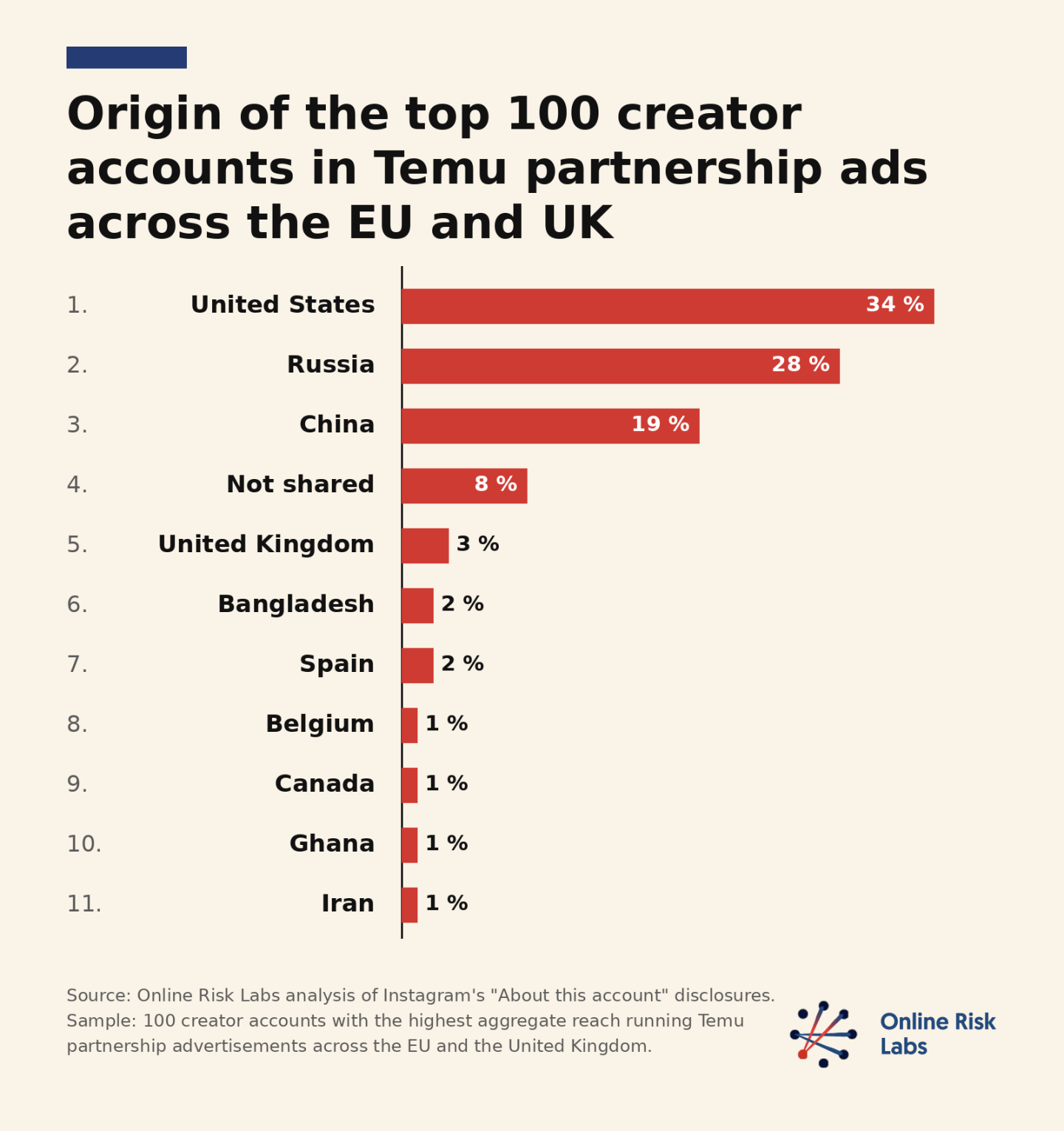
Only eight of them were verified with a real identity. And, “despite targeting E.U. audiences, 28 of the top 100 accounts were based in Russia and 19 in China, while only six were based in the E.U. or the U.K.,” ORL said in a data pack it prepared for Fortune. Of the remainder, 34 were U.S.-based, and the others were from Bangladesh, Canada, and Ghana.
Meta has struggled to prevent fraudulent advertising activity on its platforms in the past, especially as it relates to China. Last year, Reuters reported, 19% of Meta’s entire revenue from China—about $3 billion—came from ads for scams or other banned content. The company initially investigated the problem and cracked down on it but later inexplicably reversed course and abandoned its efforts against Chinese scams, Reuters reported.
ORL has filed a report with the EU’s DSA regulator asking it to make a risk assessment of Temu’s army of low-grade influencer accounts.
“Lazy, not sketchy”
“If they [Temu] think this is a way to get slightly cheaper/more performant ads, they might be doing this intentionally to game the delivery system,” said Rob Leathern, a former senior director of product management at Facebook until 2020. He is now the founder and CEO of InfoHawk, a company that protects users from scams and deception.
Luke Stillman, managing director of Madison & Wall, a technology and media consultancy, told Fortune that Chinese marketers often behave very differently online than European or U.S. ones. “It also wouldn’t be surprising for Temu to allocate a meaningful share of its Meta budget this way given how differently social commerce and the creator economy have developed in China versus Europe. In Europe and North America, this type of model is still relatively unusual. In China, social commerce accounts for a much larger share of activity, and creator partnerships and live social streams are much more integrated into how products are marketed and sold,” he said.
He thinks Temu might be being “lazy, not sketchy.”
“On one hand, I suspect there is a better form of an ad campaign that would result in higher [return on ad spend] compared to creating a huge volume of AI-generated creator content to feed through the partnership system,” he said. “On the other hand, dynamic content creation, creators augmented with AI production processes, and performance-optimization algorithms are only going to become more prevalent across the industry, and this seems to fit squarely into that bucket.”


